Entrepreneurship Today
Learning Objectives
By the end of this section, you will be able to:
- Define entrepreneur and entrepreneurship
- Describe types of entrepreneurial careers and lifestyles
- Understand entrepreneurs as problem solvers
- Explain current factors driving the growth of entrepreneurship
- Compare differences in entrepreneurial opportunities around the globe
View this section's JSON
{
"id": "m71114",
"doc_class": "",
"title": "Entrepreneurship Today",
"objectives": [
"Define entrepreneur and entrepreneurship",
"Describe types of entrepreneurial careers and lifestyles",
"Understand entrepreneurs as problem solvers",
"Explain current factors driving the growth of entrepreneurship",
"Compare differences in entrepreneurial opportunities around the globe"
],
"figures": [
{
"src": "OSX_Eship_01_01_WParker.jpg",
"alt": "(a) Photo of Dave Gilboa. (b) Photo of a Warby Parker retail store.",
"caption": "(a) Co-founder and co-CEO Dave Gilboa helped push (b) Warby Parker to become a successful entrepreneurial venture. (credit (a): modification of “775208326EC00084_TechCrunch” by TechCrunch/Flickr, CC BY 2.0; credit (b): modification of “Warby Parker Aventura Mall” by Phillip Pessar/Flickr, CC BY 2.0)"
},
{
"src": "OSX_Eship_01_01_BurtsBees.jpg",
"alt": "Photo of Burt’s Bees products, including lip butter, exfoliating clay mask, and lip oil.",
"caption": "The Burt’s Bees product line grew from an idea for a lifestyle entrepreneurial venture into a major company. (credit: “Burt’s Bees” by Carol Bleistine/Flickr, CC BY 4.0)"
},
{
"src": "OSX_Eship_01_01_EntGlobe01.jpg",
"alt": "Graph of nations with the most attractive entrepreneurial ventures. The United States has 52,676 million ventures, measured as Gross Domestic Product, with a Global Entrepreneurship Index (GEI) of 83.6 and attractiveness of the entrepreneur ecosystem over 80. Switzerland has 54,933 million ventures, with a GEI of 80.4 and attractiveness of the entrepreneur ecosystem around 80. Canada has 42,104 million ventures, with a GEI of 79.2 and attractiveness of the entrepreneur ecosystem around 80. The United Kingdom has 37,451 million ventures, with a GEI of 77.8 and attractiveness of the entrepreneur ecosystem a bit less than 80. Australia has 42,149 million ventures, with a GEI of 75.5 and attractiveness of the entrepreneur ecosystem around 76. Denmark has 44,005 million ventures, with a GEI of 74.3 and attractiveness of the entrepreneur ecosystem around 75. Iceland has 34,541 million ventures, with a GEI of 74.2 and attractiveness of the entrepreneur ecosystem around 75. Ireland has 42,012 million ventures, with a GEI of 73.7 and attractiveness of the entrepreneur ecosystem around 74. Sweden has 45,533 million ventures, with a GEI of 73.1 and attractiveness of the entrepreneur ecosystem around 73. France has 37,948 million ventures, with a GEI of 68.5 and attractiveness of the entrepreneur ecosystem around 68. Source: Inforgraphic.ly Team. “Infographic: The Growth of Entrepreneurship Around the Globe.” Entrepreneurship Middle East. January 26, 2017.",
"caption": "The number of entrepreneurial businesses, in millions, is shown for several countries. (attribution: Copyright Rice University, OpenStax, under CC BY NC-SA 4.0 license)"
},
{
"src": "OSX_Eship_01_01_EntGlobe02.jpg",
"alt": "Graph of venture capital activity showing venture capital investment and number of deals in billions by country. The United States is shown at 72.3; China is at 49.2; India is at 8.0; Israel is at 2.6; Canada is at 1.5; and Japan is at 0.8. Source: Inforgraphic.ly Team. “Infographic: The Growth of Entrepreneurship Around the Globe.” Entrepreneurship Middle East. January 26, 2017.",
"caption": "The total venture capitalist investment and number of deals for several countries are shown. (attribution: Copyright Rice University, OpenStax, under CC BY NC-SA 4.0 license)"
},
{
"src": "OSX_Eship_01_01_Air.jpg",
"alt": "Photo of a city skyline clouded by smog.",
"caption": "The Mumbai skyline is clouded by hazy pollution. (credit: modification of “Smog over Mumbai” by Christian Haugen/Flickr, CC BY 2.0)"
}
],
"tokens": 9958,
"blocks": [
{
"anchor": "m71114-b1",
"trail": [
"Learning Objectives"
],
"heading": "Learning Objectives",
"html": "<section class=\"learning-objectives\"><h2>Learning Objectives</h2><p>By the end of this section, you will be able to:</p><ul><li>Define entrepreneur and entrepreneurship</li><li>Describe types of entrepreneurial careers and lifestyles</li><li>Understand entrepreneurs as problem solvers</li><li>Explain current factors driving the growth of entrepreneurship</li><li>Compare differences in entrepreneurial opportunities around the globe</li></ul></section>",
"text": "Learning Objectives\nBy the end of this section, you will be able to:\nDefine entrepreneur and entrepreneurship\nDescribe types of entrepreneurial careers and lifestyles\nUnderstand entrepreneurs as problem solvers\nExplain current factors driving the growth of entrepreneurship\nCompare differences in entrepreneurial opportunities around the globe",
"tokens": 85
},
{
"anchor": "m71114-b2",
"trail": [],
"heading": null,
"html": "<p>As we delve into the study of entrepreneurship, let’s define what we mean by the word <em>entrepreneur</em>. An <dfn>entrepreneur</dfn> is someone who identifies and acts on an idea or problem that no one else has identified or acted on. This combination of recognizing an opportunity to bring something new to the world and acting on that opportunity is what distinguishes an entrepreneur from a small business owner. A <dfn>small business owner</dfn> is someone who owns or starts a business that already has an existing model, such as a restaurant, whereas an entrepreneur is someone who creates something new. This new creation can be a new process or product, a business that identifies a new or unique target market, or a combination of ideas that creates a new approach or method, for example.</p><p>In a broader sense, what people consider an <em>entrepreneur</em> can vary. Some scholars strictly differentiate between entrepreneurs and small business owners.<sup class=\"footnote-ref\"><a id=\"fnref1\" href=\"#fn1\" aria-label=\"Footnote 1\">1</a></sup> Others acknowledge that a small business owner may also be an entrepreneur—they are not mutually exclusive. Someone may start a venture that is not a completely new idea, but that introduces a product or service to a new region or market. Where does a <dfn>franchise</dfn> fall in this discussion? Again, there is not complete agreement, with some claiming that a <dfn>franchisee</dfn> and entrepreneur cannot be the same, and others arguing that a franchise is, indeed, an entrepreneurial venture. According to an article in <em>Forbes</em>, “In the for-profit world, an entrepreneur is someone who creates and runs a new business where one did not exist before. And, no, the McDonald’s franchisee didn’t create McDonald’s. But he certainly created a McDonald’s where there never was one before. Franchisees are entrepreneurs.”<sup class=\"footnote-ref\"><a id=\"fnref2\" href=\"#fn2\" aria-label=\"Footnote 2\">2</a></sup> The point is that small business owners and franchisees can be considered entrepreneurs. For the purposes of this course, you will learn the key principles of entrepreneurship alongside the concepts, strategies, and tools needed to succeed as a small business owner or franchisee.</p><p>Entrepreneurs have many different talents and focus on a variety of different areas, taking advantage of many opportunities for entrepreneurial ventures. An <dfn>entrepreneurial venture</dfn> is the creation of any business, organization, project, or operation of interest that includes a level of risk in acting on an opportunity that has not previously been established. For some entrepreneurs, this could be a for-profit venture; for other entrepreneurs, this could be a venture focused on social needs and take the form of a nonprofit endeavor. Entrepreneurs might take a variety of approaches to their entrepreneurial venture, such as those shown in .</p><table><thead><tr><th>Types of Entrepreneurs</th></tr><tr><th>Type of Entrepreneur</th><th>Approach to Venture</th></tr></thead><tbody><tr><td>Innovators</td><td>Find new approaches, methods, or products that add value through solving a problem in a unique manner</td></tr><tr><td>Creators</td><td>Make something new or see a problem that other people have not noticed</td></tr><tr><td>Market makers</td><td>Innovate or reinvent their market from a future perspective by asking what the market could evolve into</td></tr><tr><td>Expanders and scalers</td><td>Seek out opportunities to expand upon previously created methods, processes, or products</td></tr></tbody></table><p>In this course, you will explore these myriad avenues toward entrepreneurship.</p><aside class=\"note note-are-you-ready\"><p class=\"note-label\">How Do You Define Success?</p><p>What is your personal definition of success? How would you define success for your venture idea? Take time to consider these questions carefully.</p><ul><li>Write your answers to both questions as formal descriptions of your definition of success.</li><li>After completing your definitions, meet with your family members or your personal support group (the important people whose support you need to achieve the defined success statement) to discuss your personal definition of success.</li><li>After hearing their input, you might want to revise your personal success statements.</li></ul><p>Follow through with this activity by talking to your startup team or other supporting people about your venture’s success definition. This activity may help guide you in decision-making throughout your life journey and the journey of starting your venture. It will also be helpful when you and your startup team create a vision statement for your venture.</p></aside>",
"text": "As we delve into the study of entrepreneurship, let’s define what we mean by the word entrepreneur. An entrepreneur is someone who identifies and acts on an idea or problem that no one else has identified or acted on. This combination of recognizing an opportunity to bring something new to the world and acting on that opportunity is what distinguishes an entrepreneur from a small business owner. A small business owner is someone who owns or starts a business that already has an existing model, such as a restaurant, whereas an entrepreneur is someone who creates something new. This new creation can be a new process or product, a business that identifies a new or unique target market, or a combination of ideas that creates a new approach or method, for example.\nIn a broader sense, what people consider an entrepreneur can vary. Some scholars strictly differentiate between entrepreneurs and small business owners.1 Others acknowledge that a small business owner may also be an entrepreneur—they are not mutually exclusive. Someone may start a venture that is not a completely new idea, but that introduces a product or service to a new region or market. Where does a franchise fall in this discussion? Again, there is not complete agreement, with some claiming that a franchisee and entrepreneur cannot be the same, and others arguing that a franchise is, indeed, an entrepreneurial venture. According to an article in Forbes, “In the for-profit world, an entrepreneur is someone who creates and runs a new business where one did not exist before. And, no, the McDonald’s franchisee didn’t create McDonald’s. But he certainly created a McDonald’s where there never was one before. Franchisees are entrepreneurs.”2 The point is that small business owners and franchisees can be considered entrepreneurs. For the purposes of this course, you will learn the key principles of entrepreneurship alongside the concepts, strategies, and tools needed to succeed as a small business owner or franchisee.\nEntrepreneurs have many different talents and focus on a variety of different areas, taking advantage of many opportunities for entrepreneurial ventures. An entrepreneurial venture is the creation of any business, organization, project, or operation of interest that includes a level of risk in acting on an opportunity that has not previously been established. For some entrepreneurs, this could be a for-profit venture; for other entrepreneurs, this could be a venture focused on social needs and take the form of a nonprofit endeavor. Entrepreneurs might take a variety of approaches to their entrepreneurial venture, such as those shown in .\nTypes of Entrepreneurs\nType of EntrepreneurApproach to Venture\nInnovatorsFind new approaches, methods, or products that add value through solving a problem in a unique manner\nCreatorsMake something new or see a problem that other people have not noticed\nMarket makersInnovate or reinvent their market from a future perspective by asking what the market could evolve into\nExpanders and scalersSeek out opportunities to expand upon previously created methods, processes, or products\nIn this course, you will explore these myriad avenues toward entrepreneurship.\nHow Do You Define Success?\nWhat is your personal definition of success? How would you define success for your venture idea? Take time to consider these questions carefully.\nWrite your answers to both questions as formal descriptions of your definition of success.\nAfter completing your definitions, meet with your family members or your personal support group (the important people whose support you need to achieve the defined success statement) to discuss your personal definition of success.\nAfter hearing their input, you might want to revise your personal success statements.\nFollow through with this activity by talking to your startup team or other supporting people about your venture’s success definition. This activity may help guide you in decision-making throughout your life journey and the journey of starting your venture. It will also be helpful when you and your startup team create a vision statement for your venture.",
"tokens": 1036
},
{
"anchor": "m71114-b3",
"trail": [
"The Entrepreneurial Lifestyle and Career"
],
"heading": "The Entrepreneurial Lifestyle and Career",
"html": "<section class=\"\"><h2>The Entrepreneurial Lifestyle and Career</h2><p>People often have thought of entrepreneurs as corporate rebels, nonconformists, or activists. Being an entrepreneur has become synonymous with being an innovator, a change agent, or a risk taker. Regardless of job titles or descriptive characteristics, entrepreneurship has a universal appeal for how people think and engage with the world.</p><p>Choosing the path of entrepreneurship requires a willingness to take on calculated risks. The difference between risk and <dfn><em>calculated</em> risk</dfn> is <dfn>due diligence</dfn>, or conducting the necessary research and investigation to make informed decisions that minimize risk. Not everyone is comfortable letting go of a steady paycheck, especially when we know that there is no long-term guarantee that the paycheck will continue into the future. In one approach to minimizing personal financial risk, some startup entrepreneurs continue with their current employment while working on the side to develop their idea into a venture that eventually will generate an income. Until the venture requires near full-time work and generates income, maintaining an outside income works well for many entrepreneurial teams.</p><p>Consider the eyeglass startup <dfn>Warby Parker</dfn> (). Dave <dfn>Gilboa</dfn> and Neil <dfn>Blumenthal</dfn>, lead entrepreneurs for Warby Parker, were still working their normal jobs when they approached an angel investor with their idea. The angel investor asked a few questions and wasn’t impressed. This investor believed that Gilboa and Blumenthal should demonstrate their solid commitment to the venture by quitting their day jobs to dedicate more time and energy to Warby Parker. Instead of following that advice, Gilboa and Blumenthal kept their day jobs while they continued to work toward building their venture, and Warby Parker eventually became highly successful. There are many paths to becoming an entrepreneur, and many paths to creating a successful venture (see Entrepreneurial Journey and Pathways). It is important to identify the path that works best in your life—and for the venture—and that supports your goals and your unique situation and visions.</p><figure><img src=\"media/OSX_Eship_01_01_WParker.jpg\" alt=\"(a) Photo of Dave Gilboa. (b) Photo of a Warby Parker retail store.\"><figcaption>(a) Co-founder and co-CEO Dave Gilboa helped push (b) Warby Parker to become a successful entrepreneurial venture. (credit (a): modification of “775208326EC00084_TechCrunch” by TechCrunch/Flickr, CC BY 2.0; credit (b): modification of “Warby Parker Aventura Mall” by Phillip Pessar/Flickr, CC BY 2.0)</figcaption><span class=\"figure-alt\">(a) Photo of Dave Gilboa. (b) Photo of a Warby Parker retail store.</span></figure><p>Within the entrepreneurial world, the idea of a <dfn>lifestyle venture</dfn> has evolved to mean a business in which the founders’ primary focus is the lifestyle they will attain through becoming entrepreneurs, rather than a primary interest in financial rewards through the selling of the business. Within the entrepreneurial world, harvesting is the typical exit strategy. The <dfn>harvest</dfn> is the point at which the investors and entrepreneurial team receive their return on creating and building the venture.</p><p>For a lifestyle venture, the entrepreneur is more likely to be a solo entrepreneur, someone who moves forward in starting a new venture without the support of a team or group of likeminded individuals who recognize the value or potential of an entrepreneurial idea that could potentially result in significant returns. A lifestyle venture is also more likely to be funded through family and friends, and more traditional methods such as a bank loan or a small business loan. This lifestyle includes greater freedom to decide areas of responsibilities, hours of contribution to the venture, and other decisions that support the desired lifestyle. An example of a startup lifestyle venture is <dfn>The Wander Girls</dfn>, a company that identified the unique concerns of women traveling alone.<sup class=\"footnote-ref\"><a id=\"fnref3\" href=\"#fn3\" aria-label=\"Footnote 3\">3</a></sup> The Wander Girls organizes trips and events for groups of women traveling in India. A team member organizes the trip, travels with the female tourists, and handles daily interactions and transactions.</p><p>Another example of a lifestyle venture is based on how an entrepreneur aligns values, interests, and passions to create a balance between enjoying life and earning enough money to support those passions. Roxanne <dfn>Quimby</dfn> had a passion for living off the grid, creating her own life in the woods of Maine, and not being restricted by the rules and regulations required when working as an employee. After becoming a parent, Quimby faced the challenges presented by her lifestyle choices and started making candles to earn enough money to support her family. Eventually, Quimby’s lifestyle candle-making business expanded into the highly successful <dfn>Burt’s Bees Corporation</dfn>, moving her lifestyle business into a career as the CEO of Burt’s Bees (). After selling Burt’s Bees to <dfn>Clorox Co.</dfn>, Quimby continued her passion for the north woods of Maine by donating land and money to create a wildlife sanctuary and preserve that land from development.</p><figure><img src=\"media/OSX_Eship_01_01_BurtsBees.jpg\" alt=\"Photo of Burt’s Bees products, including lip butter, exfoliating clay mask, and lip oil.\"><figcaption>The Burt’s Bees product line grew from an idea for a lifestyle entrepreneurial venture into a major company. (credit: “Burt’s Bees” by Carol Bleistine/Flickr, CC BY 4.0)</figcaption><span class=\"figure-alt\">Photo of Burt’s Bees products, including lip butter, exfoliating clay mask, and lip oil.</span></figure><p>Quimby’s latest endeavors include creating a pasta company, <dfn>My Pasta Art</dfn>, focused on increasing employment opportunities for people in northern Maine,<sup class=\"footnote-ref\"><a id=\"fnref4\" href=\"#fn4\" aria-label=\"Footnote 4\">4</a></sup> and building the tourist industry to encourage people to enjoy the region’s beautiful habitat and scenery. Although she is highly successful from a financial perspective, money was never the motivation for her ventures. As you can see, there are many paths to finding your career in entrepreneurship, and multiple trigger points at which you might make the decision to become an entrepreneur.</p><aside class=\"note note-what-can-do\"><p class=\"note-label\">How Can You Put Your Strengths to Work?</p><p>Create a list of ten strengths that you currently possess. If you need help creating your list, ask your friends or family what they believe you are good at doing. Think about what achievements you have accomplished, what compliments you have received, and what people say about you. The answers to these questions will help you identify your strengths.</p><ul><li>Create a list of ideas that build off your strengths or are related to your strengths.</li><li>Then analyze this list to create another list of possible businesses that you could start that relate to your strengths.</li></ul></aside></section>",
"text": "The Entrepreneurial Lifestyle and Career\nPeople often have thought of entrepreneurs as corporate rebels, nonconformists, or activists. Being an entrepreneur has become synonymous with being an innovator, a change agent, or a risk taker. Regardless of job titles or descriptive characteristics, entrepreneurship has a universal appeal for how people think and engage with the world.\nChoosing the path of entrepreneurship requires a willingness to take on calculated risks. The difference between risk and calculated risk is due diligence, or conducting the necessary research and investigation to make informed decisions that minimize risk. Not everyone is comfortable letting go of a steady paycheck, especially when we know that there is no long-term guarantee that the paycheck will continue into the future. In one approach to minimizing personal financial risk, some startup entrepreneurs continue with their current employment while working on the side to develop their idea into a venture that eventually will generate an income. Until the venture requires near full-time work and generates income, maintaining an outside income works well for many entrepreneurial teams.\nConsider the eyeglass startup Warby Parker (). Dave Gilboa and Neil Blumenthal, lead entrepreneurs for Warby Parker, were still working their normal jobs when they approached an angel investor with their idea. The angel investor asked a few questions and wasn’t impressed. This investor believed that Gilboa and Blumenthal should demonstrate their solid commitment to the venture by quitting their day jobs to dedicate more time and energy to Warby Parker. Instead of following that advice, Gilboa and Blumenthal kept their day jobs while they continued to work toward building their venture, and Warby Parker eventually became highly successful. There are many paths to becoming an entrepreneur, and many paths to creating a successful venture (see Entrepreneurial Journey and Pathways). It is important to identify the path that works best in your life—and for the venture—and that supports your goals and your unique situation and visions.\n [figure: (a) Photo of Dave Gilboa. (b) Photo of a Warby Parker retail store.] (a) Co-founder and co-CEO Dave Gilboa helped push (b) Warby Parker to become a successful entrepreneurial venture. (credit (a): modification of “775208326EC00084_TechCrunch” by TechCrunch/Flickr, CC BY 2.0; credit (b): modification of “Warby Parker Aventura Mall” by Phillip Pessar/Flickr, CC BY 2.0)\n(a) Photo of Dave Gilboa. (b) Photo of a Warby Parker retail store.Within the entrepreneurial world, the idea of a lifestyle venture has evolved to mean a business in which the founders’ primary focus is the lifestyle they will attain through becoming entrepreneurs, rather than a primary interest in financial rewards through the selling of the business. Within the entrepreneurial world, harvesting is the typical exit strategy. The harvest is the point at which the investors and entrepreneurial team receive their return on creating and building the venture.\nFor a lifestyle venture, the entrepreneur is more likely to be a solo entrepreneur, someone who moves forward in starting a new venture without the support of a team or group of likeminded individuals who recognize the value or potential of an entrepreneurial idea that could potentially result in significant returns. A lifestyle venture is also more likely to be funded through family and friends, and more traditional methods such as a bank loan or a small business loan. This lifestyle includes greater freedom to decide areas of responsibilities, hours of contribution to the venture, and other decisions that support the desired lifestyle. An example of a startup lifestyle venture is The Wander Girls, a company that identified the unique concerns of women traveling alone.3 The Wander Girls organizes trips and events for groups of women traveling in India. A team member organizes the trip, travels with the female tourists, and handles daily interactions and transactions.\nAnother example of a lifestyle venture is based on how an entrepreneur aligns values, interests, and passions to create a balance between enjoying life and earning enough money to support those passions. Roxanne Quimby had a passion for living off the grid, creating her own life in the woods of Maine, and not being restricted by the rules and regulations required when working as an employee. After becoming a parent, Quimby faced the challenges presented by her lifestyle choices and started making candles to earn enough money to support her family. Eventually, Quimby’s lifestyle candle-making business expanded into the highly successful Burt’s Bees Corporation, moving her lifestyle business into a career as the CEO of Burt’s Bees (). After selling Burt’s Bees to Clorox Co., Quimby continued her passion for the north woods of Maine by donating land and money to create a wildlife sanctuary and preserve that land from development.\n [figure: Photo of Burt’s Bees products, including lip butter, exfoliating clay mask, and lip oil.] The Burt’s Bees product line grew from an idea for a lifestyle entrepreneurial venture into a major company. (credit: “Burt’s Bees” by Carol Bleistine/Flickr, CC BY 4.0)\nPhoto of Burt’s Bees products, including lip butter, exfoliating clay mask, and lip oil.Quimby’s latest endeavors include creating a pasta company, My Pasta Art, focused on increasing employment opportunities for people in northern Maine,4 and building the tourist industry to encourage people to enjoy the region’s beautiful habitat and scenery. Although she is highly successful from a financial perspective, money was never the motivation for her ventures. As you can see, there are many paths to finding your career in entrepreneurship, and multiple trigger points at which you might make the decision to become an entrepreneur.\nHow Can You Put Your Strengths to Work?\nCreate a list of ten strengths that you currently possess. If you need help creating your list, ask your friends or family what they believe you are good at doing. Think about what achievements you have accomplished, what compliments you have received, and what people say about you. The answers to these questions will help you identify your strengths.\nCreate a list of ideas that build off your strengths or are related to your strengths.\nThen analyze this list to create another list of possible businesses that you could start that relate to your strengths.",
"tokens": 1623
},
{
"anchor": "m71114-b4",
"trail": [
"The Entrepreneur as a Problem Solver"
],
"heading": "The Entrepreneur as a Problem Solver",
"html": "<section class=\"\"><h2>The Entrepreneur as a Problem Solver</h2><p>What are some challenges you face in your life? Have you ever actively thought about how you could solve those problems? Or have you actively identified exactly what the problem is from an analytical perspective? We often have a tendency to jump quickly from noticing a problem to selecting a solution, with little understanding of whether we have even correctly identified the problem. Identifying the problem—and testing the potential, novelty, and feasibility of your solution—is an important part of resolving the problem. Often, when we start to explore the problem, we find that it has multiple causes. Among them are:</p><ul><li>The need for something to be better, faster, or easier</li><li>The effects of changes in world on your industry, product, or service</li><li>Market trends based on geography, demographics, or the psychology of the customers</li></ul><p>You will learn more about identifying opportunities in Identifying Entrepreneurial Opportunity and Problem Solving and Need Recognition Techniques.</p><p>One characteristic of a savvy entrepreneur is recognizing the ability to identify a problem from an opportunity-identification perspective. We might identify feeling hungry as a problem, but an entrepreneur would identify the problem using an <dfn>opportunity-identifying perspective</dfn> by determining how the problem could be translated into an opportunity to create a new venture—perhaps combining the problem of feeling hungry between meals into a street kiosk or a vending machine with food choices or creating a new snack that is nutritious, satisfying, and portable. People need to eat, and they get hungry, but during a busy day with no open time or convenient food, people end up hungry. Rephrasing the problem, or need, from an opportunity viewpoint opens the search for a sustainable solution beyond the simple awareness of feeling hungry. We might solve this problem by opening a snack bar with offerings that contain essential vitamins and proteins, and is easy to transport with a long shelf life. Understanding the problem from the perspective of how to solve it for one person into how to solve it for multiple people rephrases the problem into an opportunity-identification perspective.</p><p>You might also have an interest in solving food-related problems on a larger scale. People trapped in a war-torn region may not be able to leave the safety of their shelters to find food, grow food, or barter for food, or they may not have the money to buy food. How could you reach your target market within a war-torn area? Red Cross emergency response vehicles traveled 2.5 million miles to deliver food, relief supplies, and support to communities affected by disasters during 2017.<sup class=\"footnote-ref\"><a id=\"fnref5\" href=\"#fn5\" aria-label=\"Footnote 5\">5</a></sup> That’s the equivalent of driving around the globe 103 times. Could your idea of creating a snack bar fit into a partnership with the Red Cross?</p><p>Although this might seem like a simple problem with a simple solution, persevering from the recognition of a problem to finding a realistic solution, then moving that solution forward into a successful venture, requires an entrepreneurial mindset. Every day, people become entrepreneurs as they identify and solve problems, or face new challenges or frustrations, and resolve them in creating products or services to address these issues.</p><aside class=\"note note-what-can-do\"><p class=\"note-label\">Recognizing Problems</p><p>In your daily life, what problems do you encounter? What would make your life easier? How would you finish this sentence: “If only ________ existed, my life would be better or easier”? To spur your creativity, you might research global problems to find an area that interests you, that sparks your passion for living a fulfilling life. When identifying a problem, consider process-related problems as well as service-related problems.</p><p>For more ideas like Chloe <dfn>Huang</dfn>’s, visit the <dfn>UNESCO Global Action Programme on Education for Sustainable Development</dfn> (https://en.unesco.org/gap) and review other submissions that may activate your own creativity in thinking about how you want to contribute your skills and knowledge to improve our world.</p><ul><li>What problem have you identified?</li><li>What can you do to resolve that problem?</li></ul></aside></section>",
"text": "The Entrepreneur as a Problem Solver\nWhat are some challenges you face in your life? Have you ever actively thought about how you could solve those problems? Or have you actively identified exactly what the problem is from an analytical perspective? We often have a tendency to jump quickly from noticing a problem to selecting a solution, with little understanding of whether we have even correctly identified the problem. Identifying the problem—and testing the potential, novelty, and feasibility of your solution—is an important part of resolving the problem. Often, when we start to explore the problem, we find that it has multiple causes. Among them are:\nThe need for something to be better, faster, or easier\nThe effects of changes in world on your industry, product, or service\nMarket trends based on geography, demographics, or the psychology of the customers\nYou will learn more about identifying opportunities in Identifying Entrepreneurial Opportunity and Problem Solving and Need Recognition Techniques.\nOne characteristic of a savvy entrepreneur is recognizing the ability to identify a problem from an opportunity-identification perspective. We might identify feeling hungry as a problem, but an entrepreneur would identify the problem using an opportunity-identifying perspective by determining how the problem could be translated into an opportunity to create a new venture—perhaps combining the problem of feeling hungry between meals into a street kiosk or a vending machine with food choices or creating a new snack that is nutritious, satisfying, and portable. People need to eat, and they get hungry, but during a busy day with no open time or convenient food, people end up hungry. Rephrasing the problem, or need, from an opportunity viewpoint opens the search for a sustainable solution beyond the simple awareness of feeling hungry. We might solve this problem by opening a snack bar with offerings that contain essential vitamins and proteins, and is easy to transport with a long shelf life. Understanding the problem from the perspective of how to solve it for one person into how to solve it for multiple people rephrases the problem into an opportunity-identification perspective.\nYou might also have an interest in solving food-related problems on a larger scale. People trapped in a war-torn region may not be able to leave the safety of their shelters to find food, grow food, or barter for food, or they may not have the money to buy food. How could you reach your target market within a war-torn area? Red Cross emergency response vehicles traveled 2.5 million miles to deliver food, relief supplies, and support to communities affected by disasters during 2017.5 That’s the equivalent of driving around the globe 103 times. Could your idea of creating a snack bar fit into a partnership with the Red Cross?\nAlthough this might seem like a simple problem with a simple solution, persevering from the recognition of a problem to finding a realistic solution, then moving that solution forward into a successful venture, requires an entrepreneurial mindset. Every day, people become entrepreneurs as they identify and solve problems, or face new challenges or frustrations, and resolve them in creating products or services to address these issues.\nRecognizing Problems\nIn your daily life, what problems do you encounter? What would make your life easier? How would you finish this sentence: “If only ________ existed, my life would be better or easier”? To spur your creativity, you might research global problems to find an area that interests you, that sparks your passion for living a fulfilling life. When identifying a problem, consider process-related problems as well as service-related problems.\nFor more ideas like Chloe Huang’s, visit the UNESCO Global Action Programme on Education for Sustainable Development (https://en.unesco.org/gap) and review other submissions that may activate your own creativity in thinking about how you want to contribute your skills and knowledge to improve our world.\nWhat problem have you identified?\nWhat can you do to resolve that problem?",
"tokens": 1029
},
{
"anchor": "m71114-b5",
"trail": [
"Factors Driving the Growth of Entrepreneurship"
],
"heading": "Factors Driving the Growth of Entrepreneurship",
"html": "<section class=\"\"><h2>Factors Driving the Growth of Entrepreneurship</h2><p>Do you know anyone who has lost their job? Or who has been rejected or mistreated at work? Or had their income reduced, or benefits removed? Research shows that 47 percent of all US employment is at risk through artificial intelligence and other technologies, although there will also be new opportunities for jobs that currently don’t exist.<sup class=\"footnote-ref\"><a id=\"fnref6\" href=\"#fn6\" aria-label=\"Footnote 6\">6</a></sup> These types of experiences and outlooks have provided the impetus for many people to start their own businesses. When we work for someone else, we are at the mercy of their decisions and actions, but we get paid and don’t carry the full risk of their decisions. When we work for ourselves, we get to make the decisions (not that making decisions is easy). But when we have our own business, we have greater control—in exchange, we also carry the risk for all decisions we make. This control over decision-making is one reason that some people find the world of entrepreneurship attractive.</p><p>Another contributing factor to the desire to become an entrepreneur is the excitement and fun of creating something new. Many entrepreneurs are excited at the idea of moving the concept through to the materialization of the idea.</p><p>A third factor that supports the growth in entrepreneurship is the combination of retirement and longer life expectancies. Many people enjoy working. For them, retirement consists of too much open time and not enough activities or the type of engagement with the outside world that fulfilled their needs during their working lives. Retirement also presents unique financial considerations, depending on an individual’s lifetime savings and planning. The combination of having available time and a desire for continued earnings encourages some older adults to explore their own entrepreneurial opportunities.</p><p>A fourth factor driving the growth of entrepreneurship is the expanding awareness and support of entrepreneurship as a viable career choice. In much of the twentieth century, families encouraged their children to find a stable career with a large corporation. During this era, there was a certain expectation of reciprocal loyalty between the employer and the employee based on some traditional employee-employer roles in that century. The general, informal agreement was that if employees came to work every day and fulfilled their responsibilities, they would have long-term employment with that corporation. But as competition increased and new business practices evolved, this unspoken guarantee no longer held true. The model of certainty of employment gradually disappeared. As people acquired a new perspective on their careers and income, they increasingly realized that we are all responsible for our own paths. Most studies suggest that people change their careers between three and seven times.<sup class=\"footnote-ref\"><a id=\"fnref7\" href=\"#fn7\" aria-label=\"Footnote 7\">7</a></sup> Note that this is not how often people change jobs, but how often they change their careers, moving from one industry to another, or moving from one type of work to a different type of work. The older model of stability through working hard for someone else has vanished. This awareness and acceptance have encouraged recent generations to consider creating their own futures through entrepreneurial ventures.</p><p>Just as individuals have become aware of the benefits of entrepreneurship, communities and organizations have also become aware of how entrepreneurial ventures add economic development and enhancements worth supporting, bolstering opportunities for those who decide on this path.</p></section>",
"text": "Factors Driving the Growth of Entrepreneurship\nDo you know anyone who has lost their job? Or who has been rejected or mistreated at work? Or had their income reduced, or benefits removed? Research shows that 47 percent of all US employment is at risk through artificial intelligence and other technologies, although there will also be new opportunities for jobs that currently don’t exist.6 These types of experiences and outlooks have provided the impetus for many people to start their own businesses. When we work for someone else, we are at the mercy of their decisions and actions, but we get paid and don’t carry the full risk of their decisions. When we work for ourselves, we get to make the decisions (not that making decisions is easy). But when we have our own business, we have greater control—in exchange, we also carry the risk for all decisions we make. This control over decision-making is one reason that some people find the world of entrepreneurship attractive.\nAnother contributing factor to the desire to become an entrepreneur is the excitement and fun of creating something new. Many entrepreneurs are excited at the idea of moving the concept through to the materialization of the idea.\nA third factor that supports the growth in entrepreneurship is the combination of retirement and longer life expectancies. Many people enjoy working. For them, retirement consists of too much open time and not enough activities or the type of engagement with the outside world that fulfilled their needs during their working lives. Retirement also presents unique financial considerations, depending on an individual’s lifetime savings and planning. The combination of having available time and a desire for continued earnings encourages some older adults to explore their own entrepreneurial opportunities.\nA fourth factor driving the growth of entrepreneurship is the expanding awareness and support of entrepreneurship as a viable career choice. In much of the twentieth century, families encouraged their children to find a stable career with a large corporation. During this era, there was a certain expectation of reciprocal loyalty between the employer and the employee based on some traditional employee-employer roles in that century. The general, informal agreement was that if employees came to work every day and fulfilled their responsibilities, they would have long-term employment with that corporation. But as competition increased and new business practices evolved, this unspoken guarantee no longer held true. The model of certainty of employment gradually disappeared. As people acquired a new perspective on their careers and income, they increasingly realized that we are all responsible for our own paths. Most studies suggest that people change their careers between three and seven times.7 Note that this is not how often people change jobs, but how often they change their careers, moving from one industry to another, or moving from one type of work to a different type of work. The older model of stability through working hard for someone else has vanished. This awareness and acceptance have encouraged recent generations to consider creating their own futures through entrepreneurial ventures.\nJust as individuals have become aware of the benefits of entrepreneurship, communities and organizations have also become aware of how entrepreneurial ventures add economic development and enhancements worth supporting, bolstering opportunities for those who decide on this path.",
"tokens": 878
},
{
"anchor": "m71114-b6-p0",
"trail": [
"Entrepreneurship around the Globe"
],
"heading": "Entrepreneurship around the Globe",
"html": "<h2>Entrepreneurship around the Globe</h2><p>In the United States, entrepreneurial opportunities abound, relatively speaking. Between 1990 and 2014, the number of campus-based entrepreneurship education programs increased from 180 to over 2,000.<sup class=\"footnote-ref\"><a id=\"fnref8\" href=\"#fn8\" aria-label=\"Footnote 8\">8</a></sup> Comparing globally, the United States has the greatest number of entrepreneurial ventures, with Switzerland, Canada, Sweden, Denmark, and Australia following in order, according to <dfn>Global Entrepreneurship Index</dfn>, a global consulting firm ().</p><figure><img src=\"media/OSX_Eship_01_01_EntGlobe01.jpg\" alt=\"Graph of nations with the most attractive entrepreneurial ventures. The United States has 52,676 million ventures, measured as Gross Domestic Product, with a Global Entrepreneurship Index (GEI) of 83.6 and attractiveness of the entrepreneur ecosystem over 80. Switzerland has 54,933 million ventures, with a GEI of 80.4 and attractiveness of the entrepreneur ecosystem around 80. Canada has 42,104 million ventures, with a GEI of 79.2 and attractiveness of the entrepreneur ecosystem around 80. The United Kingdom has 37,451 million ventures, with a GEI of 77.8 and attractiveness of the entrepreneur ecosystem a bit less than 80. Australia has 42,149 million ventures, with a GEI of 75.5 and attractiveness of the entrepreneur ecosystem around 76. Denmark has 44,005 million ventures, with a GEI of 74.3 and attractiveness of the entrepreneur ecosystem around 75. Iceland has 34,541 million ventures, with a GEI of 74.2 and attractiveness of the entrepreneur ecosystem around 75. Ireland has 42,012 million ventures, with a GEI of 73.7 and attractiveness of the entrepreneur ecosystem around 74. Sweden has 45,533 million ventures, with a GEI of 73.1 and attractiveness of the entrepreneur ecosystem around 73. France has 37,948 million ventures, with a GEI of 68.5 and attractiveness of the entrepreneur ecosystem around 68. Source: Inforgraphic.ly Team. “Infographic: The Growth of Entrepreneurship Around the Globe.” Entrepreneurship Middle East. January 26, 2017.\"><figcaption>The number of entrepreneurial businesses, in millions, is shown for several countries. (attribution: Copyright Rice University, OpenStax, under CC BY NC-SA 4.0 license)</figcaption><span class=\"figure-alt\">Graph of nations with the most attractive entrepreneurial ventures. The United States has 52,676 million ventures, measured as Gross Domestic Product, with a Global Entrepreneurship Index (GEI) of 83.6 and attractiveness of the entrepreneur ecosystem over 80. Switzerland has 54,933 million ventures, with a GEI of 80.4 and attractiveness of the entrepreneur ecosystem around 80. Canada has 42,104 million ventures, with a GEI of 79.2 and attractiveness of the entrepreneur ecosystem around 80. The United Kingdom has 37,451 million ventures, with a GEI of 77.8 and attractiveness of the entrepreneur ecosystem a bit less than 80. Australia has 42,149 million ventures, with a GEI of 75.5 and attractiveness of the entrepreneur ecosystem around 76. Denmark has 44,005 million ventures, with a GEI of 74.3 and attractiveness of the entrepreneur ecosystem around 75. Iceland has 34,541 million ventures, with a GEI of 74.2 and attractiveness of the entrepreneur ecosystem around 75. Ireland has 42,012 million ventures, with a GEI of 73.7 and attractiveness of the entrepreneur ecosystem around 74. Sweden has 45,533 million ventures, with a GEI of 73.1 and attractiveness of the entrepreneur ecosystem around 73. France has 37,948 million ventures, with a GEI of 68.5 and attractiveness of the entrepreneur ecosystem around 68. Source: Inforgraphic.ly Team. “Infographic: The Growth of Entrepreneurship Around the Globe.” Entrepreneurship Middle East. January 26, 2017.</span></figure><p>Why is the United States leading with the greatest number of entrepreneurial ventures? What does it take to become an entrepreneur? In addition to having an entrepreneurial mindset (see The Entrepreneurial Mindset), entrepreneurs also need education and funding to support their new ventures.</p><p>You will learn more about funding in Entrepreneurial Finance and Accounting, but as an introduction, you should know there are three primary sources of outside funding: family and friends, angel investors, and venture capitalists. Some family members and friends are willing and able to invest money in helping the entrepreneurial team. An <dfn>angel investor</dfn> is someone who has available funds and an interest in supporting a new venture. They are often entrepreneurs who have successfully launched and harvested their own ventures, and who have an interest in helping other entrepreneurs in their startups, staying active in the entrepreneurial world, and a desire to receive a return on their investment in the venture. Angel investors often provide funding early in the life of a venture. As the venture grows, it typically requires more funding, at which time venture capitalists may invest in the venture. A <dfn>venture capitalist</dfn> (VC) is a group of people (or organizations) who pool resources to invest in entrepreneurial ventures, contributing larger sums of funds than are available through angel investors. In each funding round, investors receive an equity stake in the venture with expectations that at some point in the future, the venture will be sold, or harvested, at which time the investors will receive a return on their investment. Because they tend to be in larger groups, VCs typically have access to larger amounts of money and resources than individual angel investors. (You will also learn about other types of financing, such as bank loans and bootstrapping, in Entrepreneurial Finance and Accounting.)</p><p>In the United States, VCs contributed $72.3 billion in 2015 for 3,916 deals, or funding rounds. In China that same year, $49.2 billion were invested in 1,611 ventures.<sup class=\"footnote-ref\"><a id=\"fnref9\" href=\"#fn9\" aria-label=\"Footnote 9\">9</a></sup> European VC investment totaled $14.4 billion and 1,598 deals. Tracking these numbers over time shows steady increases in VC funding as entrepreneurial ventures have become more common ().</p><figure><img src=\"media/OSX_Eship_01_01_EntGlobe02.jpg\" alt=\"Graph of venture capital activity showing venture capital investment and number of deals in billions by country. The United States is shown at 72.3; China is at 49.2; India is at 8.0; Israel is at 2.6; Canada is at 1.5; and Japan is at 0.8. Source: Inforgraphic.ly Team. “Infographic: The Growth of Entrepreneurship Around the Globe.” Entrepreneurship Middle East. January 26, 2017.\"><figcaption>The total venture capitalist investment and number of deals for several countries are shown. (attribution: Copyright Rice University, OpenStax, under CC BY NC-SA 4.0 license)</figcaption><span class=\"figure-alt\">Graph of venture capital activity showing venture capital investment and number of deals in billions by country. The United States is shown at 72.3; China is at 49.2; India is at 8.0; Israel is at 2.6; Canada is at 1.5; and Japan is at 0.8. Source: Inforgraphic.ly Team. “Infographic: The Growth of Entrepreneurship Around the Globe.” Entrepreneurship Middle East. January 26, 2017.</span></figure><p>Other factors that can affect entrepreneurial opportunity include employment rates, government policies, and trade issues. For example, in the Middle Eastern kingdom of Saudi Arabia, a newer driver of entrepreneurship includes a high unemployment rate with a large percentage of the population in its prime earning years. In the past, employment was less of a concern because of dependency on state support from oil revenue. The population received monthly allotments to cover expenses from state-owned oil production. More recently, the population has become restless, with a desire to become productive and have greater control over their own resources. And the rulers recognize that oil production income is volatile and unsustainable. Today, with more future-oriented leaders, countries in the Middle East desire to encourage their citizens to consider starting their own businesses.<sup class=\"footnote-ref\"><a id=\"fnref10\" href=\"#fn10\" aria-label=\"Footnote 10\">10</a></sup> The example of entrepreneurship in the United States has spread around the globe, with other countries taking an interest in developing support systems to encourage their populations to become entrepreneurs.</p><p>As noted, the United States is a world leader in entrepreneurial innovation. Perhaps because the United States is, in large part, a nation of immigrants, with people arriving from all over the world, Americans have few prescribed traditions that encourage conformity. America’s longstanding traditions and reputation for individualism, ingenuity, and self-reliance have reinforced this mindset. However, the governments of other nations have discouraged their citizens from independent or innovative thinking. Some cultures emphasize political, cultural, and economic unity, and place a strong value on not being noticed, blending in, and following prescribed habits and traditions. Countries like Japan, France, Russia, China, and others continue to reflect these norms. Other countries have complex bureaucracies that prevent quick responses and place barriers to entrepreneurial activities. Parts of worldwide economic structures (banking, investments, and technology) are not accessible or even explicitly exclude some nations and the poor. Systems like this discourage people from coming forward with entrepreneurial ideas because the culture and bureaucracy prevent people from finding access to information necessary for the successful advancement of an idea. In contrast, other countries are noticing the benefits of encouraging their populations to become more open-minded and creative through new ventures.</p><aside class=\"note note-link-to-learning\"><p class=\"note-label\">Link to learning</p><p><dfn>Transparency International</dfn> is an organization that tracks corruption, which can be an inhibitor to entrepreneurship. The <a href=\"https://openstax.org/l/52TransparencyI\" rel=\"noopener\" target=\"_blank\">Transparency International website</a> provides information to rank 180 countries in identifying the abuse of entrusted power for private gain.<sup class=\"footnote-ref\"><a id=\"fnref11\" href=\"#fn11\" aria-label=\"Footnote 11\">11</a></sup></p></aside><p>Key characteristics that encourage entrepreneurship include support for freedom to create and innovate. What conditions encourage creativity and innovation? Acceptance of failure is a key characteristic for success as an entrepreneur. Many of the great inventions in the United States resulted after dozens of failures, as when Thomas <dfn>Edison</dfn> eventually developed a working light bulb. Edison identified a problem: Once the sun set, working hours were restricted, as were daily activities such as reading a book or washing dishes. Edison, along with many other inventors, recognized the need for an artificial light source. Consider how complex this idea was and how many failures must have occurred before creating a product that emitted light.</p><p>Another condition that encourages entrepreneurial behavior is the ability and opportunity to connect with other people to discuss ideas, problems, challenges, and solutions. This connection with other people, in an open environment that supports the exchange of ideas, is essential for encouraging creativity and innovation.</p><p>With the advent of the Internet, people around the planet are becoming increasingly aware of geopolitical and environmental situations across the globe. As more people observe these changes and situations, more people exchange ideas. These discussions can generate new opportunities for people to discover methods for solving problems. Any one of us could be living in one country but identifying a problem in another country. Given our interests and backgrounds, we could actively choose to develop a solution for that problem. What we need, as a general approach, is an efficient and transparent way to form companies and enable constructive competition, along with continued free and fair trade.</p><p>These are just some of the areas that many nations and organizations consider as they seek to encourage a transition away from group-prescribed thinking toward uniquely individual entrepreneurial ideas. Each of us encounters life from a different perspective. Although we all might recognize the restrictions presented by the sun setting every night, only a few people might question why we couldn’t change that situation by creating our own light. Similarly, someone in another country may observe our country (or vice versa) and ask why that country has a particular problem. Meanwhile, people living with that problem may have become so accustomed to it that they might not recognize the opportunity to seek solutions.</p><p>Increasing opportunities in entrepreneurial education are also driving growth. More colleges and universities are teaching entrepreneurial studies and opening entrepreneurial centers that encourage students from every discipline to become entrepreneurs.<sup class=\"footnote-ref\"><a id=\"fnref12\" href=\"#fn12\" aria-label=\"Footnote 12\">12</a></sup><sup>,</sup><sup class=\"footnote-ref\"><a id=\"fnref13\" href=\"#fn13\" aria-label=\"Footnote 13\">13</a></sup> As the employment and entrepreneurial landscape continue to evolve, some institutions have started offering courses to prepare students for work in the gig economy.<sup class=\"footnote-ref\"><a id=\"fnref14\" href=\"#fn14\" aria-label=\"Footnote 14\">14</a></sup> In fact, some of the best new entrepreneurial ideas come from groups of students in different majors who collaborate to create new, innovative business ideas that meet specific needs and challenges in today’s world. In some cases, students from different universities around the globe are connecting to come up with business ideas to solve global problems, such as the lack of clean drinking water and the need for medical vaccination programs. Technology and global travel have made such partnerships more common and very productive.</p>",
"text": "Entrepreneurship around the Globe\nIn the United States, entrepreneurial opportunities abound, relatively speaking. Between 1990 and 2014, the number of campus-based entrepreneurship education programs increased from 180 to over 2,000.8 Comparing globally, the United States has the greatest number of entrepreneurial ventures, with Switzerland, Canada, Sweden, Denmark, and Australia following in order, according to Global Entrepreneurship Index, a global consulting firm ().\n [figure: Graph of nations with the most attractive entrepreneurial ventures. The United States has 52,676 million ventures, measured as Gross Domestic Product, with a Global Entrepreneurship Index (GEI) of 83.6 and attractiveness of the entrepreneur ecosystem over 80. Switzerland has 54,933 million ventures, with a GEI of 80.4 and attractiveness of the entrepreneur ecosystem around 80. Canada has 42,104 million ventures, with a GEI of 79.2 and attractiveness of the entrepreneur ecosystem around 80. The United Kingdom has 37,451 million ventures, with a GEI of 77.8 and attractiveness of the entrepreneur ecosystem a bit less than 80. Australia has 42,149 million ventures, with a GEI of 75.5 and attractiveness of the entrepreneur ecosystem around 76. Denmark has 44,005 million ventures, with a GEI of 74.3 and attractiveness of the entrepreneur ecosystem around 75. Iceland has 34,541 million ventures, with a GEI of 74.2 and attractiveness of the entrepreneur ecosystem around 75. Ireland has 42,012 million ventures, with a GEI of 73.7 and attractiveness of the entrepreneur ecosystem around 74. Sweden has 45,533 million ventures, with a GEI of 73.1 and attractiveness of the entrepreneur ecosystem around 73. France has 37,948 million ventures, with a GEI of 68.5 and attractiveness of the entrepreneur ecosystem around 68. Source: Inforgraphic.ly Team. “Infographic: The Growth of Entrepreneurship Around the Globe.” Entrepreneurship Middle East. January 26, 2017.] The number of entrepreneurial businesses, in millions, is shown for several countries. (attribution: Copyright Rice University, OpenStax, under CC BY NC-SA 4.0 license)\nGraph of nations with the most attractive entrepreneurial ventures. The United States has 52,676 million ventures, measured as Gross Domestic Product, with a Global Entrepreneurship Index (GEI) of 83.6 and attractiveness of the entrepreneur ecosystem over 80. Switzerland has 54,933 million ventures, with a GEI of 80.4 and attractiveness of the entrepreneur ecosystem around 80. Canada has 42,104 million ventures, with a GEI of 79.2 and attractiveness of the entrepreneur ecosystem around 80. The United Kingdom has 37,451 million ventures, with a GEI of 77.8 and attractiveness of the entrepreneur ecosystem a bit less than 80. Australia has 42,149 million ventures, with a GEI of 75.5 and attractiveness of the entrepreneur ecosystem around 76. Denmark has 44,005 million ventures, with a GEI of 74.3 and attractiveness of the entrepreneur ecosystem around 75. Iceland has 34,541 million ventures, with a GEI of 74.2 and attractiveness of the entrepreneur ecosystem around 75. Ireland has 42,012 million ventures, with a GEI of 73.7 and attractiveness of the entrepreneur ecosystem around 74. Sweden has 45,533 million ventures, with a GEI of 73.1 and attractiveness of the entrepreneur ecosystem around 73. France has 37,948 million ventures, with a GEI of 68.5 and attractiveness of the entrepreneur ecosystem around 68. Source: Inforgraphic.ly Team. “Infographic: The Growth of Entrepreneurship Around the Globe.” Entrepreneurship Middle East. January 26, 2017.Why is the United States leading with the greatest number of entrepreneurial ventures? What does it take to become an entrepreneur? In addition to having an entrepreneurial mindset (see The Entrepreneurial Mindset), entrepreneurs also need education and funding to support their new ventures.\nYou will learn more about funding in Entrepreneurial Finance and Accounting, but as an introduction, you should know there are three primary sources of outside funding: family and friends, angel investors, and venture capitalists. Some family members and friends are willing and able to invest money in helping the entrepreneurial team. An angel investor is someone who has available funds and an interest in supporting a new venture. They are often entrepreneurs who have successfully launched and harvested their own ventures, and who have an interest in helping other entrepreneurs in their startups, staying active in the entrepreneurial world, and a desire to receive a return on their investment in the venture. Angel investors often provide funding early in the life of a venture. As the venture grows, it typically requires more funding, at which time venture capitalists may invest in the venture. A venture capitalist (VC) is a group of people (or organizations) who pool resources to invest in entrepreneurial ventures, contributing larger sums of funds than are available through angel investors. In each funding round, investors receive an equity stake in the venture with expectations that at some point in the future, the venture will be sold, or harvested, at which time the investors will receive a return on their investment. Because they tend to be in larger groups, VCs typically have access to larger amounts of money and resources than individual angel investors. (You will also learn about other types of financing, such as bank loans and bootstrapping, in Entrepreneurial Finance and Accounting.)\nIn the United States, VCs contributed $72.3 billion in 2015 for 3,916 deals, or funding rounds. In China that same year, $49.2 billion were invested in 1,611 ventures.9 European VC investment totaled $14.4 billion and 1,598 deals. Tracking these numbers over time shows steady increases in VC funding as entrepreneurial ventures have become more common ().\n [figure: Graph of venture capital activity showing venture capital investment and number of deals in billions by country. The United States is shown at 72.3; China is at 49.2; India is at 8.0; Israel is at 2.6; Canada is at 1.5; and Japan is at 0.8. Source: Inforgraphic.ly Team. “Infographic: The Growth of Entrepreneurship Around the Globe.” Entrepreneurship Middle East. January 26, 2017.] The total venture capitalist investment and number of deals for several countries are shown. (attribution: Copyright Rice University, OpenStax, under CC BY NC-SA 4.0 license)\nGraph of venture capital activity showing venture capital investment and number of deals in billions by country. The United States is shown at 72.3; China is at 49.2; India is at 8.0; Israel is at 2.6; Canada is at 1.5; and Japan is at 0.8. Source: Inforgraphic.ly Team. “Infographic: The Growth of Entrepreneurship Around the Globe.” Entrepreneurship Middle East. January 26, 2017.Other factors that can affect entrepreneurial opportunity include employment rates, government policies, and trade issues. For example, in the Middle Eastern kingdom of Saudi Arabia, a newer driver of entrepreneurship includes a high unemployment rate with a large percentage of the population in its prime earning years. In the past, employment was less of a concern because of dependency on state support from oil revenue. The population received monthly allotments to cover expenses from state-owned oil production. More recently, the population has become restless, with a desire to become productive and have greater control over their own resources. And the rulers recognize that oil production income is volatile and unsustainable. Today, with more future-oriented leaders, countries in the Middle East desire to encourage their citizens to consider starting their own businesses.10 The example of entrepreneurship in the United States has spread around the globe, with other countries taking an interest in developing support systems to encourage their populations to become entrepreneurs.\nAs noted, the United States is a world leader in entrepreneurial innovation. Perhaps because the United States is, in large part, a nation of immigrants, with people arriving from all over the world, Americans have few prescribed traditions that encourage conformity. America’s longstanding traditions and reputation for individualism, ingenuity, and self-reliance have reinforced this mindset. However, the governments of other nations have discouraged their citizens from independent or innovative thinking. Some cultures emphasize political, cultural, and economic unity, and place a strong value on not being noticed, blending in, and following prescribed habits and traditions. Countries like Japan, France, Russia, China, and others continue to reflect these norms. Other countries have complex bureaucracies that prevent quick responses and place barriers to entrepreneurial activities. Parts of worldwide economic structures (banking, investments, and technology) are not accessible or even explicitly exclude some nations and the poor. Systems like this discourage people from coming forward with entrepreneurial ideas because the culture and bureaucracy prevent people from finding access to information necessary for the successful advancement of an idea. In contrast, other countries are noticing the benefits of encouraging their populations to become more open-minded and creative through new ventures.\nLink to learning\nTransparency International is an organization that tracks corruption, which can be an inhibitor to entrepreneurship. The Transparency International website provides information to rank 180 countries in identifying the abuse of entrusted power for private gain.11\n\nKey characteristics that encourage entrepreneurship include support for freedom to create and innovate. What conditions encourage creativity and innovation? Acceptance of failure is a key characteristic for success as an entrepreneur. Many of the great inventions in the United States resulted after dozens of failures, as when Thomas Edison eventually developed a working light bulb. Edison identified a problem: Once the sun set, working hours were restricted, as were daily activities such as reading a book or washing dishes. Edison, along with many other inventors, recognized the need for an artificial light source. Consider how complex this idea was and how many failures must have occurred before creating a product that emitted light.\nAnother condition that encourages entrepreneurial behavior is the ability and opportunity to connect with other people to discuss ideas, problems, challenges, and solutions. This connection with other people, in an open environment that supports the exchange of ideas, is essential for encouraging creativity and innovation.\nWith the advent of the Internet, people around the planet are becoming increasingly aware of geopolitical and environmental situations across the globe. As more people observe these changes and situations, more people exchange ideas. These discussions can generate new opportunities for people to discover methods for solving problems. Any one of us could be living in one country but identifying a problem in another country. Given our interests and backgrounds, we could actively choose to develop a solution for that problem. What we need, as a general approach, is an efficient and transparent way to form companies and enable constructive competition, along with continued free and fair trade.\nThese are just some of the areas that many nations and organizations consider as they seek to encourage a transition away from group-prescribed thinking toward uniquely individual entrepreneurial ideas. Each of us encounters life from a different perspective. Although we all might recognize the restrictions presented by the sun setting every night, only a few people might question why we couldn’t change that situation by creating our own light. Similarly, someone in another country may observe our country (or vice versa) and ask why that country has a particular problem. Meanwhile, people living with that problem may have become so accustomed to it that they might not recognize the opportunity to seek solutions.\nIncreasing opportunities in entrepreneurial education are also driving growth. More colleges and universities are teaching entrepreneurial studies and opening entrepreneurial centers that encourage students from every discipline to become entrepreneurs.12,13 As the employment and entrepreneurial landscape continue to evolve, some institutions have started offering courses to prepare students for work in the gig economy.14 In fact, some of the best new entrepreneurial ideas come from groups of students in different majors who collaborate to create new, innovative business ideas that meet specific needs and challenges in today’s world. In some cases, students from different universities around the globe are connecting to come up with business ideas to solve global problems, such as the lack of clean drinking water and the need for medical vaccination programs. Technology and global travel have made such partnerships more common and very productive.",
"tokens": 3265
},
{
"anchor": "m71114-b6-p1",
"trail": [
"Entrepreneurship around the Globe"
],
"heading": "Entrepreneurship around the Globe",
"html": "<p>The world of entrepreneurship opens doors for each of us to look beyond our own self-created barriers and explore opportunities around the world. Consider the creation of <dfn>Starbucks</dfn>, borne from the realization of how pleasant it can be to sit at a European café and drink excellent coffee. Awareness of an idea that is commonplace in one country, but new to a different country, presents the possibility of introducing that idea to another nation. In the Starbucks example, was there a problem that needed to be solved? Not necessarily, but the founder, Howard <dfn>Schultz</dfn>, had a desire to bring a specific quality-of-life element from one country to another, a business idea with an entrepreneurial aspect. One of the entrepreneurial aspects of creating Starbucks was the idea of mass expansion of coffee shops. Prior to Starbucks, the idea of creating a high-quality coffee drink hadn’t been developed. Even more significant was the idea of expanding the business across the United States and then around the world.</p><p>Given the growth of coffee shops throughout the United States, we might not think that this idea is innovative, but before Starbucks, coffee typically was served at a diner, and it was served out of habit, rather than as the main attraction. With Starbucks, people changed their ideas about coffee and their coffee-drinking habits. Although businesses like <dfn>Dunkin’ Donuts</dfn> served coffee, their focus was on selling donuts, not coffee. As Starbucks grew through repositioning coffee as their main product, other companies like Dunkin’ Donuts and <dfn>McDonalds</dfn> realized the missed opportunity in not reinventing the coffee market with multiple choices of high-quality coffee. In fact, Dunkin’ Donuts has changed its name to just “<dfn>Dunkin</dfn>,” removing the emphasis on doughnuts.<sup class=\"footnote-ref\"><a id=\"fnref15\" href=\"#fn15\" aria-label=\"Footnote 15\">15</a></sup></p>",
"text": "The world of entrepreneurship opens doors for each of us to look beyond our own self-created barriers and explore opportunities around the world. Consider the creation of Starbucks, borne from the realization of how pleasant it can be to sit at a European café and drink excellent coffee. Awareness of an idea that is commonplace in one country, but new to a different country, presents the possibility of introducing that idea to another nation. In the Starbucks example, was there a problem that needed to be solved? Not necessarily, but the founder, Howard Schultz, had a desire to bring a specific quality-of-life element from one country to another, a business idea with an entrepreneurial aspect. One of the entrepreneurial aspects of creating Starbucks was the idea of mass expansion of coffee shops. Prior to Starbucks, the idea of creating a high-quality coffee drink hadn’t been developed. Even more significant was the idea of expanding the business across the United States and then around the world.\nGiven the growth of coffee shops throughout the United States, we might not think that this idea is innovative, but before Starbucks, coffee typically was served at a diner, and it was served out of habit, rather than as the main attraction. With Starbucks, people changed their ideas about coffee and their coffee-drinking habits. Although businesses like Dunkin’ Donuts served coffee, their focus was on selling donuts, not coffee. As Starbucks grew through repositioning coffee as their main product, other companies like Dunkin’ Donuts and McDonalds realized the missed opportunity in not reinventing the coffee market with multiple choices of high-quality coffee. In fact, Dunkin’ Donuts has changed its name to just “Dunkin,” removing the emphasis on doughnuts.15",
"tokens": 445
},
{
"anchor": "m71114-b7",
"trail": [
"Social and Environmental Issues and Opportunities"
],
"heading": "Social and Environmental Issues and Opportunities",
"html": "<section class=\"\"><h2>Social and Environmental Issues and Opportunities</h2><p>A <dfn>social entrepreneur</dfn> has an interest in solving a social, environmental, or economic problem. A social entrepreneur identifies a problem with a social or community focus, a concern for quality of life, or concern for our entire planet’s health (you will learn more about social entrepreneurship in The Ethical and Social Responsibilities of Entrepreneurs). One such person is Angad <dfn>Daryani</dfn>, a young serial inventor. Daryani left school in the ninth grade to join the Media Lab at the Massachusetts Institute of Technology (MIT), where he worked on an industrial-scale air filter to clean pollutants and carcinogens out of our planet’s air. Daryani’s home country of India is the world’s third largest emitter of carbon dioxide, according to Global Carbon Atlas, behind China and the United States ().<sup class=\"footnote-ref\"><a id=\"fnref16\" href=\"#fn16\" aria-label=\"Footnote 16\">16</a></sup></p><figure><img src=\"media/OSX_Eship_01_01_Air.jpg\" alt=\"Photo of a city skyline clouded by smog.\"><figcaption>The Mumbai skyline is clouded by hazy pollution. (credit: modification of “Smog over Mumbai” by Christian Haugen/Flickr, CC BY 2.0)</figcaption><span class=\"figure-alt\">Photo of a city skyline clouded by smog.</span></figure><aside class=\"note note-what-can-do\"><p class=\"note-label\">Social Entrepreneurship</p><p>Consider a social issue that you might feel compelled to take on as a passion project. Some social issues include childhood hunger, access to clean water, access to education, or opioid abuse. Watch <a href=\"https://openstax.org/l/52HariTedTalk\" rel=\"noopener\" target=\"_blank\">Johann Hari’s Ted Talk on addiction</a> to learn more.</p><ul><li>Do you have any ideas for creating an entrepreneurial venture around the idea of building quality relationships and communities?</li><li>How would you balance a passion project with an entrepreneurial purpose?</li></ul></aside><p>Not only is Daryani interested in solutions for air pollution, but his product will also provide financial gains and add to his personal credibility as a <dfn>serial entrepreneur</dfn>, or someone who starts and harvests multiple entrepreneurial ventures. Darvani describes himself as an inventor and social entrepreneur, combining his interest in improving lives through a variety of entrepreneurial ventures including products like <dfn>Sharkits</dfn> (a do-it-yourself-kit company that teaches children how to build technology), the <dfn>SharkBot 3D Printer</dfn> (an attractive, low-cost, and reliable 3D printer), and several other projects that combine technology and human needs. As each of these products advances to commercialization, the products and technology are becoming more applicable for other uses as well. For more examples of projects that Darvani is working on, take a look at his website (http://www.angadmakes.com), which includes videos and articles, and highlights the international recognition he has received for his innovative work.</p><aside class=\"note note-entrepreneur-in-action\"><p class=\"note-label\">Angad Daryani</p><p>Research Angad <dfn>Daryani</dfn> and his technology to remove air pollution (https://www.cnn.com/2018/03/28/health/angad-daryani-tomorrows-hero/index.html).</p><ul><li>What other products could this technology or methodology be used for, besides the originally intended application of improving air quality?</li><li>What critical decisions would you anticipate that Angad will face in creating and commercializing his product?</li><li>How would you define success for Angad or this air-cleaning company?</li></ul></aside></section>",
"text": "Social and Environmental Issues and Opportunities\nA social entrepreneur has an interest in solving a social, environmental, or economic problem. A social entrepreneur identifies a problem with a social or community focus, a concern for quality of life, or concern for our entire planet’s health (you will learn more about social entrepreneurship in The Ethical and Social Responsibilities of Entrepreneurs). One such person is Angad Daryani, a young serial inventor. Daryani left school in the ninth grade to join the Media Lab at the Massachusetts Institute of Technology (MIT), where he worked on an industrial-scale air filter to clean pollutants and carcinogens out of our planet’s air. Daryani’s home country of India is the world’s third largest emitter of carbon dioxide, according to Global Carbon Atlas, behind China and the United States ().16\n [figure: Photo of a city skyline clouded by smog.] The Mumbai skyline is clouded by hazy pollution. (credit: modification of “Smog over Mumbai” by Christian Haugen/Flickr, CC BY 2.0)\nPhoto of a city skyline clouded by smog.Social Entrepreneurship\nConsider a social issue that you might feel compelled to take on as a passion project. Some social issues include childhood hunger, access to clean water, access to education, or opioid abuse. Watch Johann Hari’s Ted Talk on addiction to learn more.\nDo you have any ideas for creating an entrepreneurial venture around the idea of building quality relationships and communities?\nHow would you balance a passion project with an entrepreneurial purpose?\n\nNot only is Daryani interested in solutions for air pollution, but his product will also provide financial gains and add to his personal credibility as a serial entrepreneur, or someone who starts and harvests multiple entrepreneurial ventures. Darvani describes himself as an inventor and social entrepreneur, combining his interest in improving lives through a variety of entrepreneurial ventures including products like Sharkits (a do-it-yourself-kit company that teaches children how to build technology), the SharkBot 3D Printer (an attractive, low-cost, and reliable 3D printer), and several other projects that combine technology and human needs. As each of these products advances to commercialization, the products and technology are becoming more applicable for other uses as well. For more examples of projects that Darvani is working on, take a look at his website (http://www.angadmakes.com), which includes videos and articles, and highlights the international recognition he has received for his innovative work.\nAngad Daryani\nResearch Angad Daryani and his technology to remove air pollution (https://www.cnn.com/2018/03/28/health/angad-daryani-tomorrows-hero/index.html).\nWhat other products could this technology or methodology be used for, besides the originally intended application of improving air quality?\nWhat critical decisions would you anticipate that Angad will face in creating and commercializing his product?\nHow would you define success for Angad or this air-cleaning company?",
"tokens": 765
},
{
"anchor": "m71114-b8",
"trail": [
"Summary"
],
"heading": "Summary",
"html": "<section class=\"section-summary\"><h2>Summary</h2><p>An entrepreneur is someone who takes on an entrepreneurial venture to create something new that solves a problem; small business ownership and franchising are also entrepreneurial options. The venture could be for profit or not for profit, depending on the problem it intends to solve. Entrepreneurs can remain in a full-time job while pursuing their ideas on the side, in order to mitigate risk. On the opposite end of the spectrum, entrepreneurs can take on lifestyle ventures and become serial entrepreneurs. There are many factors driving the growth of entrepreneurship, including employment instability, motivation to create something new, financial factors and free time associated with retirement, and the greater acceptance of entrepreneurship as a career choice. The cultures of nations around the world affect the ability for entrepreneurs to start a venture, making the United States a leader in entrepreneurial innovation. Entrepreneurs often find inspiration in social, environmental, and economic issues.</p></section>",
"text": "Summary\nAn entrepreneur is someone who takes on an entrepreneurial venture to create something new that solves a problem; small business ownership and franchising are also entrepreneurial options. The venture could be for profit or not for profit, depending on the problem it intends to solve. Entrepreneurs can remain in a full-time job while pursuing their ideas on the side, in order to mitigate risk. On the opposite end of the spectrum, entrepreneurs can take on lifestyle ventures and become serial entrepreneurs. There are many factors driving the growth of entrepreneurship, including employment instability, motivation to create something new, financial factors and free time associated with retirement, and the greater acceptance of entrepreneurship as a career choice. The cultures of nations around the world affect the ability for entrepreneurs to start a venture, making the United States a leader in entrepreneurial innovation. Entrepreneurs often find inspiration in social, environmental, and economic issues.",
"tokens": 256
},
{
"anchor": "m71114-b9",
"trail": [
"Review Questions"
],
"heading": "Review Questions",
"html": "<section class=\"review-questions\"><h2>Review Questions</h2><div class=\"exercise\"><div class=\"problem\"><p>What factors contribute to a growing interest in entrepreneurship?</p><ol><li>unemployment levels</li><li>low job turnover rates</li><li>increasing levels of creativity</li><li>decreasing rates of discrimination</li></ol></div></div><div class=\"exercise\"><div class=\"problem\"><p>Angel investors contribute to the entrepreneurial world by ________.</p><ol><li>outpacing venture capitalists in access to startup funds</li><li>directly investing in entrepreneurial startups</li><li>holding seminars to teach people how to become an entrepreneur</li><li>forming groups of other investors to supply greater quantities of investment funds to entrepreneurs.</li></ol></div></div><div class=\"exercise\"><div class=\"problem\"><p>An entrepreneur is someone who ________.</p><ol><li>creates a small business based on other existing businesses</li><li>creates a home-based business that sells products available through other retailers</li><li>creates a business around the idea of solving a problem</li><li>is highly creative</li></ol></div></div><div class=\"exercise\"><div class=\"problem\"><p>Roxanne Quimby of Burt’s Bees is an example of an entrepreneur primarily for which of the following reasons?</p><ol><li>She saw available resources and recognized the resources could be used to create a business.</li><li>She acted on her passions.</li><li>She solved a significant societal problem.</li><li>She had the time and energy to dedicate to starting business.</li></ol></div></div><div class=\"exercise\"><div class=\"problem\"><p>In the early stages of developing an entrepreneurial venture, the entrepreneur might seek funding from which group?</p><ol><li>venture capitalists</li><li>the local bank</li><li>friends and family</li><li>shark tank</li></ol></div></div></section>",
"text": "Review Questions\nWhat factors contribute to a growing interest in entrepreneurship?\nunemployment levels\nlow job turnover rates\nincreasing levels of creativity\ndecreasing rates of discrimination\nAngel investors contribute to the entrepreneurial world by ________.\noutpacing venture capitalists in access to startup funds\ndirectly investing in entrepreneurial startups\nholding seminars to teach people how to become an entrepreneur\nforming groups of other investors to supply greater quantities of investment funds to entrepreneurs.\nAn entrepreneur is someone who ________.\ncreates a small business based on other existing businesses\ncreates a home-based business that sells products available through other retailers\ncreates a business around the idea of solving a problem\nis highly creative\nRoxanne Quimby of Burt’s Bees is an example of an entrepreneur primarily for which of the following reasons?\nShe saw available resources and recognized the resources could be used to create a business.\nShe acted on her passions.\nShe solved a significant societal problem.\nShe had the time and energy to dedicate to starting business.\nIn the early stages of developing an entrepreneurial venture, the entrepreneur might seek funding from which group?\nventure capitalists\nthe local bank\nfriends and family\nshark tank",
"tokens": 326
},
{
"anchor": "m71114-b10",
"trail": [
"Discussion Questions"
],
"heading": "Discussion Questions",
"html": "<section class=\"discussion-questions\"><h2>Discussion Questions</h2><div class=\"exercise\"><div class=\"problem\"><p>Why is the United States a leader in entrepreneurship?</p></div></div><div class=\"exercise\"><div class=\"problem\"><p>What commonalities do the top five countries have that put them in the lead for entrepreneurial ventures?</p></div></div><div class=\"exercise\"><div class=\"problem\"><p>One of Roxanne Quimby’s motivations in starting businesses included helping employ people in her community. How does or doesn’t this motivation fit in the definition of an entrepreneur as someone who identifies a problem and solves that problem?</p></div></div><div class=\"exercise\"><div class=\"problem\"><p>What are the similarities and differences between the business ventures of Wander Girls and Roxanne Quimby?</p></div></div></section>",
"text": "Discussion Questions\nWhy is the United States a leader in entrepreneurship?\nWhat commonalities do the top five countries have that put them in the lead for entrepreneurial ventures?\nOne of Roxanne Quimby’s motivations in starting businesses included helping employ people in her community. How does or doesn’t this motivation fit in the definition of an entrepreneur as someone who identifies a problem and solves that problem?\nWhat are the similarities and differences between the business ventures of Wander Girls and Roxanne Quimby?",
"tokens": 133
},
{
"anchor": "m71114-b11",
"trail": [
"Case Questions"
],
"heading": "Case Questions",
"html": "<section class=\"case-questions\"><h2>Case Questions</h2><div class=\"exercise\"><div class=\"problem\"><p>What suggestions could you make to Angad Daryani on other products that would fit his focus on improving the lives of people?</p></div></div><div class=\"exercise\"><div class=\"problem\"><p>On Angad Daryani’s website, he says he believes “that the path humanity follows, need to be pivoted for the better.” What other needs or problems do humans have? Create a list of twenty needs that would fit Angad Daryani’s belief statement.</p></div></div></section>",
"text": "Case Questions\nWhat suggestions could you make to Angad Daryani on other products that would fit his focus on improving the lives of people?\nOn Angad Daryani’s website, he says he believes “that the path humanity follows, need to be pivoted for the better.” What other needs or problems do humans have? Create a list of twenty needs that would fit Angad Daryani’s belief statement.",
"tokens": 95
},
{
"anchor": "m71114-b12",
"trail": [
"Suggested Resources"
],
"heading": "Suggested Resources",
"html": "<section class=\"suggested-resources\"><h2>Suggested Resources</h2><p>https://www.entrepreneurship-campus.org</p><p>https://youtu.be/zV2vi8FilLM</p></section>",
"text": "Suggested Resources\nhttps://www.entrepreneurship-campus.org\nhttps://youtu.be/zV2vi8FilLM",
"tokens": 22
}
],
"footnotes": [
{
"id": "fn1",
"html": "Hamid Bouchikhi. “A Constructivist Framework for Understanding Entrepreneurship Performance.” <em>Organization Studies</em>. July 1, 1993. doi.org/10.1177/017084069301400405; William D. Bygrave and Charles W. Hofer. “Theorizing about Entrepreneurship.” <em>Entrepreneurship Theory and Practice</em> 16, no. 2 (1991): 13–22.; Michael A. Hitt, R. Duane Ireland, S. Michael Camp, and Donald L. Sexton. <em>Strategic Entrepreneurship: Creating a New Mindset</em>. (Hoboken, NJ: Wiley-Blackwell, 2002).; Jeffry A. Timmons. <em>New Venture Creation: Entrepreneurship for the 21st Century</em>. (Irwin Press, Burr Ridge, IL: Irwin Press, 1994)."
},
{
"id": "fn2",
"html": "Paul B. Brown. “Franchisees Are Entrepreneurs (Let the Debate Begin).” <em>Forbes</em>. September 19, 2012. https://www.forbes.com/sites/actiontrumpseverything/2012/09/19/franchisees-are-entrepreneurs-let-the-debate-begin/#55c9fb8f2bf3"
},
{
"id": "fn3",
"html": "The Wander Girls. n.d. http://thewandergirls.com/"
},
{
"id": "fn4",
"html": "Mary Pols. “Making Pasta’s the New Focus for Roxanne Quimby.” <em>Portland Press Herald</em>. August 13, 2017."
},
{
"id": "fn5",
"html": "American Red Cross. “2017 in Review: Red Cross Delivers More Food, Relief Items, and Shelter Stays Than Last 4 Years Combined.” December 18, 2017. https://www.redcross.org/local/georgia/about-us/news-and-events/news/2017-in-Review-Red-Cross-Delivers-More-Food-Relief-Items-and-Shelter-Stays-than-Last-4-Years-Combined.html"
},
{
"id": "fn6",
"html": "Carl Benedikt Frey and Michael A. Osborne. “The Future of Employment: How Susceptible Are Jobs to Computerization?” <em>Technological Forecasting and Social Change</em> 114 (2013): 254–280. https://www.oxfordmartin.ox.ac.uk/downloads/academic/The_Future_of_Employment.pdf"
},
{
"id": "fn7",
"html": "Dawn Rosenberg McKay. “How Often Do People Change Careers?” <em>The Balance</em>. September 20, 2019. https://www.thebalancecareers.com/how-often-do-people-change-careers-3969407"
},
{
"id": "fn8",
"html": "Infographic.ly Team. “Infograpic: The Growth of Entrepreneurship around the Globe.” <em>Entrepreneur Middle East</em>. January 26, 2017. https://www.entrepreneur.com/article/288286"
},
{
"id": "fn9",
"html": "Infographic.ly Team. “Infographic: The Growth of Entrepreneurship around the Globe.” <em>Entrepreneur Middle East</em>. January 26, 2017. https://www.entrepreneur.com/article/288286 "
},
{
"id": "fn10",
"html": "Infographic.ly Team. “Infographic: The Growth of Entrepreneurship around the Globe.” <em>Entrepreneur Middle East</em>. January 26, 2017. https://www.entrepreneur.com/article/288286"
},
{
"id": "fn11",
"html": "Transparency International. n.d. www.transparency.org"
},
{
"id": "fn12",
"html": "National Survey of Entrepreneurship Education. n.d. www.nationalsurvey.org"
},
{
"id": "fn13",
"html": "“The Princeton Review & Entrepreneur Name the Top Undergraduate & Graduate Schools for Entrepreneurship Studies for 2020.” Cision PR Network. November 12, 2019. https://www.prnewswire.com/news-releases/the-princeton-review--entrepreneur-name-the-top-undergraduate--graduate-schools-for-entrepreneurship-studies-for-2020-300955876.html"
},
{
"id": "fn14",
"html": "Diane Mulcahy. “Universities Should Be Preparing Students for the Gig Economy.” <em>Harvard Business Review</em>. October 3, 2019. https://hbr.org/2019/10/universities-should-be-preparing-students-for-the-gig-economy"
},
{
"id": "fn15",
"html": "Kate Taylor. “Dunkin’ Donuts Is Officially Dropping the ‘Donuts’ from Its Name Despite Earlier Backlash.” <em>Business Insider</em>. September 25, 2018. https://www.businessinsider.com/dunkin-donuts-changes-name-no-donuts-2018-9"
},
{
"id": "fn16",
"html": "“Fossil Fuel Emissions.” Global Carbon Atlas. 2017. http://www.globalcarbonatlas.org/en/CO2-emissions"
}
],
"kind": "section",
"chapter": 1,
"number": "1.1"
}As we delve into the study of entrepreneurship, let’s define what we mean by the word entrepreneur. An entrepreneur is someone who identifies and acts on an idea or problem that no one else has identified or acted on. This combination of recognizing an opportunity to bring something new to the world and acting on that opportunity is what distinguishes an entrepreneur from a small business owner. A small business owner is someone who owns or starts a business that already has an existing model, such as a restaurant, whereas an entrepreneur is someone who creates something new. This new creation can be a new process or product, a business that identifies a new or unique target market, or a combination of ideas that creates a new approach or method, for example.
In a broader sense, what people consider an entrepreneur can vary. Some scholars strictly differentiate between entrepreneurs and small business owners.1 Others acknowledge that a small business owner may also be an entrepreneur—they are not mutually exclusive. Someone may start a venture that is not a completely new idea, but that introduces a product or service to a new region or market. Where does a franchise fall in this discussion? Again, there is not complete agreement, with some claiming that a franchisee and entrepreneur cannot be the same, and others arguing that a franchise is, indeed, an entrepreneurial venture. According to an article in Forbes, “In the for-profit world, an entrepreneur is someone who creates and runs a new business where one did not exist before. And, no, the McDonald’s franchisee didn’t create McDonald’s. But he certainly created a McDonald’s where there never was one before. Franchisees are entrepreneurs.”2 The point is that small business owners and franchisees can be considered entrepreneurs. For the purposes of this course, you will learn the key principles of entrepreneurship alongside the concepts, strategies, and tools needed to succeed as a small business owner or franchisee.
Entrepreneurs have many different talents and focus on a variety of different areas, taking advantage of many opportunities for entrepreneurial ventures. An entrepreneurial venture is the creation of any business, organization, project, or operation of interest that includes a level of risk in acting on an opportunity that has not previously been established. For some entrepreneurs, this could be a for-profit venture; for other entrepreneurs, this could be a venture focused on social needs and take the form of a nonprofit endeavor. Entrepreneurs might take a variety of approaches to their entrepreneurial venture, such as those shown in .
| Types of Entrepreneurs | |
|---|---|
| Type of Entrepreneur | Approach to Venture |
| Innovators | Find new approaches, methods, or products that add value through solving a problem in a unique manner |
| Creators | Make something new or see a problem that other people have not noticed |
| Market makers | Innovate or reinvent their market from a future perspective by asking what the market could evolve into |
| Expanders and scalers | Seek out opportunities to expand upon previously created methods, processes, or products |
In this course, you will explore these myriad avenues toward entrepreneurship.
The Entrepreneurial Lifestyle and Career
People often have thought of entrepreneurs as corporate rebels, nonconformists, or activists. Being an entrepreneur has become synonymous with being an innovator, a change agent, or a risk taker. Regardless of job titles or descriptive characteristics, entrepreneurship has a universal appeal for how people think and engage with the world.
Choosing the path of entrepreneurship requires a willingness to take on calculated risks. The difference between risk and calculated risk is due diligence, or conducting the necessary research and investigation to make informed decisions that minimize risk. Not everyone is comfortable letting go of a steady paycheck, especially when we know that there is no long-term guarantee that the paycheck will continue into the future. In one approach to minimizing personal financial risk, some startup entrepreneurs continue with their current employment while working on the side to develop their idea into a venture that eventually will generate an income. Until the venture requires near full-time work and generates income, maintaining an outside income works well for many entrepreneurial teams.
Consider the eyeglass startup Warby Parker (). Dave Gilboa and Neil Blumenthal, lead entrepreneurs for Warby Parker, were still working their normal jobs when they approached an angel investor with their idea. The angel investor asked a few questions and wasn’t impressed. This investor believed that Gilboa and Blumenthal should demonstrate their solid commitment to the venture by quitting their day jobs to dedicate more time and energy to Warby Parker. Instead of following that advice, Gilboa and Blumenthal kept their day jobs while they continued to work toward building their venture, and Warby Parker eventually became highly successful. There are many paths to becoming an entrepreneur, and many paths to creating a successful venture (see Entrepreneurial Journey and Pathways). It is important to identify the path that works best in your life—and for the venture—and that supports your goals and your unique situation and visions.
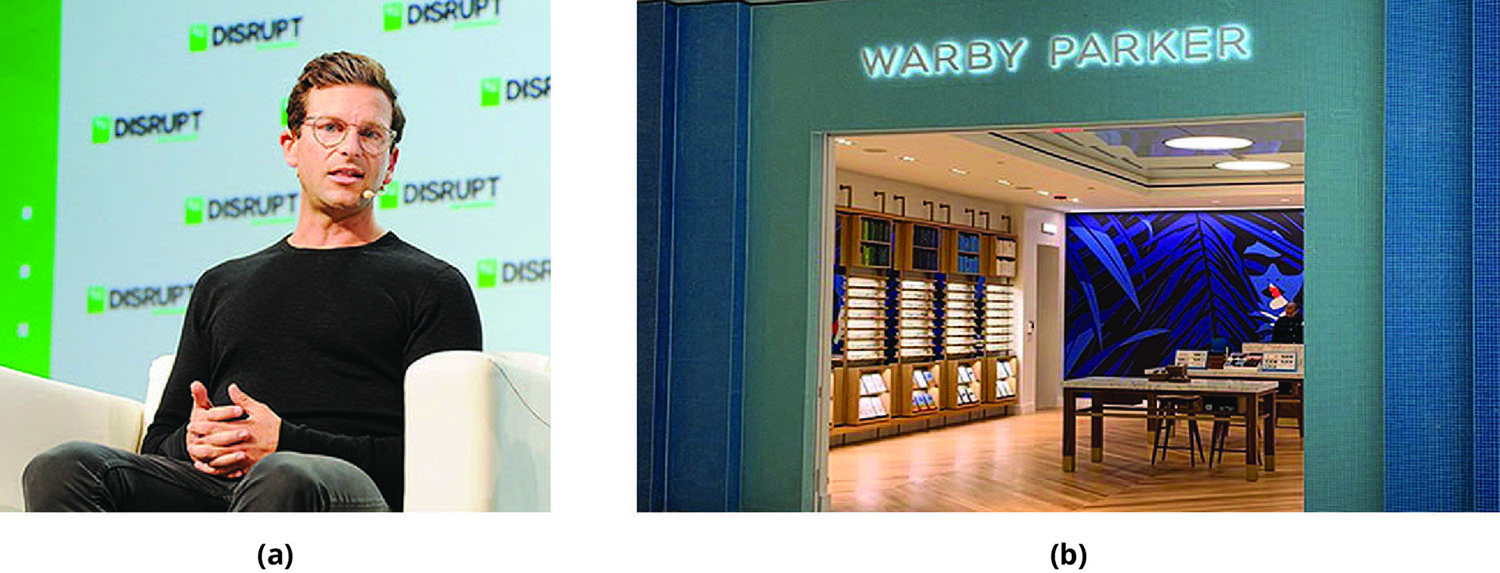
Within the entrepreneurial world, the idea of a lifestyle venture has evolved to mean a business in which the founders’ primary focus is the lifestyle they will attain through becoming entrepreneurs, rather than a primary interest in financial rewards through the selling of the business. Within the entrepreneurial world, harvesting is the typical exit strategy. The harvest is the point at which the investors and entrepreneurial team receive their return on creating and building the venture.
For a lifestyle venture, the entrepreneur is more likely to be a solo entrepreneur, someone who moves forward in starting a new venture without the support of a team or group of likeminded individuals who recognize the value or potential of an entrepreneurial idea that could potentially result in significant returns. A lifestyle venture is also more likely to be funded through family and friends, and more traditional methods such as a bank loan or a small business loan. This lifestyle includes greater freedom to decide areas of responsibilities, hours of contribution to the venture, and other decisions that support the desired lifestyle. An example of a startup lifestyle venture is The Wander Girls, a company that identified the unique concerns of women traveling alone.3 The Wander Girls organizes trips and events for groups of women traveling in India. A team member organizes the trip, travels with the female tourists, and handles daily interactions and transactions.
Another example of a lifestyle venture is based on how an entrepreneur aligns values, interests, and passions to create a balance between enjoying life and earning enough money to support those passions. Roxanne Quimby had a passion for living off the grid, creating her own life in the woods of Maine, and not being restricted by the rules and regulations required when working as an employee. After becoming a parent, Quimby faced the challenges presented by her lifestyle choices and started making candles to earn enough money to support her family. Eventually, Quimby’s lifestyle candle-making business expanded into the highly successful Burt’s Bees Corporation, moving her lifestyle business into a career as the CEO of Burt’s Bees (). After selling Burt’s Bees to Clorox Co., Quimby continued her passion for the north woods of Maine by donating land and money to create a wildlife sanctuary and preserve that land from development.
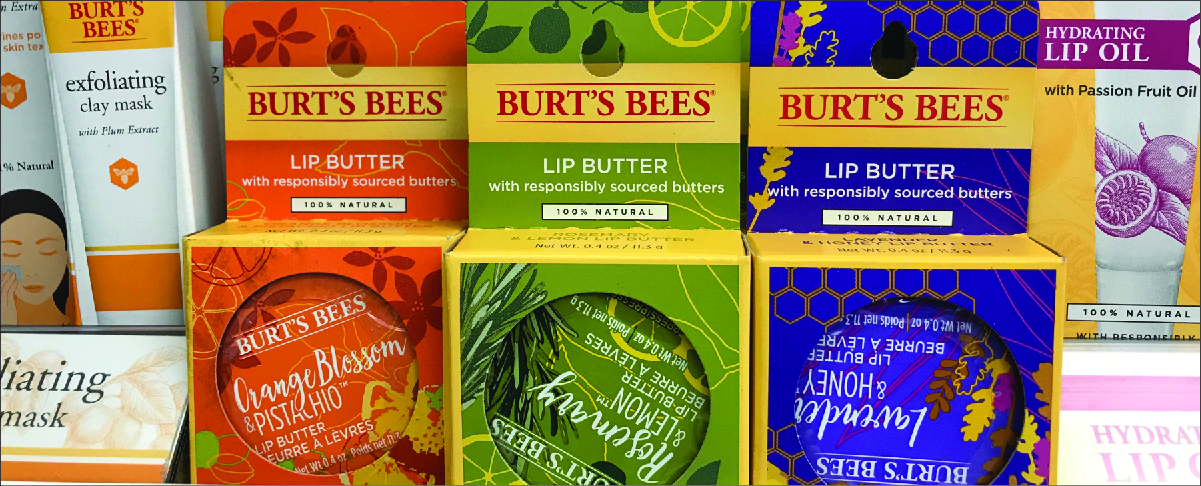
Quimby’s latest endeavors include creating a pasta company, My Pasta Art, focused on increasing employment opportunities for people in northern Maine,4 and building the tourist industry to encourage people to enjoy the region’s beautiful habitat and scenery. Although she is highly successful from a financial perspective, money was never the motivation for her ventures. As you can see, there are many paths to finding your career in entrepreneurship, and multiple trigger points at which you might make the decision to become an entrepreneur.
The Entrepreneur as a Problem Solver
What are some challenges you face in your life? Have you ever actively thought about how you could solve those problems? Or have you actively identified exactly what the problem is from an analytical perspective? We often have a tendency to jump quickly from noticing a problem to selecting a solution, with little understanding of whether we have even correctly identified the problem. Identifying the problem—and testing the potential, novelty, and feasibility of your solution—is an important part of resolving the problem. Often, when we start to explore the problem, we find that it has multiple causes. Among them are:
- The need for something to be better, faster, or easier
- The effects of changes in world on your industry, product, or service
- Market trends based on geography, demographics, or the psychology of the customers
You will learn more about identifying opportunities in Identifying Entrepreneurial Opportunity and Problem Solving and Need Recognition Techniques.
One characteristic of a savvy entrepreneur is recognizing the ability to identify a problem from an opportunity-identification perspective. We might identify feeling hungry as a problem, but an entrepreneur would identify the problem using an opportunity-identifying perspective by determining how the problem could be translated into an opportunity to create a new venture—perhaps combining the problem of feeling hungry between meals into a street kiosk or a vending machine with food choices or creating a new snack that is nutritious, satisfying, and portable. People need to eat, and they get hungry, but during a busy day with no open time or convenient food, people end up hungry. Rephrasing the problem, or need, from an opportunity viewpoint opens the search for a sustainable solution beyond the simple awareness of feeling hungry. We might solve this problem by opening a snack bar with offerings that contain essential vitamins and proteins, and is easy to transport with a long shelf life. Understanding the problem from the perspective of how to solve it for one person into how to solve it for multiple people rephrases the problem into an opportunity-identification perspective.
You might also have an interest in solving food-related problems on a larger scale. People trapped in a war-torn region may not be able to leave the safety of their shelters to find food, grow food, or barter for food, or they may not have the money to buy food. How could you reach your target market within a war-torn area? Red Cross emergency response vehicles traveled 2.5 million miles to deliver food, relief supplies, and support to communities affected by disasters during 2017.5 That’s the equivalent of driving around the globe 103 times. Could your idea of creating a snack bar fit into a partnership with the Red Cross?
Although this might seem like a simple problem with a simple solution, persevering from the recognition of a problem to finding a realistic solution, then moving that solution forward into a successful venture, requires an entrepreneurial mindset. Every day, people become entrepreneurs as they identify and solve problems, or face new challenges or frustrations, and resolve them in creating products or services to address these issues.
Factors Driving the Growth of Entrepreneurship
Do you know anyone who has lost their job? Or who has been rejected or mistreated at work? Or had their income reduced, or benefits removed? Research shows that 47 percent of all US employment is at risk through artificial intelligence and other technologies, although there will also be new opportunities for jobs that currently don’t exist.6 These types of experiences and outlooks have provided the impetus for many people to start their own businesses. When we work for someone else, we are at the mercy of their decisions and actions, but we get paid and don’t carry the full risk of their decisions. When we work for ourselves, we get to make the decisions (not that making decisions is easy). But when we have our own business, we have greater control—in exchange, we also carry the risk for all decisions we make. This control over decision-making is one reason that some people find the world of entrepreneurship attractive.
Another contributing factor to the desire to become an entrepreneur is the excitement and fun of creating something new. Many entrepreneurs are excited at the idea of moving the concept through to the materialization of the idea.
A third factor that supports the growth in entrepreneurship is the combination of retirement and longer life expectancies. Many people enjoy working. For them, retirement consists of too much open time and not enough activities or the type of engagement with the outside world that fulfilled their needs during their working lives. Retirement also presents unique financial considerations, depending on an individual’s lifetime savings and planning. The combination of having available time and a desire for continued earnings encourages some older adults to explore their own entrepreneurial opportunities.
A fourth factor driving the growth of entrepreneurship is the expanding awareness and support of entrepreneurship as a viable career choice. In much of the twentieth century, families encouraged their children to find a stable career with a large corporation. During this era, there was a certain expectation of reciprocal loyalty between the employer and the employee based on some traditional employee-employer roles in that century. The general, informal agreement was that if employees came to work every day and fulfilled their responsibilities, they would have long-term employment with that corporation. But as competition increased and new business practices evolved, this unspoken guarantee no longer held true. The model of certainty of employment gradually disappeared. As people acquired a new perspective on their careers and income, they increasingly realized that we are all responsible for our own paths. Most studies suggest that people change their careers between three and seven times.7 Note that this is not how often people change jobs, but how often they change their careers, moving from one industry to another, or moving from one type of work to a different type of work. The older model of stability through working hard for someone else has vanished. This awareness and acceptance have encouraged recent generations to consider creating their own futures through entrepreneurial ventures.
Just as individuals have become aware of the benefits of entrepreneurship, communities and organizations have also become aware of how entrepreneurial ventures add economic development and enhancements worth supporting, bolstering opportunities for those who decide on this path.
Entrepreneurship around the Globe
In the United States, entrepreneurial opportunities abound, relatively speaking. Between 1990 and 2014, the number of campus-based entrepreneurship education programs increased from 180 to over 2,000.8 Comparing globally, the United States has the greatest number of entrepreneurial ventures, with Switzerland, Canada, Sweden, Denmark, and Australia following in order, according to Global Entrepreneurship Index, a global consulting firm ().
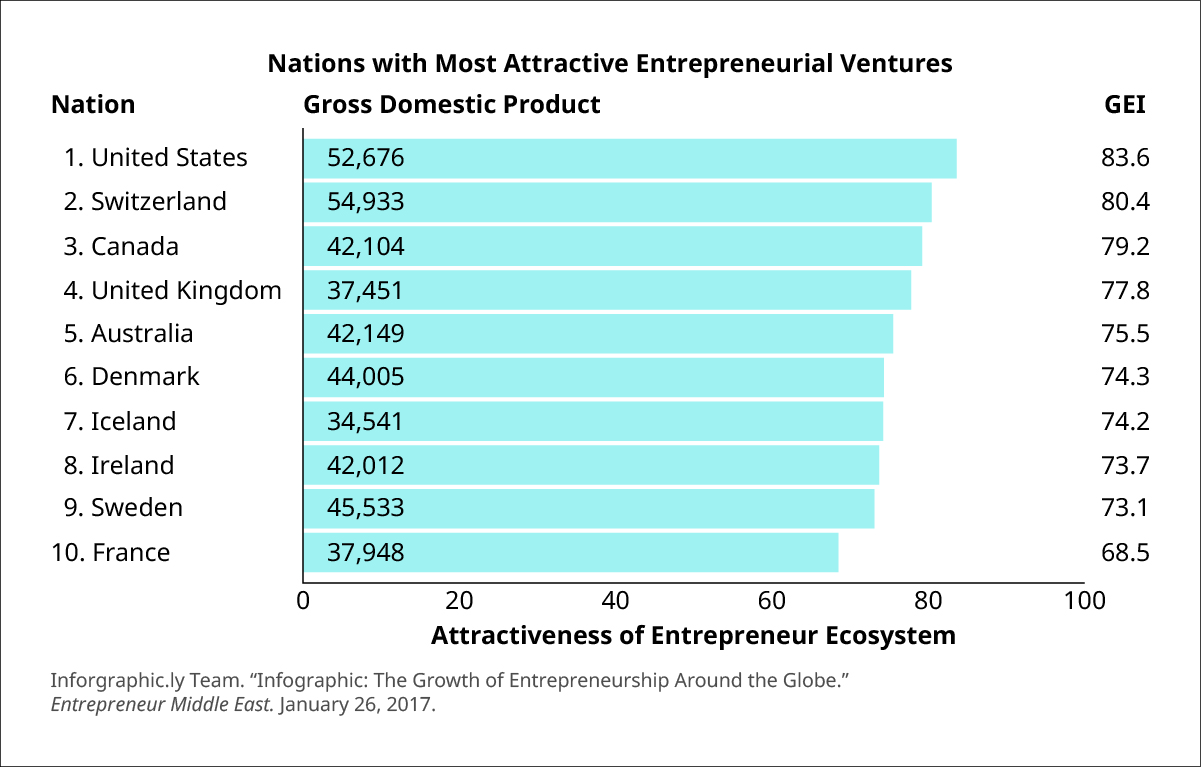
Why is the United States leading with the greatest number of entrepreneurial ventures? What does it take to become an entrepreneur? In addition to having an entrepreneurial mindset (see The Entrepreneurial Mindset), entrepreneurs also need education and funding to support their new ventures.
You will learn more about funding in Entrepreneurial Finance and Accounting, but as an introduction, you should know there are three primary sources of outside funding: family and friends, angel investors, and venture capitalists. Some family members and friends are willing and able to invest money in helping the entrepreneurial team. An angel investor is someone who has available funds and an interest in supporting a new venture. They are often entrepreneurs who have successfully launched and harvested their own ventures, and who have an interest in helping other entrepreneurs in their startups, staying active in the entrepreneurial world, and a desire to receive a return on their investment in the venture. Angel investors often provide funding early in the life of a venture. As the venture grows, it typically requires more funding, at which time venture capitalists may invest in the venture. A venture capitalist (VC) is a group of people (or organizations) who pool resources to invest in entrepreneurial ventures, contributing larger sums of funds than are available through angel investors. In each funding round, investors receive an equity stake in the venture with expectations that at some point in the future, the venture will be sold, or harvested, at which time the investors will receive a return on their investment. Because they tend to be in larger groups, VCs typically have access to larger amounts of money and resources than individual angel investors. (You will also learn about other types of financing, such as bank loans and bootstrapping, in Entrepreneurial Finance and Accounting.)
In the United States, VCs contributed $72.3 billion in 2015 for 3,916 deals, or funding rounds. In China that same year, $49.2 billion were invested in 1,611 ventures.9 European VC investment totaled $14.4 billion and 1,598 deals. Tracking these numbers over time shows steady increases in VC funding as entrepreneurial ventures have become more common ().
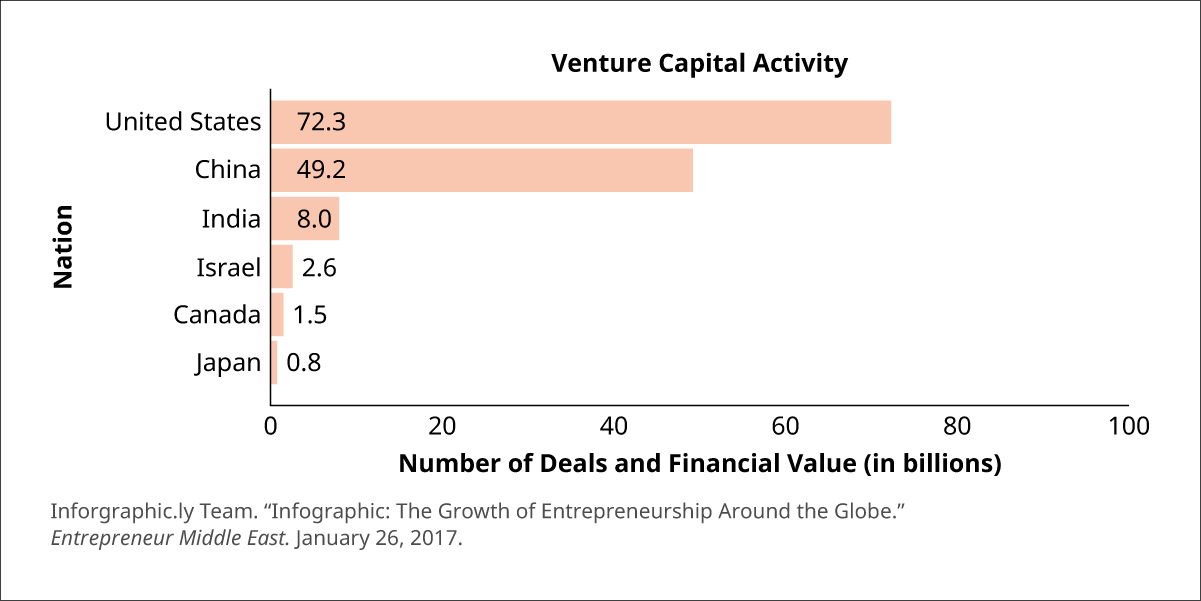
Other factors that can affect entrepreneurial opportunity include employment rates, government policies, and trade issues. For example, in the Middle Eastern kingdom of Saudi Arabia, a newer driver of entrepreneurship includes a high unemployment rate with a large percentage of the population in its prime earning years. In the past, employment was less of a concern because of dependency on state support from oil revenue. The population received monthly allotments to cover expenses from state-owned oil production. More recently, the population has become restless, with a desire to become productive and have greater control over their own resources. And the rulers recognize that oil production income is volatile and unsustainable. Today, with more future-oriented leaders, countries in the Middle East desire to encourage their citizens to consider starting their own businesses.10 The example of entrepreneurship in the United States has spread around the globe, with other countries taking an interest in developing support systems to encourage their populations to become entrepreneurs.
As noted, the United States is a world leader in entrepreneurial innovation. Perhaps because the United States is, in large part, a nation of immigrants, with people arriving from all over the world, Americans have few prescribed traditions that encourage conformity. America’s longstanding traditions and reputation for individualism, ingenuity, and self-reliance have reinforced this mindset. However, the governments of other nations have discouraged their citizens from independent or innovative thinking. Some cultures emphasize political, cultural, and economic unity, and place a strong value on not being noticed, blending in, and following prescribed habits and traditions. Countries like Japan, France, Russia, China, and others continue to reflect these norms. Other countries have complex bureaucracies that prevent quick responses and place barriers to entrepreneurial activities. Parts of worldwide economic structures (banking, investments, and technology) are not accessible or even explicitly exclude some nations and the poor. Systems like this discourage people from coming forward with entrepreneurial ideas because the culture and bureaucracy prevent people from finding access to information necessary for the successful advancement of an idea. In contrast, other countries are noticing the benefits of encouraging their populations to become more open-minded and creative through new ventures.
Key characteristics that encourage entrepreneurship include support for freedom to create and innovate. What conditions encourage creativity and innovation? Acceptance of failure is a key characteristic for success as an entrepreneur. Many of the great inventions in the United States resulted after dozens of failures, as when Thomas Edison eventually developed a working light bulb. Edison identified a problem: Once the sun set, working hours were restricted, as were daily activities such as reading a book or washing dishes. Edison, along with many other inventors, recognized the need for an artificial light source. Consider how complex this idea was and how many failures must have occurred before creating a product that emitted light.
Another condition that encourages entrepreneurial behavior is the ability and opportunity to connect with other people to discuss ideas, problems, challenges, and solutions. This connection with other people, in an open environment that supports the exchange of ideas, is essential for encouraging creativity and innovation.
With the advent of the Internet, people around the planet are becoming increasingly aware of geopolitical and environmental situations across the globe. As more people observe these changes and situations, more people exchange ideas. These discussions can generate new opportunities for people to discover methods for solving problems. Any one of us could be living in one country but identifying a problem in another country. Given our interests and backgrounds, we could actively choose to develop a solution for that problem. What we need, as a general approach, is an efficient and transparent way to form companies and enable constructive competition, along with continued free and fair trade.
These are just some of the areas that many nations and organizations consider as they seek to encourage a transition away from group-prescribed thinking toward uniquely individual entrepreneurial ideas. Each of us encounters life from a different perspective. Although we all might recognize the restrictions presented by the sun setting every night, only a few people might question why we couldn’t change that situation by creating our own light. Similarly, someone in another country may observe our country (or vice versa) and ask why that country has a particular problem. Meanwhile, people living with that problem may have become so accustomed to it that they might not recognize the opportunity to seek solutions.
Increasing opportunities in entrepreneurial education are also driving growth. More colleges and universities are teaching entrepreneurial studies and opening entrepreneurial centers that encourage students from every discipline to become entrepreneurs.12,13 As the employment and entrepreneurial landscape continue to evolve, some institutions have started offering courses to prepare students for work in the gig economy.14 In fact, some of the best new entrepreneurial ideas come from groups of students in different majors who collaborate to create new, innovative business ideas that meet specific needs and challenges in today’s world. In some cases, students from different universities around the globe are connecting to come up with business ideas to solve global problems, such as the lack of clean drinking water and the need for medical vaccination programs. Technology and global travel have made such partnerships more common and very productive.
The world of entrepreneurship opens doors for each of us to look beyond our own self-created barriers and explore opportunities around the world. Consider the creation of Starbucks, borne from the realization of how pleasant it can be to sit at a European café and drink excellent coffee. Awareness of an idea that is commonplace in one country, but new to a different country, presents the possibility of introducing that idea to another nation. In the Starbucks example, was there a problem that needed to be solved? Not necessarily, but the founder, Howard Schultz, had a desire to bring a specific quality-of-life element from one country to another, a business idea with an entrepreneurial aspect. One of the entrepreneurial aspects of creating Starbucks was the idea of mass expansion of coffee shops. Prior to Starbucks, the idea of creating a high-quality coffee drink hadn’t been developed. Even more significant was the idea of expanding the business across the United States and then around the world.
Given the growth of coffee shops throughout the United States, we might not think that this idea is innovative, but before Starbucks, coffee typically was served at a diner, and it was served out of habit, rather than as the main attraction. With Starbucks, people changed their ideas about coffee and their coffee-drinking habits. Although businesses like Dunkin’ Donuts served coffee, their focus was on selling donuts, not coffee. As Starbucks grew through repositioning coffee as their main product, other companies like Dunkin’ Donuts and McDonalds realized the missed opportunity in not reinventing the coffee market with multiple choices of high-quality coffee. In fact, Dunkin’ Donuts has changed its name to just “Dunkin,” removing the emphasis on doughnuts.15
Social and Environmental Issues and Opportunities
A social entrepreneur has an interest in solving a social, environmental, or economic problem. A social entrepreneur identifies a problem with a social or community focus, a concern for quality of life, or concern for our entire planet’s health (you will learn more about social entrepreneurship in The Ethical and Social Responsibilities of Entrepreneurs). One such person is Angad Daryani, a young serial inventor. Daryani left school in the ninth grade to join the Media Lab at the Massachusetts Institute of Technology (MIT), where he worked on an industrial-scale air filter to clean pollutants and carcinogens out of our planet’s air. Daryani’s home country of India is the world’s third largest emitter of carbon dioxide, according to Global Carbon Atlas, behind China and the United States ().16

Not only is Daryani interested in solutions for air pollution, but his product will also provide financial gains and add to his personal credibility as a serial entrepreneur, or someone who starts and harvests multiple entrepreneurial ventures. Darvani describes himself as an inventor and social entrepreneur, combining his interest in improving lives through a variety of entrepreneurial ventures including products like Sharkits (a do-it-yourself-kit company that teaches children how to build technology), the SharkBot 3D Printer (an attractive, low-cost, and reliable 3D printer), and several other projects that combine technology and human needs. As each of these products advances to commercialization, the products and technology are becoming more applicable for other uses as well. For more examples of projects that Darvani is working on, take a look at his website (http://www.angadmakes.com), which includes videos and articles, and highlights the international recognition he has received for his innovative work.
Summary
An entrepreneur is someone who takes on an entrepreneurial venture to create something new that solves a problem; small business ownership and franchising are also entrepreneurial options. The venture could be for profit or not for profit, depending on the problem it intends to solve. Entrepreneurs can remain in a full-time job while pursuing their ideas on the side, in order to mitigate risk. On the opposite end of the spectrum, entrepreneurs can take on lifestyle ventures and become serial entrepreneurs. There are many factors driving the growth of entrepreneurship, including employment instability, motivation to create something new, financial factors and free time associated with retirement, and the greater acceptance of entrepreneurship as a career choice. The cultures of nations around the world affect the ability for entrepreneurs to start a venture, making the United States a leader in entrepreneurial innovation. Entrepreneurs often find inspiration in social, environmental, and economic issues.
Review Questions
What factors contribute to a growing interest in entrepreneurship?
- unemployment levels
- low job turnover rates
- increasing levels of creativity
- decreasing rates of discrimination
Angel investors contribute to the entrepreneurial world by ________.
- outpacing venture capitalists in access to startup funds
- directly investing in entrepreneurial startups
- holding seminars to teach people how to become an entrepreneur
- forming groups of other investors to supply greater quantities of investment funds to entrepreneurs.
An entrepreneur is someone who ________.
- creates a small business based on other existing businesses
- creates a home-based business that sells products available through other retailers
- creates a business around the idea of solving a problem
- is highly creative
Roxanne Quimby of Burt’s Bees is an example of an entrepreneur primarily for which of the following reasons?
- She saw available resources and recognized the resources could be used to create a business.
- She acted on her passions.
- She solved a significant societal problem.
- She had the time and energy to dedicate to starting business.
In the early stages of developing an entrepreneurial venture, the entrepreneur might seek funding from which group?
- venture capitalists
- the local bank
- friends and family
- shark tank
Discussion Questions
Why is the United States a leader in entrepreneurship?
What commonalities do the top five countries have that put them in the lead for entrepreneurial ventures?
One of Roxanne Quimby’s motivations in starting businesses included helping employ people in her community. How does or doesn’t this motivation fit in the definition of an entrepreneur as someone who identifies a problem and solves that problem?
What are the similarities and differences between the business ventures of Wander Girls and Roxanne Quimby?
Case Questions
What suggestions could you make to Angad Daryani on other products that would fit his focus on improving the lives of people?
On Angad Daryani’s website, he says he believes “that the path humanity follows, need to be pivoted for the better.” What other needs or problems do humans have? Create a list of twenty needs that would fit Angad Daryani’s belief statement.
Suggested Resources
https://www.entrepreneurship-campus.org
https://youtu.be/zV2vi8FilLM
Footnotes
- Hamid Bouchikhi. “A Constructivist Framework for Understanding Entrepreneurship Performance.” Organization Studies. July 1, 1993. doi.org/10.1177/017084069301400405; William D. Bygrave and Charles W. Hofer. “Theorizing about Entrepreneurship.” Entrepreneurship Theory and Practice 16, no. 2 (1991): 13–22.; Michael A. Hitt, R. Duane Ireland, S. Michael Camp, and Donald L. Sexton. Strategic Entrepreneurship: Creating a New Mindset. (Hoboken, NJ: Wiley-Blackwell, 2002).; Jeffry A. Timmons. New Venture Creation: Entrepreneurship for the 21st Century. (Irwin Press, Burr Ridge, IL: Irwin Press, 1994). ↩
- Paul B. Brown. “Franchisees Are Entrepreneurs (Let the Debate Begin).” Forbes. September 19, 2012. https://www.forbes.com/sites/actiontrumpseverything/2012/09/19/franchisees-are-entrepreneurs-let-the-debate-begin/#55c9fb8f2bf3 ↩
- The Wander Girls. n.d. http://thewandergirls.com/ ↩
- Mary Pols. “Making Pasta’s the New Focus for Roxanne Quimby.” Portland Press Herald. August 13, 2017. ↩
- American Red Cross. “2017 in Review: Red Cross Delivers More Food, Relief Items, and Shelter Stays Than Last 4 Years Combined.” December 18, 2017. https://www.redcross.org/local/georgia/about-us/news-and-events/news/2017-in-Review-Red-Cross-Delivers-More-Food-Relief-Items-and-Shelter-Stays-than-Last-4-Years-Combined.html ↩
- Carl Benedikt Frey and Michael A. Osborne. “The Future of Employment: How Susceptible Are Jobs to Computerization?” Technological Forecasting and Social Change 114 (2013): 254–280. https://www.oxfordmartin.ox.ac.uk/downloads/academic/The_Future_of_Employment.pdf ↩
- Dawn Rosenberg McKay. “How Often Do People Change Careers?” The Balance. September 20, 2019. https://www.thebalancecareers.com/how-often-do-people-change-careers-3969407 ↩
- Infographic.ly Team. “Infograpic: The Growth of Entrepreneurship around the Globe.” Entrepreneur Middle East. January 26, 2017. https://www.entrepreneur.com/article/288286 ↩
- Infographic.ly Team. “Infographic: The Growth of Entrepreneurship around the Globe.” Entrepreneur Middle East. January 26, 2017. https://www.entrepreneur.com/article/288286 ↩
- Infographic.ly Team. “Infographic: The Growth of Entrepreneurship around the Globe.” Entrepreneur Middle East. January 26, 2017. https://www.entrepreneur.com/article/288286 ↩
- Transparency International. n.d. www.transparency.org ↩
- National Survey of Entrepreneurship Education. n.d. www.nationalsurvey.org ↩
- “The Princeton Review & Entrepreneur Name the Top Undergraduate & Graduate Schools for Entrepreneurship Studies for 2020.” Cision PR Network. November 12, 2019. https://www.prnewswire.com/news-releases/the-princeton-review--entrepreneur-name-the-top-undergraduate--graduate-schools-for-entrepreneurship-studies-for-2020-300955876.html ↩
- Diane Mulcahy. “Universities Should Be Preparing Students for the Gig Economy.” Harvard Business Review. October 3, 2019. https://hbr.org/2019/10/universities-should-be-preparing-students-for-the-gig-economy ↩
- Kate Taylor. “Dunkin’ Donuts Is Officially Dropping the ‘Donuts’ from Its Name Despite Earlier Backlash.” Business Insider. September 25, 2018. https://www.businessinsider.com/dunkin-donuts-changes-name-no-donuts-2018-9 ↩
- “Fossil Fuel Emissions.” Global Carbon Atlas. 2017. http://www.globalcarbonatlas.org/en/CO2-emissions ↩