Designing the Business Model
Learning Objectives
By the end of this section, you will be able to:
- Define a business model and its purpose
- Describe a business model canvas
- Describe a lean model canvas
- Describe a social business model canvas
View this section's JSON
{
"id": "m71178",
"doc_class": "",
"title": "Designing the Business Model",
"objectives": [
"Define a business model and its purpose",
"Describe a business model canvas",
"Describe a lean model canvas",
"Describe a social business model canvas"
],
"figures": [
{
"src": "OSX_Eship_11_02_BMCParts.jpg",
"alt": "The business model canvas consists of key partners, key activities, key resources, value propositions, customer relationships, channels, customer segments, cost structure, and revenue streams.",
"caption": "The business model canvas can be used to map or lay out the initial concept of your business. (attribution: Copyright Rice University, OpenStax, under CC BY NC-SA 4.0 license)"
},
{
"src": "OSX_Eship_11_02_IVPFormula.jpg",
"alt": "Formula showing that the end result that the customer wants plus a specific period of time plus addressing objections equals the initial value proposition.",
"caption": "Maurya’s formula to determine value proposition considers customer needs and potential objections within a specific period of time. (attribution: Copyright Rice University, OpenStax, under CC BY NC-SA 4.0 license)"
},
{
"src": "OSX_Eship_11_02_LeanCanv.jpg",
"alt": "The lean model canvas consists of problems, solutions, metrics, value propositions, customer relationships, channels, customer segments, cost structure, and revenue streams.",
"caption": "The <dfn>lean model canvas</dfn> is a modification of the Business Model Canvas. (attribution: Copyright Rice University, OpenStax, under CC BY NC-SA 4.0 license)"
},
{
"src": "OSX_Eship_11_02_EmpMap.jpg",
"alt": "With the customer shown in the middle, the empathy map shows the customer connected to the words see, say, do, hear, and think.",
"caption": "An empathy map portrays the target customer in order to understand the market needs. (attribution: Copyright Rice University, OpenStax, under CC BY NC-SA 4.0 license)"
},
{
"src": "OSX_Eship_11_02_Framework.jpg",
"alt": "A triangle showing the words desirability, viability, and feasibility at the corners, with double-headed arrows between them as the sides of the triangle.",
"caption": "The framework of desirability, feasibility, and viability form a story about a company’s startup. (attribution: Copyright Rice University, OpenStax, under CC BY NC-SA 4.0 license)"
},
{
"src": "OSX_Eship_11_02_Party_img.png",
"alt": "Photo of a table set for a party, with fancy party hats, napkins, and platters of cookies.",
"caption": "The Birthday Party Project helps provide celebrations to honor the birthdays of homeless children. (credit: modification of "children's birthday table" by "Efraimstochter"/Pixabay, CC0)"
}
],
"tokens": 6811,
"blocks": [
{
"anchor": "m71178-b1",
"trail": [],
"heading": null,
"html": "<p>Portions of the material in this section are based on original work by Geoffrey Graybeal and produced with support from the Rebus Community. The original is freely available under the terms of the CC BY 4.0 license at https://press.rebus.community/media-innovation-and-entrepreneurship/.</p>",
"text": "Portions of the material in this section are based on original work by Geoffrey Graybeal and produced with support from the Rebus Community. The original is freely available under the terms of the CC BY 4.0 license at https://press.rebus.community/media-innovation-and-entrepreneurship/.",
"tokens": 71
},
{
"anchor": "m71178-b2",
"trail": [
"Learning Objectives"
],
"heading": "Learning Objectives",
"html": "<section class=\"learning-objectives\"><h2>Learning Objectives</h2><p>By the end of this section, you will be able to:</p><ul><li>Define a business model and its purpose</li><li>Describe a business model canvas</li><li>Describe a lean model canvas</li><li>Describe a social business model canvas</li></ul></section>",
"text": "Learning Objectives\nBy the end of this section, you will be able to:\nDefine a business model and its purpose\nDescribe a business model canvas\nDescribe a lean model canvas\nDescribe a social business model canvas",
"tokens": 52
},
{
"anchor": "m71178-b3",
"trail": [],
"heading": null,
"html": "<p>According to Alexander <dfn>Osterwalder</dfn> and Yves <dfn>Pigneur</dfn>, the authors of <em>Business Model Generation</em>, a business model “describes the rationale of how an organization creates, delivers and captures value.” Nevertheless, there is no single definition of this term, and usage varies widely.<sup class=\"footnote-ref\"><a id=\"fnref1\" href=\"#fn1\" aria-label=\"Footnote 1\">1</a></sup></p><p>In standard business usage, a <dfn>business model</dfn> is a plan for how venture will be funded; how the venture creates value for its stakeholders, including customers; how the venture’s offerings are made and distributed to the end users; and the how income will be generated through this process. The business model refers more to the design of the business, whereas a <dfn>business plan</dfn> is a planning document used for operations.</p><p>Each business model is unique to the company it describes. A typical business model addresses the desirability, feasibility, and viability of a company, product, or service. At a bare minimum, a business model needs to address revenue streams (e.g., a revenue model), a value proposition, and customer segments. In non-jargon English, this means you want to address what your idea is, who will use it, why they will use it, and how you will make money off it.</p><p>A canvas is a display that would-be entrepreneurs commonly use to map out and plan different components of their business models. There are several different types of canvases, with the business model canvas and the lean canvas being the most commonly used. There are hard-copy canvases modeled after an art canvas as well as digital versions. The original physical canvases are meant to serve as visual tools, used with sticky notes and sketches.</p><p>As developed by Osterwalder and Pigneur, the <dfn>business model canvas</dfn> has nine components, as shown in .</p><figure><img src=\"media/OSX_Eship_11_02_BMCParts.jpg\" alt=\"The business model canvas consists of key partners, key activities, key resources, value propositions, customer relationships, channels, customer segments, cost structure, and revenue streams.\"><figcaption>The business model canvas can be used to map or lay out the initial concept of your business. (attribution: Copyright Rice University, OpenStax, under CC BY NC-SA 4.0 license)</figcaption><span class=\"figure-alt\">The business model canvas consists of key partners, key activities, key resources, value propositions, customer relationships, channels, customer segments, cost structure, and revenue streams.</span></figure><aside class=\"note note-link-to-learning\"><p class=\"note-label\">Link to learning</p><p>Visit this site <a href=\"https://openstax.org/l/52BMCsamples\" rel=\"noopener\" target=\"_blank\">to see examples of completed Business Model Canvases for a variety of industries</a> for a deeper understanding of how the different categories are filled in.</p></aside><p>Osterwalder and Pigneur wrote <em>Value Proposition Design</em> as a sequel to <em>Business Model Generation</em>. Their value proposition canvas is a plug-in that complements the business model canvas, going in depth on activities such as encouraging entrepreneurs to address and tackle customer pains, gains, and jobs-to-be-done trigger questions, and designing pain relievers and gains. The complementary and accompanying activities and resources can be useful for a deeper dive into and understanding of customer value creation in the form of value proposition, although there are other approaches to conceptualizing your value proposition. For Christensen, the originator of the disruptive innovation and jobs-to-be-done theories, a value proposition is a product that helps customers do a job they’ve been trying to do more effectively, conveniently, and affordably.</p><p>Finding the intersection of your customers’ problems and your solutions is how you create a unique value proposition, according to the entrepreneur Ash <dfn>Maurya</dfn>, the author of <em>Scaling Lean</em> and <em>Running Lean</em>. In <em>Running Lean</em>, Maurya offers the following formula for creating an initial value proposition in the canvas, as shown in .</p><figure><img src=\"media/OSX_Eship_11_02_IVPFormula.jpg\" alt=\"Formula showing that the end result that the customer wants plus a specific period of time plus addressing objections equals the initial value proposition.\"><figcaption>Maurya’s formula to determine value proposition considers customer needs and potential objections within a specific period of time. (attribution: Copyright Rice University, OpenStax, under CC BY NC-SA 4.0 license)</figcaption><span class=\"figure-alt\">Formula showing that the end result that the customer wants plus a specific period of time plus addressing objections equals the initial value proposition.</span></figure><p>Maurya deviated from the standard business model canvas to create the lean canvas. It overlaps the business model canvas in five of the nine components: customer segments, value proposition, revenue streams, channels, and cost structure (]. Rather than addressing key partners, key activities, and key resources, the lean canvas helps you tackle problems, solutions, and key metrics instead.</p><figure><img src=\"media/OSX_Eship_11_02_LeanCanv.jpg\" alt=\"The lean model canvas consists of problems, solutions, metrics, value propositions, customer relationships, channels, customer segments, cost structure, and revenue streams.\"><figcaption>The <dfn>lean model canvas</dfn> is a modification of the Business Model Canvas. (attribution: Copyright Rice University, OpenStax, under CC BY NC-SA 4.0 license)</figcaption><span class=\"figure-alt\">The lean model canvas consists of problems, solutions, metrics, value propositions, customer relationships, channels, customer segments, cost structure, and revenue streams.</span></figure><aside class=\"note note-link-to-learning\"><p class=\"note-label\">Link to learning</p><p>Visit this site <a href=\"https://openstax.org/l/52LMCsamples\" rel=\"noopener\" target=\"_blank\">to see examples of completed Lean Model Canvases from some major companies</a> for a deeper understanding of how the canvas can be applied.</p></aside><p>While the business model canvas and the lean canvas are similar in format, there are differences in how they are used. It is generally accepted that the lean canvas model is a better fit for startups, whereas the business model canvas works well for already established businesses. The lean canvas is simpler; the business model canvas provides a more complete picture of a mature business.</p><aside class=\"note note-link-to-learning\"><p class=\"note-label\">Link to learning</p><p>Watch this <a href=\"https://openstax.org/l/52LeanCanvUb\" rel=\"noopener\" target=\"_blank\">Railsware video that demonstrates how the lean canvas model might be applied to startups</a> to learn more. In the case example in the video, the lean canvas model is applied to the successful P2P ride-sharing app Uber, as if it were a startup.</p></aside><p>Both the business model canvas and the lean canvas are designed for constant iterations, allowing for multiple versions and changes throughout the entrepreneurial process. Part of that process involves customer discovery; thus, the canvases invoke customer-focused design. The target customer is integrated into the canvas from the start through the use of a customer empathy map and a number of design-thinking ideation activities.<sup class=\"footnote-ref\"><a id=\"fnref2\" href=\"#fn2\" aria-label=\"Footnote 2\">2</a></sup> The <dfn>customer empathy map</dfn> is a portrayal of a <dfn>target customer</dfn>—the most promising candidate from a business’s customer segments—that explores the understanding of that person’s problems and needs (). <dfn>Osterwalder</dfn> and <dfn>Pigneur</dfn> used a customer empathy map as part of the design ideation phase of developing a business model canvas. There are differing versions of customer empathy maps, but most seek to answer common questions pertaining to the customer, such as:</p><ul><li>With whom are we empathizing?</li><li>What do they need to do?</li><li>What do they see?</li><li>What do they say?</li><li>What do they do?</li><li>What do they hear?</li><li>What do they think?</li></ul><p>Phillips, Proctor & Gamble, Microsoft, and Yeti are examples of well-known companies that make use of customer empathy mapping because, according to the journal <em>Entrepreneur</em>, every transaction can be turned into a meaningful and valuable customer interaction.<sup class=\"footnote-ref\"><a id=\"fnref3\" href=\"#fn3\" aria-label=\"Footnote 3\">3</a></sup> Once a company analyzes the results of customer mapping exercises, it may very well lead to new products that serve customer needs and/or wants.</p><p>For example, Philips used empathy mapping to detect a high level of fear in young patients immediately before an MRI medical procedure, so it invented a miniature version of the CAT scan equipment used in the procedure called the “kitten scanner” along with toy animal characters that were used to dispel the fear of MRIs among children. Proctor & Gamble created a new advertisement that was released for the 2012 Olympics visualizing the trials and tribulations of mothers raising young athletes, demonstrating Proctor and Gamble’s awareness that some of its customers wanted or needed empathy for the sacrifices they had made to help their children succeed. Likewise, Microsoft has attempted to demonstrate empathy with customers’ privacy concerns by developing an interactive website that explains not only how data is stolen but also how we can better protect our own data.<sup class=\"footnote-ref\"><a id=\"fnref4\" href=\"#fn4\" aria-label=\"Footnote 4\">4</a></sup></p><p>On their company website, the now-famous Yeti cooler company publicly extols the value of empathy mapping, explaining that it leads to better products. Yeti doesn’t just create one on its own, it actually asks its clients to work with the company to create an empathy map.<sup class=\"footnote-ref\"><a id=\"fnref5\" href=\"#fn5\" aria-label=\"Footnote 5\">5</a></sup> Thus, empathy mapping for Yeti is part of its product development process.</p><p>Customer empathy maps also strive to address customer pains (in this case, fears, frustrations, and anxieties) and gains (wants, needs, hopes, and dreams).<sup class=\"footnote-ref\"><a id=\"fnref6\" href=\"#fn6\" aria-label=\"Footnote 6\">6</a></sup></p><figure><img src=\"media/OSX_Eship_11_02_EmpMap.jpg\" alt=\"With the customer shown in the middle, the empathy map shows the customer connected to the words see, say, do, hear, and think.\"><figcaption>An empathy map portrays the target customer in order to understand the market needs. (attribution: Copyright Rice University, OpenStax, under CC BY NC-SA 4.0 license)</figcaption><span class=\"figure-alt\">With the customer shown in the middle, the empathy map shows the customer connected to the words see, say, do, hear, and think.</span></figure><aside class=\"note note-link-to-learning\"><p class=\"note-label\">Link to learning</p><p><dfn>Strategyzer</dfn> offers <a href=\"https://openstax.org/l/52BMCvideos\" rel=\"noopener\" target=\"_blank\">six videos outlining the business model canvas</a> that total about 12 minutes; specifically they cover the prototyping journey from ideation to visualization of conceptualization.</p></aside>",
"text": "According to Alexander Osterwalder and Yves Pigneur, the authors of Business Model Generation, a business model “describes the rationale of how an organization creates, delivers and captures value.” Nevertheless, there is no single definition of this term, and usage varies widely.1\nIn standard business usage, a business model is a plan for how venture will be funded; how the venture creates value for its stakeholders, including customers; how the venture’s offerings are made and distributed to the end users; and the how income will be generated through this process. The business model refers more to the design of the business, whereas a business plan is a planning document used for operations.\nEach business model is unique to the company it describes. A typical business model addresses the desirability, feasibility, and viability of a company, product, or service. At a bare minimum, a business model needs to address revenue streams (e.g., a revenue model), a value proposition, and customer segments. In non-jargon English, this means you want to address what your idea is, who will use it, why they will use it, and how you will make money off it.\nA canvas is a display that would-be entrepreneurs commonly use to map out and plan different components of their business models. There are several different types of canvases, with the business model canvas and the lean canvas being the most commonly used. There are hard-copy canvases modeled after an art canvas as well as digital versions. The original physical canvases are meant to serve as visual tools, used with sticky notes and sketches.\nAs developed by Osterwalder and Pigneur, the business model canvas has nine components, as shown in .\n [figure: The business model canvas consists of key partners, key activities, key resources, value propositions, customer relationships, channels, customer segments, cost structure, and revenue streams.] The business model canvas can be used to map or lay out the initial concept of your business. (attribution: Copyright Rice University, OpenStax, under CC BY NC-SA 4.0 license)\nThe business model canvas consists of key partners, key activities, key resources, value propositions, customer relationships, channels, customer segments, cost structure, and revenue streams.Link to learning\nVisit this site to see examples of completed Business Model Canvases for a variety of industries for a deeper understanding of how the different categories are filled in.\n\nOsterwalder and Pigneur wrote Value Proposition Design as a sequel to Business Model Generation. Their value proposition canvas is a plug-in that complements the business model canvas, going in depth on activities such as encouraging entrepreneurs to address and tackle customer pains, gains, and jobs-to-be-done trigger questions, and designing pain relievers and gains. The complementary and accompanying activities and resources can be useful for a deeper dive into and understanding of customer value creation in the form of value proposition, although there are other approaches to conceptualizing your value proposition. For Christensen, the originator of the disruptive innovation and jobs-to-be-done theories, a value proposition is a product that helps customers do a job they’ve been trying to do more effectively, conveniently, and affordably.\nFinding the intersection of your customers’ problems and your solutions is how you create a unique value proposition, according to the entrepreneur Ash Maurya, the author of Scaling Lean and Running Lean. In Running Lean, Maurya offers the following formula for creating an initial value proposition in the canvas, as shown in .\n [figure: Formula showing that the end result that the customer wants plus a specific period of time plus addressing objections equals the initial value proposition.] Maurya’s formula to determine value proposition considers customer needs and potential objections within a specific period of time. (attribution: Copyright Rice University, OpenStax, under CC BY NC-SA 4.0 license)\nFormula showing that the end result that the customer wants plus a specific period of time plus addressing objections equals the initial value proposition.Maurya deviated from the standard business model canvas to create the lean canvas. It overlaps the business model canvas in five of the nine components: customer segments, value proposition, revenue streams, channels, and cost structure (]. Rather than addressing key partners, key activities, and key resources, the lean canvas helps you tackle problems, solutions, and key metrics instead.\n [figure: The lean model canvas consists of problems, solutions, metrics, value propositions, customer relationships, channels, customer segments, cost structure, and revenue streams.] The lean model canvas is a modification of the Business Model Canvas. (attribution: Copyright Rice University, OpenStax, under CC BY NC-SA 4.0 license)\nThe lean model canvas consists of problems, solutions, metrics, value propositions, customer relationships, channels, customer segments, cost structure, and revenue streams.Link to learning\nVisit this site to see examples of completed Lean Model Canvases from some major companies for a deeper understanding of how the canvas can be applied.\n\nWhile the business model canvas and the lean canvas are similar in format, there are differences in how they are used. It is generally accepted that the lean canvas model is a better fit for startups, whereas the business model canvas works well for already established businesses. The lean canvas is simpler; the business model canvas provides a more complete picture of a mature business.\nLink to learning\nWatch this Railsware video that demonstrates how the lean canvas model might be applied to startups to learn more. In the case example in the video, the lean canvas model is applied to the successful P2P ride-sharing app Uber, as if it were a startup.\n\nBoth the business model canvas and the lean canvas are designed for constant iterations, allowing for multiple versions and changes throughout the entrepreneurial process. Part of that process involves customer discovery; thus, the canvases invoke customer-focused design. The target customer is integrated into the canvas from the start through the use of a customer empathy map and a number of design-thinking ideation activities.2 The customer empathy map is a portrayal of a target customer—the most promising candidate from a business’s customer segments—that explores the understanding of that person’s problems and needs (). Osterwalder and Pigneur used a customer empathy map as part of the design ideation phase of developing a business model canvas. There are differing versions of customer empathy maps, but most seek to answer common questions pertaining to the customer, such as:\nWith whom are we empathizing?\nWhat do they need to do?\nWhat do they see?\nWhat do they say?\nWhat do they do?\nWhat do they hear?\nWhat do they think?\nPhillips, Proctor & Gamble, Microsoft, and Yeti are examples of well-known companies that make use of customer empathy mapping because, according to the journal Entrepreneur, every transaction can be turned into a meaningful and valuable customer interaction.3 Once a company analyzes the results of customer mapping exercises, it may very well lead to new products that serve customer needs and/or wants.\nFor example, Philips used empathy mapping to detect a high level of fear in young patients immediately before an MRI medical procedure, so it invented a miniature version of the CAT scan equipment used in the procedure called the “kitten scanner” along with toy animal characters that were used to dispel the fear of MRIs among children. Proctor & Gamble created a new advertisement that was released for the 2012 Olympics visualizing the trials and tribulations of mothers raising young athletes, demonstrating Proctor and Gamble’s awareness that some of its customers wanted or needed empathy for the sacrifices they had made to help their children succeed. Likewise, Microsoft has attempted to demonstrate empathy with customers’ privacy concerns by developing an interactive website that explains not only how data is stolen but also how we can better protect our own data.4\nOn their company website, the now-famous Yeti cooler company publicly extols the value of empathy mapping, explaining that it leads to better products. Yeti doesn’t just create one on its own, it actually asks its clients to work with the company to create an empathy map.5 Thus, empathy mapping for Yeti is part of its product development process.\nCustomer empathy maps also strive to address customer pains (in this case, fears, frustrations, and anxieties) and gains (wants, needs, hopes, and dreams).6\n [figure: With the customer shown in the middle, the empathy map shows the customer connected to the words see, say, do, hear, and think.] An empathy map portrays the target customer in order to understand the market needs. (attribution: Copyright Rice University, OpenStax, under CC BY NC-SA 4.0 license)\nWith the customer shown in the middle, the empathy map shows the customer connected to the words see, say, do, hear, and think.Link to learning\nStrategyzer offers six videos outlining the business model canvas that total about 12 minutes; specifically they cover the prototyping journey from ideation to visualization of conceptualization.",
"tokens": 2350
},
{
"anchor": "m71178-b4",
"trail": [
"Business Model Canvas"
],
"heading": "Business Model Canvas",
"html": "<section class=\"\"><h2>Business Model Canvas<sup class=\"footnote-ref\"><a id=\"fnref7\" href=\"#fn7\" aria-label=\"Footnote 7\">7</a></sup></h2><p>As Osterwalder and Pigneur describe it, according to <em>Media Innovation and Entrepreneurship</em>, their business model canvas blocks include revenue streams, customer segments, value propositions, cost structures, channels, key activities, key partners, key resources, and customer relationships.</p><p>Early on, your greatest focus should be on the right side of the canvas because:</p><ul><li>These are, in many ways, the most critical aspects of starting a new venture (customer segments, value propositions, channels, and revenue streams).</li><li>The most fluid (revenue streams, channels, and value propositions will likely differ for the differing customer segments and, as you iterate and adapt throughout the customer discovery process, could likely change).</li><li>These follow a logical temporal order (there’s no need to focus on the costs of building a company if you won’t have customers).</li></ul><p>In a follow-up to business model generation, the Strategyzer team created a second canvas, the value proposition canvas: https://www.strategyzer.com/canvas/value-proposition-canvas. The <dfn>value proposition canvas</dfn> is a new tool that pulls out the customer segment and value proposition blocks of the business model canvas, and encourages more in-depth exploration of those blocks to achieve a good fit between the two. The value proposition canvas tool looks at customer pains, gains and jobs to be done on the customer side and painkillers, gain creators, and products and services on the value proposition side.<sup class=\"footnote-ref\"><a id=\"fnref8\" href=\"#fn8\" aria-label=\"Footnote 8\">8</a></sup></p><aside class=\"note note-link-to-learning\"><p class=\"note-label\">Link to learning</p><p>Read this blog that <a href=\"https://openstax.org/l/52VPfillin\" rel=\"noopener\" target=\"_blank\">provides a walk-through of how to fill in a value proposition canvas</a> to learn more.</p></aside><p>When you peel away the language used to describe business models, the early startup planning stages come down to a series of questions. When it comes to formulating a business model for a startup concept, another popular framework used in entrepreneurial circles is that of desirability-feasibility-viability ). This framework forces the entrepreneur to address broad questions about the startup concept:</p><ul><li>Desirability: How desirable is the product? Who will use it and why?</li><li>Feasibility: How feasible is this idea? What are the costs of making it? How practical is the concept?</li><li>Viability: Will this idea remain viable? How will it make money? How will it be sustained over time?</li></ul><p>These questions then begin to connect to form a narrative about where the startup concept came from, whom it serves, why it’s needed, how it will make money, and how it will be sustained in the future.</p><figure><img src=\"media/OSX_Eship_11_02_Framework.jpg\" alt=\"A triangle showing the words desirability, viability, and feasibility at the corners, with double-headed arrows between them as the sides of the triangle.\"><figcaption>The framework of desirability, feasibility, and viability form a story about a company’s startup. (attribution: Copyright Rice University, OpenStax, under CC BY NC-SA 4.0 license)</figcaption><span class=\"figure-alt\">A triangle showing the words desirability, viability, and feasibility at the corners, with double-headed arrows between them as the sides of the triangle.</span></figure><p>The value propositions, customer relationships, customer segments, and channels address the assumptions that will create <dfn>customer value</dfn> (desirability). The cost structure and revenue stream blocks are aimed at viability, or overcoming flawed business models. The key partners, key activities, and key resources are about execution and address feasibility. The risk of poor execution can undermine your assumptions that you chose the right infrastructure to execute your business model (feasibility). The risk of solving an irrelevant customer job (sometimes derisively labeled “a solution in search of a problem”) undercuts desirability in your business. The risk of a flawed business model would hamper the financial assumption that your business will earn more money than you spend (viability). Adaptability is about the assumption that you chose the right business model within the context of external factors such as technology change, competition, and regulation.</p><p>The business model canvas is not an exhaustive planning tool by any means.<sup class=\"footnote-ref\"><a id=\"fnref9\" href=\"#fn9\" aria-label=\"Footnote 9\">9</a></sup>,<sup class=\"footnote-ref\"><a id=\"fnref10\" href=\"#fn10\" aria-label=\"Footnote 10\">10</a></sup> The risk of such external threats is not specifically addressed on the canvas blocks. The external threats not specifically covered by the canvas blocks can be designed for adaptability, that is, the business model canvas is a necessary but insufficient component of determining the viability of the business idea/concept. There are many elements not included in the canvas that entrepreneurs must address. Industry analysis, including a competitive analysis, for example, falls “off canvas” but is important nonetheless.</p></section>",
"text": "Business Model Canvas7\nAs Osterwalder and Pigneur describe it, according to Media Innovation and Entrepreneurship, their business model canvas blocks include revenue streams, customer segments, value propositions, cost structures, channels, key activities, key partners, key resources, and customer relationships.\nEarly on, your greatest focus should be on the right side of the canvas because:\nThese are, in many ways, the most critical aspects of starting a new venture (customer segments, value propositions, channels, and revenue streams).\nThe most fluid (revenue streams, channels, and value propositions will likely differ for the differing customer segments and, as you iterate and adapt throughout the customer discovery process, could likely change).\nThese follow a logical temporal order (there’s no need to focus on the costs of building a company if you won’t have customers).\nIn a follow-up to business model generation, the Strategyzer team created a second canvas, the value proposition canvas: https://www.strategyzer.com/canvas/value-proposition-canvas. The value proposition canvas is a new tool that pulls out the customer segment and value proposition blocks of the business model canvas, and encourages more in-depth exploration of those blocks to achieve a good fit between the two. The value proposition canvas tool looks at customer pains, gains and jobs to be done on the customer side and painkillers, gain creators, and products and services on the value proposition side.8\nLink to learning\nRead this blog that provides a walk-through of how to fill in a value proposition canvas to learn more.\n\nWhen you peel away the language used to describe business models, the early startup planning stages come down to a series of questions. When it comes to formulating a business model for a startup concept, another popular framework used in entrepreneurial circles is that of desirability-feasibility-viability ). This framework forces the entrepreneur to address broad questions about the startup concept:\nDesirability: How desirable is the product? Who will use it and why?\nFeasibility: How feasible is this idea? What are the costs of making it? How practical is the concept?\nViability: Will this idea remain viable? How will it make money? How will it be sustained over time?\nThese questions then begin to connect to form a narrative about where the startup concept came from, whom it serves, why it’s needed, how it will make money, and how it will be sustained in the future.\n [figure: A triangle showing the words desirability, viability, and feasibility at the corners, with double-headed arrows between them as the sides of the triangle.] The framework of desirability, feasibility, and viability form a story about a company’s startup. (attribution: Copyright Rice University, OpenStax, under CC BY NC-SA 4.0 license)\nA triangle showing the words desirability, viability, and feasibility at the corners, with double-headed arrows between them as the sides of the triangle.The value propositions, customer relationships, customer segments, and channels address the assumptions that will create customer value (desirability). The cost structure and revenue stream blocks are aimed at viability, or overcoming flawed business models. The key partners, key activities, and key resources are about execution and address feasibility. The risk of poor execution can undermine your assumptions that you chose the right infrastructure to execute your business model (feasibility). The risk of solving an irrelevant customer job (sometimes derisively labeled “a solution in search of a problem”) undercuts desirability in your business. The risk of a flawed business model would hamper the financial assumption that your business will earn more money than you spend (viability). Adaptability is about the assumption that you chose the right business model within the context of external factors such as technology change, competition, and regulation.\nThe business model canvas is not an exhaustive planning tool by any means.9,10 The risk of such external threats is not specifically addressed on the canvas blocks. The external threats not specifically covered by the canvas blocks can be designed for adaptability, that is, the business model canvas is a necessary but insufficient component of determining the viability of the business idea/concept. There are many elements not included in the canvas that entrepreneurs must address. Industry analysis, including a competitive analysis, for example, falls “off canvas” but is important nonetheless.",
"tokens": 1143
},
{
"anchor": "m71178-b5",
"trail": [
"The Lean Model Canvas"
],
"heading": "The Lean Model Canvas",
"html": "<section class=\"\"><h2>The Lean Model Canvas</h2><p>The <dfn>lean model canvas</dfn> is Ash <dfn>Maurya</dfn>’s adaptation of the original business model canvas. As we noted earlier, gone are the customer relationships, key activities, key partners, and key resources blocks. Instead, a problem block is added, because as Maurya explains, “Most startups fail, not because they fail to build what they set out to build, but because they waste time, money and effort building the wrong product. I attribute a significant contributor to this failure to a lack of proper ‘problem understanding’ from the start.” Maurya next added a solution block to the lean model canvas, which corresponds well with features on a <dfn>minimum viable product</dfn> (MVP), which you will recall was covered in depth in Launch for Growth to Success. The lean model canvas also adds an “Unfair Advantage” block, similar to the block for competitive advantages or barriers to entry found in a business plan.<sup class=\"footnote-ref\"><a id=\"fnref11\" href=\"#fn11\" aria-label=\"Footnote 11\">11</a></sup></p></section>",
"text": "The Lean Model Canvas\nThe lean model canvas is Ash Maurya’s adaptation of the original business model canvas. As we noted earlier, gone are the customer relationships, key activities, key partners, and key resources blocks. Instead, a problem block is added, because as Maurya explains, “Most startups fail, not because they fail to build what they set out to build, but because they waste time, money and effort building the wrong product. I attribute a significant contributor to this failure to a lack of proper ‘problem understanding’ from the start.” Maurya next added a solution block to the lean model canvas, which corresponds well with features on a minimum viable product (MVP), which you will recall was covered in depth in Launch for Growth to Success. The lean model canvas also adds an “Unfair Advantage” block, similar to the block for competitive advantages or barriers to entry found in a business plan.11",
"tokens": 230
},
{
"anchor": "m71178-b6",
"trail": [
"Social Business Model Canvas"
],
"heading": "Social Business Model Canvas",
"html": "<section class=\"\"><h2>Social Business Model Canvas</h2><p>As you’ve noticed by now, the core canvas components are common throughout the various versions. Many of the blocks of the <dfn>social business model canvas</dfn> are similar to those used in the business model canvas and the lean model canvas.<sup class=\"footnote-ref\"><a id=\"fnref12\" href=\"#fn12\" aria-label=\"Footnote 12\">12</a></sup> A few differences, as developed by <dfn>Tandemic</dfn>, focus on areas unique to social entrepreneurship ventures. For example, the new areas added include measures of what kind of social impact you are creating or developing, measures of surplus to address what happens with profits and where you intend to reinvest them, and measures of beneficiary segments, and social and customer value propositions.<sup class=\"footnote-ref\"><a id=\"fnref13\" href=\"#fn13\" aria-label=\"Footnote 13\">13</a></sup> These could be measures such as the number of trees planted, number of refugees housed and fed, jobs created, or investments made—depending on the venture. <dfn>Social impact</dfn> looks at an organization’s social mission beyond the bottom line. Measurement can differ among social entrepreneurs, but in terms of the canvas, impact measures are an effort to establish quantifiable metrics.</p><p>Social impact can be hard to measure, but nonetheless, many social entrepreneurs aim for long-lasting impact.<sup class=\"footnote-ref\"><a id=\"fnref14\" href=\"#fn14\" aria-label=\"Footnote 14\">14</a></sup> A 2014 report by the think tank, consultancy, and member network SustainAbility lists cooperative ownership, inclusive sourcing, and the “buy one, give one” model as three forms of social impact.<sup class=\"footnote-ref\"><a id=\"fnref15\" href=\"#fn15\" aria-label=\"Footnote 15\">15</a></sup> In addition to the Tandemic social business model canvas, there are other versions of similar canvases used for social entrepreneurship. For instance, <dfn>Osterwalder</dfn> adapted the business model canvas for mission-driven organizations into a mission model canvas.<sup class=\"footnote-ref\"><a id=\"fnref16\" href=\"#fn16\" aria-label=\"Footnote 16\">16</a></sup> There’s also a social lean canvas that adds purpose (explaining your reason for creating the venture in terms of social or environmental problems) and impact sections (describing the intended social or environmental impact).<sup class=\"footnote-ref\"><a id=\"fnref17\" href=\"#fn17\" aria-label=\"Footnote 17\">17</a></sup></p><aside class=\"note note-link-to-learning\"><p class=\"note-label\">Link to learning</p><p>This completed <a href=\"https://openstax.org/l/52SocialBMC\" rel=\"noopener\" target=\"_blank\">social business model canvas for the popular peer-to-peer lending platform Kiva</a> illustrates how the business model canvas can and perhaps should be adapted for social entrepreneurship ventures.</p></aside><aside class=\"note note-what-can-do\"><p class=\"note-label\">TOMS Shoes</p><p><dfn>Toms Shoes</dfn> is perhaps one of the best-known companies for adopting a social entrepreneurship purpose into its business model. Part of its early success hinged on the fact that for every pair of shoes a customer bought, the company donated a pair of shoes to someone in need. The company won a prize in 2006 for its innovative solution to poverty. This “<dfn>1-for-1 business model</dfn>,” sometimes commonly called the “Toms model” after the shoe company that popularized it, gained traction among other companies that followed suit in similar fashion, seeing both the social and the financial successes in the Toms model. <dfn>Warby Parker</dfn> is another example of a company that does essentially the same: A customer purchases a pair of eyeglasses, and the company donates a pair (although Warby Parker pays a third party to procure the glasses, as eyeglasses require an individual prescription, whereas shoes do not).</p><ul><li>Can you think of an innovative social entrepreneurship business model?</li></ul></aside><aside class=\"note note-what-can-do\"><p class=\"note-label\">The Birthday Party Project</p><figure><img src=\"media/OSX_Eship_11_02_Party_img.png\" alt=\"Photo of a table set for a party, with fancy party hats, napkins, and platters of cookies.\"><figcaption>The Birthday Party Project helps provide celebrations to honor the birthdays of homeless children. (credit: modification of "children's birthday table" by "Efraimstochter"/Pixabay, CC0)</figcaption><span class=\"figure-alt\">Photo of a table set for a party, with fancy party hats, napkins, and platters of cookies.</span></figure><p>Paige <dfn>Chenault</dfn> wanted homeless children in Dallas to feel special on their birthdays. Many have never experienced a birthday party. So this professional event planner sprang into action in January 2012. She launched the <dfn>Birthday Party Project</dfn> (https://www.thebirthdaypartyproject.org/), a nonprofit group whose mission is to celebrate the lives of homeless children (ages one to twenty-two). The group organizes monthly birthday parties with partner shelters. Since its inception, the concept has spread beyond Texas to cities across the United States, including Atlanta, Chicago, Los Angeles, New York, and San Francisco. In six years, the Birthday Party Project has celebrated 4,800 birthdays with 30,000 kids in attendance, eaten 40,000 cupcakes, cracked 30,000 glow sticks, and performed 1,100 renditions of “Happy Birthday.”</p><ul><li>Identify a need in your community that could become a social entrepreneurship business, as Paige discovered with an initial passion project.</li></ul></aside></section>",
"text": "Social Business Model Canvas\nAs you’ve noticed by now, the core canvas components are common throughout the various versions. Many of the blocks of the social business model canvas are similar to those used in the business model canvas and the lean model canvas.12 A few differences, as developed by Tandemic, focus on areas unique to social entrepreneurship ventures. For example, the new areas added include measures of what kind of social impact you are creating or developing, measures of surplus to address what happens with profits and where you intend to reinvest them, and measures of beneficiary segments, and social and customer value propositions.13 These could be measures such as the number of trees planted, number of refugees housed and fed, jobs created, or investments made—depending on the venture. Social impact looks at an organization’s social mission beyond the bottom line. Measurement can differ among social entrepreneurs, but in terms of the canvas, impact measures are an effort to establish quantifiable metrics.\nSocial impact can be hard to measure, but nonetheless, many social entrepreneurs aim for long-lasting impact.14 A 2014 report by the think tank, consultancy, and member network SustainAbility lists cooperative ownership, inclusive sourcing, and the “buy one, give one” model as three forms of social impact.15 In addition to the Tandemic social business model canvas, there are other versions of similar canvases used for social entrepreneurship. For instance, Osterwalder adapted the business model canvas for mission-driven organizations into a mission model canvas.16 There’s also a social lean canvas that adds purpose (explaining your reason for creating the venture in terms of social or environmental problems) and impact sections (describing the intended social or environmental impact).17\nLink to learning\nThis completed social business model canvas for the popular peer-to-peer lending platform Kiva illustrates how the business model canvas can and perhaps should be adapted for social entrepreneurship ventures.\n\nTOMS Shoes\nToms Shoes is perhaps one of the best-known companies for adopting a social entrepreneurship purpose into its business model. Part of its early success hinged on the fact that for every pair of shoes a customer bought, the company donated a pair of shoes to someone in need. The company won a prize in 2006 for its innovative solution to poverty. This “1-for-1 business model,” sometimes commonly called the “Toms model” after the shoe company that popularized it, gained traction among other companies that followed suit in similar fashion, seeing both the social and the financial successes in the Toms model. Warby Parker is another example of a company that does essentially the same: A customer purchases a pair of eyeglasses, and the company donates a pair (although Warby Parker pays a third party to procure the glasses, as eyeglasses require an individual prescription, whereas shoes do not).\nCan you think of an innovative social entrepreneurship business model?\n\nThe Birthday Party Project\n [figure: Photo of a table set for a party, with fancy party hats, napkins, and platters of cookies.] The Birthday Party Project helps provide celebrations to honor the birthdays of homeless children. (credit: modification of \"children's birthday table\" by \"Efraimstochter\"/Pixabay, CC0)\nPhoto of a table set for a party, with fancy party hats, napkins, and platters of cookies.Paige Chenault wanted homeless children in Dallas to feel special on their birthdays. Many have never experienced a birthday party. So this professional event planner sprang into action in January 2012. She launched the Birthday Party Project (https://www.thebirthdaypartyproject.org/), a nonprofit group whose mission is to celebrate the lives of homeless children (ages one to twenty-two). The group organizes monthly birthday parties with partner shelters. Since its inception, the concept has spread beyond Texas to cities across the United States, including Atlanta, Chicago, Los Angeles, New York, and San Francisco. In six years, the Birthday Party Project has celebrated 4,800 birthdays with 30,000 kids in attendance, eaten 40,000 cupcakes, cracked 30,000 glow sticks, and performed 1,100 renditions of “Happy Birthday.”\nIdentify a need in your community that could become a social entrepreneurship business, as Paige discovered with an initial passion project.",
"tokens": 1106
},
{
"anchor": "m71178-b7",
"trail": [
"Summary"
],
"heading": "Summary",
"html": "<section class=\"section-summary\"><h2>Summary</h2><p>A business model, which is unique to a company, describes the rationale of how an organization creates, delivers, and captures values. A business model canvas is a popular tool used by entrepreneurs and intrapraneurs to map out and plan different components of a business model. The business model canvas addresses customer segments, customer relationships, channels (of distribution), revenue streams, value propositions, key partners, key activities, key resources, and cost structure. The lean model canvas and social business model canvas are derivations of the original business model canvas. They are designed more for tech/software/app endeavors and social entrepreneurial ventures, respectively.</p></section>",
"text": "Summary\nA business model, which is unique to a company, describes the rationale of how an organization creates, delivers, and captures values. A business model canvas is a popular tool used by entrepreneurs and intrapraneurs to map out and plan different components of a business model. The business model canvas addresses customer segments, customer relationships, channels (of distribution), revenue streams, value propositions, key partners, key activities, key resources, and cost structure. The lean model canvas and social business model canvas are derivations of the original business model canvas. They are designed more for tech/software/app endeavors and social entrepreneurial ventures, respectively.",
"tokens": 177
},
{
"anchor": "m71178-b8",
"trail": [
"Review Questions"
],
"heading": "Review Questions",
"html": "<section class=\"review-questions\"><h2>Review Questions</h2><div class=\"exercise\"><div class=\"problem\"><p>A tool to identify your idealized target customer and develop a better understanding of their environment, behavior, concerns, and aspirations.</p><ol><li>jobs to be done</li><li>business plan</li><li>business model canvas</li><li>empathy map</li></ol></div></div><div class=\"exercise\"><div class=\"problem\"><p>A ________ is a formal document that typically describes the business and industry, market strategies, sales potential, and competitive analysis, as well as the company’s long-term goals and objectives.</p><ol><li>business plan</li><li>business model</li><li>customer empathy map</li><li>revenue model</li></ol></div></div><div class=\"exercise\"><div class=\"problem\"><p>Select the item that does not belong to the business model canvas.</p><ol><li>market size</li><li>revenue streams</li><li>value proposition</li><li>customer segments</li></ol></div></div><div class=\"exercise\"><div class=\"problem\"><p>The finished story benefit formula of [end customer wants] + [specific period of time] + [address objections] is designed for what component of the lean model canvas?</p><ol><li>unfair advantage</li><li>unique value proposition</li><li>early adopters</li><li>high concept pitch</li></ol></div></div><div class=\"exercise\"><div class=\"problem\"><p>How does the social business model canvas differ from the business model canvas and lean model canvas?</p><ol><li>is only used by nonprofit company</li><li>doesn’t have customer block and investment block</li><li>has profit block to talk about ways the company can makes more money</li><li>has impact measure, surplus, beneficiary segments, and social and customer value propositions</li></ol></div></div></section>",
"text": "Review Questions\nA tool to identify your idealized target customer and develop a better understanding of their environment, behavior, concerns, and aspirations.\njobs to be done\nbusiness plan\nbusiness model canvas\nempathy map\nA ________ is a formal document that typically describes the business and industry, market strategies, sales potential, and competitive analysis, as well as the company’s long-term goals and objectives.\nbusiness plan\nbusiness model\ncustomer empathy map\nrevenue model\nSelect the item that does not belong to the business model canvas.\nmarket size\nrevenue streams\nvalue proposition\ncustomer segments\nThe finished story benefit formula of [end customer wants] + [specific period of time] + [address objections] is designed for what component of the lean model canvas?\nunfair advantage\nunique value proposition\nearly adopters\nhigh concept pitch\nHow does the social business model canvas differ from the business model canvas and lean model canvas?\nis only used by nonprofit company\ndoesn’t have customer block and investment block\nhas profit block to talk about ways the company can makes more money\nhas impact measure, surplus, beneficiary segments, and social and customer value propositions",
"tokens": 303
},
{
"anchor": "m71178-b9",
"trail": [
"Discussion Questions"
],
"heading": "Discussion Questions",
"html": "<section class=\"discussion-questions\"><h2>Discussion Questions</h2><div class=\"exercise\"><div class=\"problem\"><p>What are the advantages of using a canvas to plan your business?</p></div></div><div class=\"exercise\"><div class=\"problem\"><p>What types of businesses fit best with each respective canvas type?</p></div></div><div class=\"exercise\"><div class=\"problem\"><p>Why would impact measures be important in social entrepreneurship ventures?</p></div></div><div class=\"exercise\"><div class=\"problem\"><p>How do the arts relate to the business model creation process?</p></div></div><div class=\"exercise\"><div class=\"problem\"><p>What are the advantages of using a lean model canvas compared to the traditional business model canvas?</p></div></div></section>",
"text": "Discussion Questions\nWhat are the advantages of using a canvas to plan your business?\nWhat types of businesses fit best with each respective canvas type?\nWhy would impact measures be important in social entrepreneurship ventures?\nHow do the arts relate to the business model creation process?\nWhat are the advantages of using a lean model canvas compared to the traditional business model canvas?",
"tokens": 99
},
{
"anchor": "m71178-b10",
"trail": [
"Case Questions"
],
"heading": "Case Questions",
"html": "<section class=\"case-questions\"><h2>Case Questions</h2><div class=\"exercise\"><div class=\"problem\"><p>As youth programs face severe budget cuts, many youth sports organizations respond by raising their fees, which shifts the costs to families. <dfn>Good Sports</dfn> was founded in 2003, to tackle this problem by providing new equipment, footwear, and apparel to those most in need. The organization’s addressable markets include children ages five to eighteen living in low-income households, as defined by poverty data, and participating in youth sports in top fifty metropolitan service areas. This Boston-based organization has plans to expand from its three existing markets in Dallas, Chicago, and Boston to seven total markets by 2023 with a goal to serve 600,000 kids by that target date.</p><ol><li>What would a customer empathy map look like for Good Sports’ target user? What about its target customer segment? Would it or should it differ in differing markets? Is the Boston area user any different from say, an Atlanta, user?</li><li>Given its social mission, what are some impact measures Good Sports could use to gauge success and impact?</li></ol></div></div><div class=\"exercise\"><div class=\"problem\"><p><dfn>DoSomething.Org</dfn> is a “global movement for good” among 6 million young people, transforming their communities across the United States and in 131 countries worldwide. This nonprofit organization constantly holds cause-based campaigns, ranging from receiving over 1 million pairs of donated jeans from teens to clothe homeless youth to cleaning up 3.7 million cigarette butts through its Get the Filter Out initiative. A past campaign, “Don’t Be a Sucker,” addressed the problem of Americans losing $5.8 billion annually and producing 8.7 billion pounds of carbon pollution by leaving unused devices plugged in. The campaign sought to slay those “energy vampires” not in use by having users unplug equipment and post a sticky note next to the outlet to remind others not to let them suck the energy dry. Further research the problem, solution and this campaign and answer the following:</p><ol><li>Identify what social impact(s) the campaign addressed.</li><li>What impact measures could the campaign assess?</li><li>Could a viable business be created around this problem?</li></ol></div></div><div class=\"exercise\"><div class=\"problem\"><p>In recent years, the entrepreneurial educator and author Steve <dfn>Blank</dfn> began applying lean startup principles to various US governmental agencies. Through a Hacking for Diplomacy course, students at Stanford University began tackling problems for the Department of State. A former US ambassador to the United Nations, a State Department representative to Silicon Valley and senior advisor for technology and innovation, a retired US Army colonel, and other entrepreneurial educators joined Blank in applying lean startup methods to State Department issues. Then-Secretary of State John Kerry even visited the Stanford students and said he was looking forward to the solutions students develop during the ten weeks. One project that emerged was from a group calling themselves Team Space Evaders. The team was tasked with working on the problem of satellite collision. Members charted satellite positioning data and explored how information about potential collision was shared by commercial operators and governmental entities ranging from the Federal Aviation Administration to the Department of Defense.</p><ol><li>Apply the lean startup methodology to identify potential customer segments and problems and solutions that students such as yourself could identify for the State Department on the issue of satellite collision.</li><li>What would a unique value proposition for a State Department solution to this issue be? How could a high-level concept pitch work when selling the concept within the State Department?</li></ol></div></div><div class=\"exercise\"><div class=\"problem\"><p>Incorporated in 2003, <dfn>Tesla</dfn> declared in its mission statement that its goal is “to accelerate the world’s transition to sustainable transport,”<sup class=\"footnote-ref\"><a id=\"fnref18\" href=\"#fn18\" aria-label=\"Footnote 18\">18</a></sup> and it has proven itself a leader in green technology in the automotive sector. In its initial business plan, by co-founder Martin <dfn>Eberhard</dfn>, the electric sports car company promised to provide the value of a high-end sports car at a lower cost to the customer and a lower environmental cost to the planet. Electric vehicles were seen as inferior to standard vehicles prior to Tesla’s innovations in creating powerful cars that piqued consumer desire. The generic automotive manufacturing business model relies on collaborative manufacturing with industry partners and a distribution model dependent on third parties. Standard cars are aimed at people and businesses with individual transportation needs. This model is commercially viable because of custom-equipped add-on features to the per-vehicle prices.</p><ol><li>Tesla’s business model is different. Identify at least three ways in which the Tesla model differs from the traditional automotive business model.</li></ol></div></div></section>",
"text": "Case Questions\nAs youth programs face severe budget cuts, many youth sports organizations respond by raising their fees, which shifts the costs to families. Good Sports was founded in 2003, to tackle this problem by providing new equipment, footwear, and apparel to those most in need. The organization’s addressable markets include children ages five to eighteen living in low-income households, as defined by poverty data, and participating in youth sports in top fifty metropolitan service areas. This Boston-based organization has plans to expand from its three existing markets in Dallas, Chicago, and Boston to seven total markets by 2023 with a goal to serve 600,000 kids by that target date.\nWhat would a customer empathy map look like for Good Sports’ target user? What about its target customer segment? Would it or should it differ in differing markets? Is the Boston area user any different from say, an Atlanta, user?\nGiven its social mission, what are some impact measures Good Sports could use to gauge success and impact?\nDoSomething.Org is a “global movement for good” among 6 million young people, transforming their communities across the United States and in 131 countries worldwide. This nonprofit organization constantly holds cause-based campaigns, ranging from receiving over 1 million pairs of donated jeans from teens to clothe homeless youth to cleaning up 3.7 million cigarette butts through its Get the Filter Out initiative. A past campaign, “Don’t Be a Sucker,” addressed the problem of Americans losing $5.8 billion annually and producing 8.7 billion pounds of carbon pollution by leaving unused devices plugged in. The campaign sought to slay those “energy vampires” not in use by having users unplug equipment and post a sticky note next to the outlet to remind others not to let them suck the energy dry. Further research the problem, solution and this campaign and answer the following:\nIdentify what social impact(s) the campaign addressed.\nWhat impact measures could the campaign assess?\nCould a viable business be created around this problem?\nIn recent years, the entrepreneurial educator and author Steve Blank began applying lean startup principles to various US governmental agencies. Through a Hacking for Diplomacy course, students at Stanford University began tackling problems for the Department of State. A former US ambassador to the United Nations, a State Department representative to Silicon Valley and senior advisor for technology and innovation, a retired US Army colonel, and other entrepreneurial educators joined Blank in applying lean startup methods to State Department issues. Then-Secretary of State John Kerry even visited the Stanford students and said he was looking forward to the solutions students develop during the ten weeks. One project that emerged was from a group calling themselves Team Space Evaders. The team was tasked with working on the problem of satellite collision. Members charted satellite positioning data and explored how information about potential collision was shared by commercial operators and governmental entities ranging from the Federal Aviation Administration to the Department of Defense.\nApply the lean startup methodology to identify potential customer segments and problems and solutions that students such as yourself could identify for the State Department on the issue of satellite collision.\nWhat would a unique value proposition for a State Department solution to this issue be? How could a high-level concept pitch work when selling the concept within the State Department?\nIncorporated in 2003, Tesla declared in its mission statement that its goal is “to accelerate the world’s transition to sustainable transport,”18 and it has proven itself a leader in green technology in the automotive sector. In its initial business plan, by co-founder Martin Eberhard, the electric sports car company promised to provide the value of a high-end sports car at a lower cost to the customer and a lower environmental cost to the planet. Electric vehicles were seen as inferior to standard vehicles prior to Tesla’s innovations in creating powerful cars that piqued consumer desire. The generic automotive manufacturing business model relies on collaborative manufacturing with industry partners and a distribution model dependent on third parties. Standard cars are aimed at people and businesses with individual transportation needs. This model is commercially viable because of custom-equipped add-on features to the per-vehicle prices.\nTesla’s business model is different. Identify at least three ways in which the Tesla model differs from the traditional automotive business model.",
"tokens": 1170
},
{
"anchor": "m71178-b11",
"trail": [
"Suggested Resources"
],
"heading": "Suggested Resources",
"html": "<section class=\"suggested-resources\"><h2>Suggested Resources</h2><p>Business model canvas and resources: Strategyzer.com</p><p>Lean canvas and associated resources: Leanstack.com</p><p>Social business model canvas and related resources: Socialbusinessmodelcanvas.com</p><p>Christopher Steiner and Brett Nelson. “The 20 Most Important Questions in Business.” <em>Forbes</em>. June 17, 2010: https://www.forbes.com/2010/06/17/most-important-questions-in-business-entrepreneurs-management-small-business.html#7975585a3e93</p></section>",
"text": "Suggested Resources\nBusiness model canvas and resources: Strategyzer.com\nLean canvas and associated resources: Leanstack.com\nSocial business model canvas and related resources: Socialbusinessmodelcanvas.com\nChristopher Steiner and Brett Nelson. “The 20 Most Important Questions in Business.” Forbes. June 17, 2010: https://www.forbes.com/2010/06/17/most-important-questions-in-business-entrepreneurs-management-small-business.html#7975585a3e93",
"tokens": 110
}
],
"footnotes": [
{
"id": "fn1",
"html": "Alexander Osterwalder and Yves Pigneur. <em>Business Model Generation: A Handbook for Visionaries, Game Changers, and Challengers.</em> Hoboken, NJ: Wiley, 2010."
},
{
"id": "fn2",
"html": "Charlene Perrin. “Create A Customer Empathy Map in 6 Easy Steps!” <em>Conceptboard</em>. March 28, 2019. https://conceptboard.com/blog/create-a-customer-empathy-map-in-6-easy-steps/"
},
{
"id": "fn3",
"html": "Vineet Arya. “How to Infuse Empathy in Your Marketing?” <em>Entrepreneur</em>. June 28, 2019. https://www.entrepreneur.com/article/335987 "
},
{
"id": "fn4",
"html": "Vineet Arya. “How to Infuse Empathy in Your Marketing?” <em>Entrepreneur</em>. June 28, 2019. https://www.entrepreneur.com/article/335987"
},
{
"id": "fn5",
"html": "Mike Godlewski. “The Secret to Knowing What a Client Is Thinking? Empathy Maps.” Yeti. February 8, 2016. https://yeti.co/blog/the-secret-to-knowing-what-your-client-is-thinking-empathy-maps/"
},
{
"id": "fn6",
"html": "Germán Coppola. “What Is an Empathy Map, and Why Is It Valuable for Your Business?” <em>Medium</em>. November 28, 2017. https://medium.com/swlh/what-is-an-empathy-map-and-why-is-it-valuable-for-your-business-14236be4fdf4"
},
{
"id": "fn7",
"html": "This material is based on original work by Geoffrey Graybeal and produced with support from the Rebus Community. The original is freely available under the terms of the CC BY 4.0 license at https://press.rebus.community/media-innovation-and-entrepreneurship/."
},
{
"id": "fn8",
"html": "Michelle Ferrier and Elizabeth Mays. <em>Media Innovation and Entrepreneurship</em>. The Rebus Foundation, 2017. https://press.rebus.community/media-innovation-and-entrepreneurship/."
},
{
"id": "fn9",
"html": "Jennifer van der Meer. "Do You Suffer from Value Proposition Confusion?" <em>Linkedin</em>. October 19, 2016. https://www.linkedin.com/pulse/do-you-suffer-from-value-proposition-confusion-jennifer-van-der-meer/"
},
{
"id": "fn10",
"html": "“The Value Proposition Canvas.” <em>Strategyzer</em>. n.d. https://strategyzer.com/canvas/value-proposition-canvas"
},
{
"id": "fn11",
"html": "Ash Maurya. “Why Lean Canvas vs Business Model Canvas?” <em>Medium</em>. February 27, 2012. https://blog.leanstack.com/why-lean-canvas-vs-business-model-canvas-af62c0f250f0"
},
{
"id": "fn12",
"html": ""Social Business Model Canvas.” <em>Business Model Toolbox</em>. 2013. https://bmtoolbox.net/tools/social-business-model-canvas/"
},
{
"id": "fn13",
"html": "“The Business Model Canvas Reinvented for Social Business.” <em>Tandemic</em>. n.d. http://www.socialbusinessmodelcanvas.com "
},
{
"id": "fn14",
"html": "Ayse Guclu, J. Gregory Dees, and Beth Battle Anderson. “The Process of Social Entrepreneurship: Creating Opportunities Worthy of Serious Pursuit.” <em>Duke/Fuqua case</em>. 2002. https://centers.fuqua.duke.edu/case/knowledge_items/the-process-of-social-entrepreneurship-creating-opportunities-worthy-of-serious-pursuit/"
},
{
"id": "fn15",
"html": "Lindsay Clinton and Ryan Whisnant. “Model Behavior: 20 Business Model Innovations for Sustainability.” <em>SustainAbility</em>. February 2014. https://sustainability.com/wp-content/uploads/2016/07/model_behavior_20_business_model_innovations_for_sustainability.pdf"
},
{
"id": "fn16",
"html": "Alexander Osterwalder. “The Mission Model Canvas: An Adapted Business Model Canvas for Mission-Driven Organizations.” <em>Strategyzer</em>. February 25, 2016. https://blog.strategyzer.com/posts/2016/2/24/the-mission-model-canvas-an-adapted-business-model-canvas-for-mission-driven-organizations"
},
{
"id": "fn17",
"html": "Social Lean Canvas. n.d. https://socialleancanvas.com/"
},
{
"id": "fn18",
"html": "In 2016, it was changed from “sustainable transport” to “sustainable energy.” https://www.tesla.com/about"
}
],
"kind": "section",
"chapter": 11,
"number": "11.2"
}Before you read 6 concepts to know
This section builds on ideas introduced earlier in the book:
- entrepreneur someone who identifies an idea that no one else has acted on or identified; small business ownership and franchising are also entrepreneurial options §1.1 Entrepreneurship Today
- entrepreneurial venture any business, organization, project, or operation of interest that includes a level of risk in acting on an opportunity that has not previously been established §1.1 Entrepreneurship Today
- value proposition summary describing the benefits (value) customers can expect from a particular product or service §1.2 Entrepreneurial Vision and Goals
- business model plan for how venture will be funded; how the venture creates value for its stakeholders, including customers; how the venture’s offerings are made and distributed to the end users; and the how income will be generated through this process §2.2 The Process of Becoming an Entrepreneur
- social entrepreneurship entrepreneurial ventures focused on identifying a societal problem and creating a product or process to solve that problem §3.2 Corporate Social Responsibility and Social Entrepreneurship
- empathy human ability to feel what other humans are feeling, which in the context of creativity, innovation, and invention is essential to beginning a process of human-centric design §4.1 Tools for Creativity and Innovation
Portions of the material in this section are based on original work by Geoffrey Graybeal and produced with support from the Rebus Community. The original is freely available under the terms of the CC BY 4.0 license at https://press.rebus.community/media-innovation-and-entrepreneurship/.
Learning Objectives
By the end of this section, you will be able to:
- Define a business model and its purpose
- Describe a business model canvas
- Describe a lean model canvas
- Describe a social business model canvas
According to Alexander Osterwalder and Yves Pigneur, the authors of Business Model Generation, a business model “describes the rationale of how an organization creates, delivers and captures value.” Nevertheless, there is no single definition of this term, and usage varies widely.1
In standard business usage, a business model is a plan for how venture will be funded; how the venture creates value for its stakeholders, including customers; how the venture’s offerings are made and distributed to the end users; and the how income will be generated through this process. The business model refers more to the design of the business, whereas a business plan is a planning document used for operations.
Each business model is unique to the company it describes. A typical business model addresses the desirability, feasibility, and viability of a company, product, or service. At a bare minimum, a business model needs to address revenue streams (e.g., a revenue model), a value proposition, and customer segments. In non-jargon English, this means you want to address what your idea is, who will use it, why they will use it, and how you will make money off it.
A canvas is a display that would-be entrepreneurs commonly use to map out and plan different components of their business models. There are several different types of canvases, with the business model canvas and the lean canvas being the most commonly used. There are hard-copy canvases modeled after an art canvas as well as digital versions. The original physical canvases are meant to serve as visual tools, used with sticky notes and sketches.
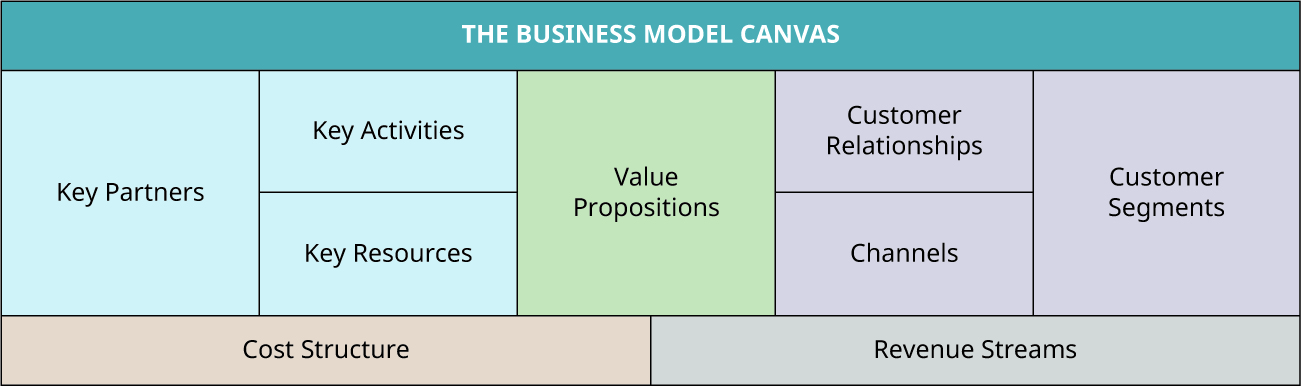
As developed by Osterwalder and Pigneur, the business model canvas has nine components, as shown in .
Osterwalder and Pigneur wrote Value Proposition Design as a sequel to Business Model Generation. Their value proposition canvas is a plug-in that complements the business model canvas, going in depth on activities such as encouraging entrepreneurs to address and tackle customer pains, gains, and jobs-to-be-done trigger questions, and designing pain relievers and gains. The complementary and accompanying activities and resources can be useful for a deeper dive into and understanding of customer value creation in the form of value proposition, although there are other approaches to conceptualizing your value proposition. For Christensen, the originator of the disruptive innovation and jobs-to-be-done theories, a value proposition is a product that helps customers do a job they’ve been trying to do more effectively, conveniently, and affordably.
Finding the intersection of your customers’ problems and your solutions is how you create a unique value proposition, according to the entrepreneur Ash Maurya, the author of Scaling Lean and Running Lean. In Running Lean, Maurya offers the following formula for creating an initial value proposition in the canvas, as shown in .

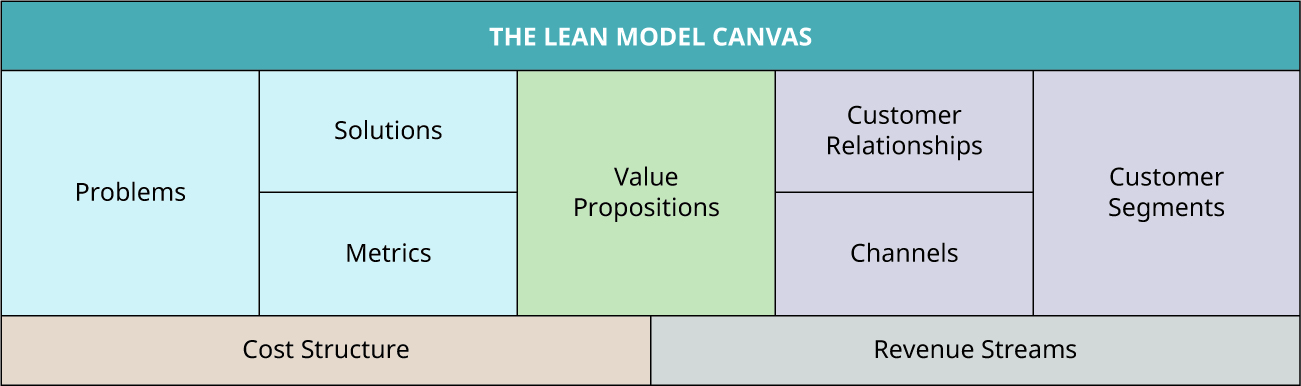
Maurya deviated from the standard business model canvas to create the lean canvas. It overlaps the business model canvas in five of the nine components: customer segments, value proposition, revenue streams, channels, and cost structure (]. Rather than addressing key partners, key activities, and key resources, the lean canvas helps you tackle problems, solutions, and key metrics instead.
While the business model canvas and the lean canvas are similar in format, there are differences in how they are used. It is generally accepted that the lean canvas model is a better fit for startups, whereas the business model canvas works well for already established businesses. The lean canvas is simpler; the business model canvas provides a more complete picture of a mature business.
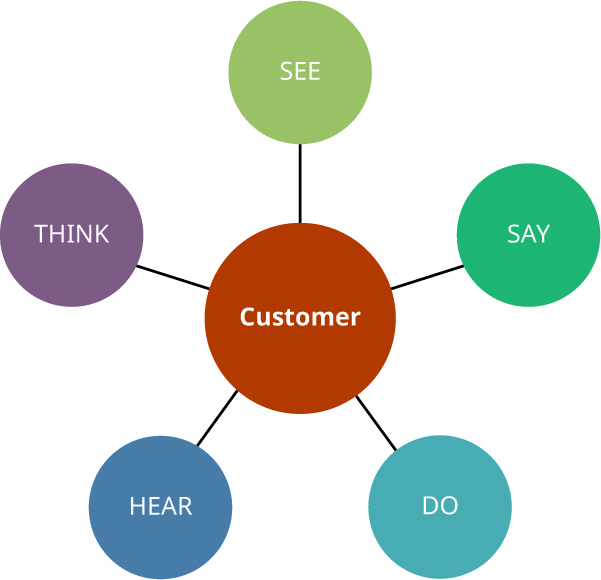
Both the business model canvas and the lean canvas are designed for constant iterations, allowing for multiple versions and changes throughout the entrepreneurial process. Part of that process involves customer discovery; thus, the canvases invoke customer-focused design. The target customer is integrated into the canvas from the start through the use of a customer empathy map and a number of design-thinking ideation activities.2 The customer empathy map is a portrayal of a target customer—the most promising candidate from a business’s customer segments—that explores the understanding of that person’s problems and needs (). Osterwalder and Pigneur used a customer empathy map as part of the design ideation phase of developing a business model canvas. There are differing versions of customer empathy maps, but most seek to answer common questions pertaining to the customer, such as:
- With whom are we empathizing?
- What do they need to do?
- What do they see?
- What do they say?
- What do they do?
- What do they hear?
- What do they think?
Phillips, Proctor & Gamble, Microsoft, and Yeti are examples of well-known companies that make use of customer empathy mapping because, according to the journal Entrepreneur, every transaction can be turned into a meaningful and valuable customer interaction.3 Once a company analyzes the results of customer mapping exercises, it may very well lead to new products that serve customer needs and/or wants.
For example, Philips used empathy mapping to detect a high level of fear in young patients immediately before an MRI medical procedure, so it invented a miniature version of the CAT scan equipment used in the procedure called the “kitten scanner” along with toy animal characters that were used to dispel the fear of MRIs among children. Proctor & Gamble created a new advertisement that was released for the 2012 Olympics visualizing the trials and tribulations of mothers raising young athletes, demonstrating Proctor and Gamble’s awareness that some of its customers wanted or needed empathy for the sacrifices they had made to help their children succeed. Likewise, Microsoft has attempted to demonstrate empathy with customers’ privacy concerns by developing an interactive website that explains not only how data is stolen but also how we can better protect our own data.4
On their company website, the now-famous Yeti cooler company publicly extols the value of empathy mapping, explaining that it leads to better products. Yeti doesn’t just create one on its own, it actually asks its clients to work with the company to create an empathy map.5 Thus, empathy mapping for Yeti is part of its product development process.
Customer empathy maps also strive to address customer pains (in this case, fears, frustrations, and anxieties) and gains (wants, needs, hopes, and dreams).6
Business Model Canvas7
As Osterwalder and Pigneur describe it, according to Media Innovation and Entrepreneurship, their business model canvas blocks include revenue streams, customer segments, value propositions, cost structures, channels, key activities, key partners, key resources, and customer relationships.
Early on, your greatest focus should be on the right side of the canvas because:
- These are, in many ways, the most critical aspects of starting a new venture (customer segments, value propositions, channels, and revenue streams).
- The most fluid (revenue streams, channels, and value propositions will likely differ for the differing customer segments and, as you iterate and adapt throughout the customer discovery process, could likely change).
- These follow a logical temporal order (there’s no need to focus on the costs of building a company if you won’t have customers).
In a follow-up to business model generation, the Strategyzer team created a second canvas, the value proposition canvas: https://www.strategyzer.com/canvas/value-proposition-canvas. The value proposition canvas is a new tool that pulls out the customer segment and value proposition blocks of the business model canvas, and encourages more in-depth exploration of those blocks to achieve a good fit between the two. The value proposition canvas tool looks at customer pains, gains and jobs to be done on the customer side and painkillers, gain creators, and products and services on the value proposition side.8
When you peel away the language used to describe business models, the early startup planning stages come down to a series of questions. When it comes to formulating a business model for a startup concept, another popular framework used in entrepreneurial circles is that of desirability-feasibility-viability ). This framework forces the entrepreneur to address broad questions about the startup concept:
- Desirability: How desirable is the product? Who will use it and why?
- Feasibility: How feasible is this idea? What are the costs of making it? How practical is the concept?
- Viability: Will this idea remain viable? How will it make money? How will it be sustained over time?
These questions then begin to connect to form a narrative about where the startup concept came from, whom it serves, why it’s needed, how it will make money, and how it will be sustained in the future.
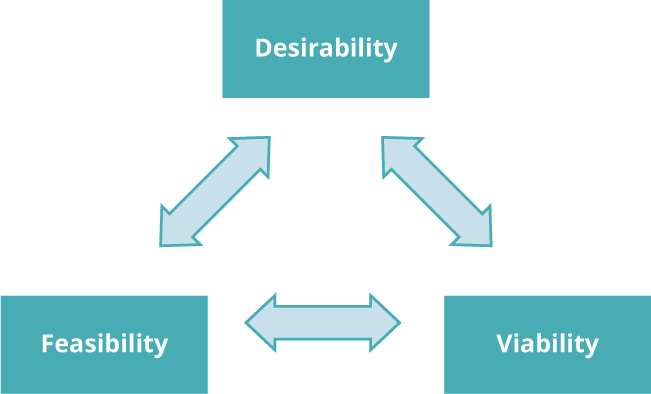
The value propositions, customer relationships, customer segments, and channels address the assumptions that will create customer value (desirability). The cost structure and revenue stream blocks are aimed at viability, or overcoming flawed business models. The key partners, key activities, and key resources are about execution and address feasibility. The risk of poor execution can undermine your assumptions that you chose the right infrastructure to execute your business model (feasibility). The risk of solving an irrelevant customer job (sometimes derisively labeled “a solution in search of a problem”) undercuts desirability in your business. The risk of a flawed business model would hamper the financial assumption that your business will earn more money than you spend (viability). Adaptability is about the assumption that you chose the right business model within the context of external factors such as technology change, competition, and regulation.
The business model canvas is not an exhaustive planning tool by any means.9,10 The risk of such external threats is not specifically addressed on the canvas blocks. The external threats not specifically covered by the canvas blocks can be designed for adaptability, that is, the business model canvas is a necessary but insufficient component of determining the viability of the business idea/concept. There are many elements not included in the canvas that entrepreneurs must address. Industry analysis, including a competitive analysis, for example, falls “off canvas” but is important nonetheless.
The Lean Model Canvas
The lean model canvas is Ash Maurya’s adaptation of the original business model canvas. As we noted earlier, gone are the customer relationships, key activities, key partners, and key resources blocks. Instead, a problem block is added, because as Maurya explains, “Most startups fail, not because they fail to build what they set out to build, but because they waste time, money and effort building the wrong product. I attribute a significant contributor to this failure to a lack of proper ‘problem understanding’ from the start.” Maurya next added a solution block to the lean model canvas, which corresponds well with features on a minimum viable product (MVP), which you will recall was covered in depth in Launch for Growth to Success. The lean model canvas also adds an “Unfair Advantage” block, similar to the block for competitive advantages or barriers to entry found in a business plan.11
Social Business Model Canvas
As you’ve noticed by now, the core canvas components are common throughout the various versions. Many of the blocks of the social business model canvas are similar to those used in the business model canvas and the lean model canvas.12 A few differences, as developed by Tandemic, focus on areas unique to social entrepreneurship ventures. For example, the new areas added include measures of what kind of social impact you are creating or developing, measures of surplus to address what happens with profits and where you intend to reinvest them, and measures of beneficiary segments, and social and customer value propositions.13 These could be measures such as the number of trees planted, number of refugees housed and fed, jobs created, or investments made—depending on the venture. Social impact looks at an organization’s social mission beyond the bottom line. Measurement can differ among social entrepreneurs, but in terms of the canvas, impact measures are an effort to establish quantifiable metrics.
Social impact can be hard to measure, but nonetheless, many social entrepreneurs aim for long-lasting impact.14 A 2014 report by the think tank, consultancy, and member network SustainAbility lists cooperative ownership, inclusive sourcing, and the “buy one, give one” model as three forms of social impact.15 In addition to the Tandemic social business model canvas, there are other versions of similar canvases used for social entrepreneurship. For instance, Osterwalder adapted the business model canvas for mission-driven organizations into a mission model canvas.16 There’s also a social lean canvas that adds purpose (explaining your reason for creating the venture in terms of social or environmental problems) and impact sections (describing the intended social or environmental impact).17
Summary
A business model, which is unique to a company, describes the rationale of how an organization creates, delivers, and captures values. A business model canvas is a popular tool used by entrepreneurs and intrapraneurs to map out and plan different components of a business model. The business model canvas addresses customer segments, customer relationships, channels (of distribution), revenue streams, value propositions, key partners, key activities, key resources, and cost structure. The lean model canvas and social business model canvas are derivations of the original business model canvas. They are designed more for tech/software/app endeavors and social entrepreneurial ventures, respectively.
Review Questions
A tool to identify your idealized target customer and develop a better understanding of their environment, behavior, concerns, and aspirations.
- jobs to be done
- business plan
- business model canvas
- empathy map
A ________ is a formal document that typically describes the business and industry, market strategies, sales potential, and competitive analysis, as well as the company’s long-term goals and objectives.
- business plan
- business model
- customer empathy map
- revenue model
Select the item that does not belong to the business model canvas.
- market size
- revenue streams
- value proposition
- customer segments
The finished story benefit formula of [end customer wants] + [specific period of time] + [address objections] is designed for what component of the lean model canvas?
- unfair advantage
- unique value proposition
- early adopters
- high concept pitch
How does the social business model canvas differ from the business model canvas and lean model canvas?
- is only used by nonprofit company
- doesn’t have customer block and investment block
- has profit block to talk about ways the company can makes more money
- has impact measure, surplus, beneficiary segments, and social and customer value propositions
Discussion Questions
What are the advantages of using a canvas to plan your business?
What types of businesses fit best with each respective canvas type?
Why would impact measures be important in social entrepreneurship ventures?
How do the arts relate to the business model creation process?
What are the advantages of using a lean model canvas compared to the traditional business model canvas?
Case Questions
As youth programs face severe budget cuts, many youth sports organizations respond by raising their fees, which shifts the costs to families. Good Sports was founded in 2003, to tackle this problem by providing new equipment, footwear, and apparel to those most in need. The organization’s addressable markets include children ages five to eighteen living in low-income households, as defined by poverty data, and participating in youth sports in top fifty metropolitan service areas. This Boston-based organization has plans to expand from its three existing markets in Dallas, Chicago, and Boston to seven total markets by 2023 with a goal to serve 600,000 kids by that target date.
- What would a customer empathy map look like for Good Sports’ target user? What about its target customer segment? Would it or should it differ in differing markets? Is the Boston area user any different from say, an Atlanta, user?
- Given its social mission, what are some impact measures Good Sports could use to gauge success and impact?
DoSomething.Org is a “global movement for good” among 6 million young people, transforming their communities across the United States and in 131 countries worldwide. This nonprofit organization constantly holds cause-based campaigns, ranging from receiving over 1 million pairs of donated jeans from teens to clothe homeless youth to cleaning up 3.7 million cigarette butts through its Get the Filter Out initiative. A past campaign, “Don’t Be a Sucker,” addressed the problem of Americans losing $5.8 billion annually and producing 8.7 billion pounds of carbon pollution by leaving unused devices plugged in. The campaign sought to slay those “energy vampires” not in use by having users unplug equipment and post a sticky note next to the outlet to remind others not to let them suck the energy dry. Further research the problem, solution and this campaign and answer the following:
- Identify what social impact(s) the campaign addressed.
- What impact measures could the campaign assess?
- Could a viable business be created around this problem?
In recent years, the entrepreneurial educator and author Steve Blank began applying lean startup principles to various US governmental agencies. Through a Hacking for Diplomacy course, students at Stanford University began tackling problems for the Department of State. A former US ambassador to the United Nations, a State Department representative to Silicon Valley and senior advisor for technology and innovation, a retired US Army colonel, and other entrepreneurial educators joined Blank in applying lean startup methods to State Department issues. Then-Secretary of State John Kerry even visited the Stanford students and said he was looking forward to the solutions students develop during the ten weeks. One project that emerged was from a group calling themselves Team Space Evaders. The team was tasked with working on the problem of satellite collision. Members charted satellite positioning data and explored how information about potential collision was shared by commercial operators and governmental entities ranging from the Federal Aviation Administration to the Department of Defense.
- Apply the lean startup methodology to identify potential customer segments and problems and solutions that students such as yourself could identify for the State Department on the issue of satellite collision.
- What would a unique value proposition for a State Department solution to this issue be? How could a high-level concept pitch work when selling the concept within the State Department?
Incorporated in 2003, Tesla declared in its mission statement that its goal is “to accelerate the world’s transition to sustainable transport,”18 and it has proven itself a leader in green technology in the automotive sector. In its initial business plan, by co-founder Martin Eberhard, the electric sports car company promised to provide the value of a high-end sports car at a lower cost to the customer and a lower environmental cost to the planet. Electric vehicles were seen as inferior to standard vehicles prior to Tesla’s innovations in creating powerful cars that piqued consumer desire. The generic automotive manufacturing business model relies on collaborative manufacturing with industry partners and a distribution model dependent on third parties. Standard cars are aimed at people and businesses with individual transportation needs. This model is commercially viable because of custom-equipped add-on features to the per-vehicle prices.
- Tesla’s business model is different. Identify at least three ways in which the Tesla model differs from the traditional automotive business model.
Suggested Resources
Business model canvas and resources: Strategyzer.com
Lean canvas and associated resources: Leanstack.com
Social business model canvas and related resources: Socialbusinessmodelcanvas.com
Christopher Steiner and Brett Nelson. “The 20 Most Important Questions in Business.” Forbes. June 17, 2010: https://www.forbes.com/2010/06/17/most-important-questions-in-business-entrepreneurs-management-small-business.html#7975585a3e93
Footnotes
- Alexander Osterwalder and Yves Pigneur. Business Model Generation: A Handbook for Visionaries, Game Changers, and Challengers. Hoboken, NJ: Wiley, 2010. ↩
- Charlene Perrin. “Create A Customer Empathy Map in 6 Easy Steps!” Conceptboard. March 28, 2019. https://conceptboard.com/blog/create-a-customer-empathy-map-in-6-easy-steps/ ↩
- Vineet Arya. “How to Infuse Empathy in Your Marketing?” Entrepreneur. June 28, 2019. https://www.entrepreneur.com/article/335987 ↩
- Vineet Arya. “How to Infuse Empathy in Your Marketing?” Entrepreneur. June 28, 2019. https://www.entrepreneur.com/article/335987 ↩
- Mike Godlewski. “The Secret to Knowing What a Client Is Thinking? Empathy Maps.” Yeti. February 8, 2016. https://yeti.co/blog/the-secret-to-knowing-what-your-client-is-thinking-empathy-maps/ ↩
- Germán Coppola. “What Is an Empathy Map, and Why Is It Valuable for Your Business?” Medium. November 28, 2017. https://medium.com/swlh/what-is-an-empathy-map-and-why-is-it-valuable-for-your-business-14236be4fdf4 ↩
- This material is based on original work by Geoffrey Graybeal and produced with support from the Rebus Community. The original is freely available under the terms of the CC BY 4.0 license at https://press.rebus.community/media-innovation-and-entrepreneurship/. ↩
- Michelle Ferrier and Elizabeth Mays. Media Innovation and Entrepreneurship. The Rebus Foundation, 2017. https://press.rebus.community/media-innovation-and-entrepreneurship/. ↩
- Jennifer van der Meer. "Do You Suffer from Value Proposition Confusion?" Linkedin. October 19, 2016. https://www.linkedin.com/pulse/do-you-suffer-from-value-proposition-confusion-jennifer-van-der-meer/ ↩
- “The Value Proposition Canvas.” Strategyzer. n.d. https://strategyzer.com/canvas/value-proposition-canvas ↩
- Ash Maurya. “Why Lean Canvas vs Business Model Canvas?” Medium. February 27, 2012. https://blog.leanstack.com/why-lean-canvas-vs-business-model-canvas-af62c0f250f0 ↩
- "Social Business Model Canvas.” Business Model Toolbox. 2013. https://bmtoolbox.net/tools/social-business-model-canvas/ ↩
- “The Business Model Canvas Reinvented for Social Business.” Tandemic. n.d. http://www.socialbusinessmodelcanvas.com ↩
- Ayse Guclu, J. Gregory Dees, and Beth Battle Anderson. “The Process of Social Entrepreneurship: Creating Opportunities Worthy of Serious Pursuit.” Duke/Fuqua case. 2002. https://centers.fuqua.duke.edu/case/knowledge_items/the-process-of-social-entrepreneurship-creating-opportunities-worthy-of-serious-pursuit/ ↩
- Lindsay Clinton and Ryan Whisnant. “Model Behavior: 20 Business Model Innovations for Sustainability.” SustainAbility. February 2014. https://sustainability.com/wp-content/uploads/2016/07/model_behavior_20_business_model_innovations_for_sustainability.pdf ↩
- Alexander Osterwalder. “The Mission Model Canvas: An Adapted Business Model Canvas for Mission-Driven Organizations.” Strategyzer. February 25, 2016. https://blog.strategyzer.com/posts/2016/2/24/the-mission-model-canvas-an-adapted-business-model-canvas-for-mission-driven-organizations ↩
- Social Lean Canvas. n.d. https://socialleancanvas.com/ ↩
- In 2016, it was changed from “sustainable transport” to “sustainable energy.” https://www.tesla.com/about ↩