Developing Ideas, Innovations, and Inventions
Learning Objectives
By the end of this section, you will be able to:
- Describe and apply the five stages of creativity
- Discuss innovation as a system for problem solving and much more
- Outline the sequence of steps in developing an invention
View this section's JSON
{
"id": "m71134",
"doc_class": "",
"title": "Developing Ideas, Innovations, and Inventions",
"objectives": [
"Describe and apply the five stages of creativity",
"Discuss innovation as a system for problem solving and much more",
"Outline the sequence of steps in developing an invention"
],
"figures": [
{
"src": "OSX_Eship_04_02_FiveStages.jpg",
"alt": "The five stages of creativity are preparation, incubation, insight, evaluation, and elaboration.",
"caption": "These are the five stages of creativity, according to Graham Wallas in <em>The Art of Thought</em>.<span class=\"footnote\">Eugene Sadler-Smith. “Wallas’ Four-Stage Model of the Creative Process: More Than Meets the Eye?” <em>Creativity Research Journal</em> 27, no. 4 (2015): 342–352.</span> (attribution: Copyright Rice University, OpenStax, under CC BY NC-SA 4.0 license)"
},
{
"src": "OSX_Eship_04_02_InnovPyr.jpg",
"alt": "The innovation pyramid has problem solving at the base, then prevention, then continuous improvement, and future of enterprise at the top.",
"caption": "The innovation pyramid is one multileveled approach to innovation. (attribution: Copyright Rice University, OpenStax, under CC BY NC-SA 4.0 license)"
},
{
"src": "OSX_Eship_04_03_DICEE.jpg",
"alt": "Innovative products are deep (anticipating users’ needs before they have them), indulgent (having a depth of quality and richness of experience), complete (including services wrapped around a product), elegant (having an intuitive design that immediately makes sense), and emotive (evoking an intended emotion and demand to be admired).",
"caption": "Innovative products are deep, indulgent, complete, elegant, and emotive. (attribution: Copyright Rice University, OpenStax, under CC BY NC-SA 4.0 license)"
},
{
"src": "OSX_Eship_04_02_JGutenberg.jpg",
"alt": "(a) Drawing of men working on a printing press. (b) Photo of movable type for a printing press.",
"caption": "Gutenberg’s invention of movable type was an important innovation in printing. (credit (a): modification of “Printer in 1568-ce” by “Parhamr”/Wikimedia Commons, Public Domain; credit (b): modification of “Metal movable type” by Willi Heidelbach/Wikimedia Commons, CC BY 2.5)"
},
{
"src": "OSX_Eship_04_03_FiveSteps.jpg",
"alt": "The five steps for developing an invention are educate yourself, stay organized, conduct market research, conduct patent research, and develop a prototype.",
"caption": "These are the five steps for developing an invention, according to Sourcify. (attribution: Copyright Rice University, OpenStax, under CC BY NC-SA 4.0 license)"
}
],
"tokens": 8143,
"blocks": [
{
"anchor": "m71134-b1",
"trail": [
"Learning Objectives"
],
"heading": "Learning Objectives",
"html": "<section class=\"learning-objectives\"><h2>Learning Objectives</h2><p>By the end of this section, you will be able to:</p><ul><li>Describe and apply the five stages of creativity</li><li>Discuss innovation as a system for problem solving and much more</li><li>Outline the sequence of steps in developing an invention</li></ul></section>",
"text": "Learning Objectives\nBy the end of this section, you will be able to:\nDescribe and apply the five stages of creativity\nDiscuss innovation as a system for problem solving and much more\nOutline the sequence of steps in developing an invention",
"tokens": 59
},
{
"anchor": "m71134-b2",
"trail": [],
"heading": null,
"html": "<p>The previous section defined creativity, innovation, and invention, and provided examples. You might think of creativity as raw; innovation as transforming creativity into a functional purpose, often meant to eradicate a pain point or to fulfill a need; and invention as a creation that leaves a lasting impact. In this section, you will learn about processes designed to help you apply knowledge from the previous section.</p>",
"text": "The previous section defined creativity, innovation, and invention, and provided examples. You might think of creativity as raw; innovation as transforming creativity into a functional purpose, often meant to eradicate a pain point or to fulfill a need; and invention as a creation that leaves a lasting impact. In this section, you will learn about processes designed to help you apply knowledge from the previous section.",
"tokens": 105
},
{
"anchor": "m71134-b3",
"trail": [
"The Creative Process: The Five Stages of Creativity"
],
"heading": "The Creative Process: The Five Stages of Creativity",
"html": "<section class=\"\"><h2>The Creative Process: The Five Stages of Creativity</h2><p>Raw creativity and an affinity for lateral thinking may be innate, but creative people must refine these skills in order to become masters in their respective fields. They practice in order to apply their skills readily and consistently, and to integrate them with other thought processes and emotions. Anyone can improve in creative efforts with practice. For our purposes, practice is a model for applied creativity that is derived from an entrepreneurial approach ().<sup class=\"footnote-ref\"><a id=\"fnref1\" href=\"#fn1\" aria-label=\"Footnote 1\">1</a></sup> It requires:</p><ol><li>Preparation</li><li>Incubation</li><li>Insight</li><li>Evaluation</li><li>Elaboration</li></ol><figure><img src=\"media/OSX_Eship_04_02_FiveStages.jpg\" alt=\"The five stages of creativity are preparation, incubation, insight, evaluation, and elaboration.\"><figcaption>These are the five stages of creativity, according to Graham Wallas in <em>The Art of Thought</em>.<sup class=\"footnote-ref\"><a id=\"fnref2\" href=\"#fn2\" aria-label=\"Footnote 2\">2</a></sup> (attribution: Copyright Rice University, OpenStax, under CC BY NC-SA 4.0 license)</figcaption><span class=\"figure-alt\">The five stages of creativity are preparation, incubation, insight, evaluation, and elaboration.</span></figure><section class=\"\"><h3>Preparation</h3><p><dfn><em>Preparation</em></dfn> involves investigating a chosen field of interest, opening your mind, and becoming immersed in materials, mindset, and meaning. If you have ever tried to produce something creative without first absorbing relevant information and observing skilled practitioners at work, then you understand how difficult it is. This base of knowledge and experience mixed with an ability to integrate new thoughts and practices can help you sift through the ideas quicker. However, relying too heavily on prior knowledge can restrict the creative process. When you immerse yourself in a creative practice, you make use of the products or the materials of others’ creativity. For example, a video-game designer plays different types of video games on different consoles, computers, and online in networks. They may play alone, with friends in collaboration, or in competition. Consuming the products in a field gives you a sense of what is possible and indicates boundaries that you may attempt to push with your own creative work. Preparation broadens your mind and lets you study the products, practice, and culture in a field. It is also a time for goal setting. Whether your chosen field is directly related to art and design, such as publishing, or involves human-centric design, which includes all sorts of software and product design efforts, you need a period of open-minded reception to ideas. Repetitive practice is also part of the preparation stage, so that you can understand the current field of production and become aware of best practices, whether or not you are currently capable of matching them. During the preparation stage, you can begin to see how other creative people put meaning into their products, and you can establish benchmarks against which to measure your own creative work.</p></section><section class=\"\"><h3>Incubation</h3><p><dfn><em>Incubation</em></dfn> refers to giving yourself, and your subconscious mind in particular, time to incorporate what you learned and practiced in the preparation stage. Incubation involves the absence of practice. It may look to an outsider as though you are at rest, but your mind is at work. A change of environment is key to incubating ideas.<sup class=\"footnote-ref\"><a id=\"fnref3\" href=\"#fn3\" aria-label=\"Footnote 3\">3</a></sup> A new environment allows you to receive stimuli other than those directly associated with the creative problem you are working on. It could be as simple as taking a walk or going to a new coffee shop to allow your mind to wander and take in the information you gathered in the previous stage. <dfn>Mozart</dfn> stated, “When I am, as it were, completely myself, entirely alone, and of good cheer—say, traveling in a carriage, or walking after a good meal, or during the night when I cannot sleep; it is on such occasions that my ideas flow best and most abundantly.”<sup class=\"footnote-ref\"><a id=\"fnref4\" href=\"#fn4\" aria-label=\"Footnote 4\">4</a></sup> Incubation allows your mind to integrate your creative problem with your stored memories and with other thoughts or emotions you might have. This simply is not possible to do when you are consciously fixated on the creative problem and related tasks and practice.</p><p>Incubation can take a short or a long time, and you can perform other activities while allowing this process to take place. One theory about incubation is that it takes language out of the thought process. If you are not working to apply words to your creative problems and interests, you can free your mind to make associations that go deeper, so to speak, than language.<sup class=\"footnote-ref\"><a id=\"fnref5\" href=\"#fn5\" aria-label=\"Footnote 5\">5</a></sup> Patiently waiting for incubation to work is quite difficult. Many creative and innovative people develop hobbies involving physical activity to keep their minds busy while they allow ideas to incubate.</p></section><section class=\"\"><h3>Insight</h3><p><dfn><em>Insight</em></dfn> or “illumination” is a term for the “aha!” moment—when the solution to a creative problem suddenly becomes readily accessible to your conscious mind. The “aha!” moment has been observed in literature, in history, and in cognitive studies of creativity.<sup class=\"footnote-ref\"><a id=\"fnref6\" href=\"#fn6\" aria-label=\"Footnote 6\">6</a></sup> Insights may come all at once or in increments. They are not easily understood because, by their very nature, they are difficult to isolate in research and experimental settings. For the creative entrepreneur, however, insights are a delight. An insight is the fleeting time when your preparation, practice, and period of incubation coalesce into a stroke of genius. Whether the illumination is the solution to a seemingly impossible problem or the creation of a particularly clever melody or turn of phrase, creative people often consider it a highlight in their lives. For an entrepreneur, an insight holds the promise of success and the potential to help massive numbers of people overcome a pain point or problem. Not every insight will have a global impact, but coming up with a solution that your subconscious mind has been working on for some time is a real joy.</p></section><section class=\"\"><h3>Evaluation</h3><p><dfn><em>Evaluation</em></dfn> is the purposeful examination of ideas. You will want to compare your insights with the products and ideas you encountered during preparation. You also will want to compare your ideas and product prototypes to the goals you set out for yourself during the preparation phase. Creative professionals will often invite others to critique their work at this stage. Because evaluation is specific to the expectations, best practices, and existing product leaders in each field, evaluation can take on many forms. You are looking for assurance that your standards for evaluation are appropriate. Judge yourself fairly, even as you apply strict criteria and the well-developed sense of taste you acquired during the preparation phase. For example, you might choose to interview a few customers in your target demographics for your product or service. The primary objective is to understand the customer perspective and the extent to which your idea aligns with their position.</p></section><section class=\"\"><h3>Elaboration</h3><p>The last stage in the creative process is <dfn><em>elaboration</em></dfn>, that is, actual production. Elaboration can involve the release of a <dfn>minimum viable product (MVP)</dfn>. This version of your invention may not be polished or complete, but it should function well enough that you can begin to market it while still elaborating on it in an iterative development process. Elaboration also can involve the development and launch of a prototype, the release of a software beta, or the production of some piece of artistic work for sale. Many consumer-product companies, such as <dfn>Johnson & Johnson</dfn> or <dfn>Procter & Gamble</dfn>, will establish a small test market to garner feedback and evaluations of new products from actual customers. These insights can give the company valuable information that can help make the product or service as successful as possible.</p><p>At this stage what matters most in the entrepreneurial creative process is that the work becomes available to the public so that they have a chance to adopt it.</p><aside class=\"note note-link-to-learning\"><p class=\"note-label\">Link to learning</p><p>Test marketing can reveal much information about the potential users of a product. Visit the <a href=\"https://openstax.org/l/52TestMarkets\" rel=\"noopener\" target=\"_blank\">Drive Research site on test markets</a> for more information.</p></aside></section></section>",
"text": "The Creative Process: The Five Stages of Creativity\nRaw creativity and an affinity for lateral thinking may be innate, but creative people must refine these skills in order to become masters in their respective fields. They practice in order to apply their skills readily and consistently, and to integrate them with other thought processes and emotions. Anyone can improve in creative efforts with practice. For our purposes, practice is a model for applied creativity that is derived from an entrepreneurial approach ().1 It requires:\nPreparation\nIncubation\nInsight\nEvaluation\nElaboration\n [figure: The five stages of creativity are preparation, incubation, insight, evaluation, and elaboration.] These are the five stages of creativity, according to Graham Wallas in The Art of Thought.2 (attribution: Copyright Rice University, OpenStax, under CC BY NC-SA 4.0 license)\nThe five stages of creativity are preparation, incubation, insight, evaluation, and elaboration.Preparation\nPreparation involves investigating a chosen field of interest, opening your mind, and becoming immersed in materials, mindset, and meaning. If you have ever tried to produce something creative without first absorbing relevant information and observing skilled practitioners at work, then you understand how difficult it is. This base of knowledge and experience mixed with an ability to integrate new thoughts and practices can help you sift through the ideas quicker. However, relying too heavily on prior knowledge can restrict the creative process. When you immerse yourself in a creative practice, you make use of the products or the materials of others’ creativity. For example, a video-game designer plays different types of video games on different consoles, computers, and online in networks. They may play alone, with friends in collaboration, or in competition. Consuming the products in a field gives you a sense of what is possible and indicates boundaries that you may attempt to push with your own creative work. Preparation broadens your mind and lets you study the products, practice, and culture in a field. It is also a time for goal setting. Whether your chosen field is directly related to art and design, such as publishing, or involves human-centric design, which includes all sorts of software and product design efforts, you need a period of open-minded reception to ideas. Repetitive practice is also part of the preparation stage, so that you can understand the current field of production and become aware of best practices, whether or not you are currently capable of matching them. During the preparation stage, you can begin to see how other creative people put meaning into their products, and you can establish benchmarks against which to measure your own creative work.\nIncubation\nIncubation refers to giving yourself, and your subconscious mind in particular, time to incorporate what you learned and practiced in the preparation stage. Incubation involves the absence of practice. It may look to an outsider as though you are at rest, but your mind is at work. A change of environment is key to incubating ideas.3 A new environment allows you to receive stimuli other than those directly associated with the creative problem you are working on. It could be as simple as taking a walk or going to a new coffee shop to allow your mind to wander and take in the information you gathered in the previous stage. Mozart stated, “When I am, as it were, completely myself, entirely alone, and of good cheer—say, traveling in a carriage, or walking after a good meal, or during the night when I cannot sleep; it is on such occasions that my ideas flow best and most abundantly.”4 Incubation allows your mind to integrate your creative problem with your stored memories and with other thoughts or emotions you might have. This simply is not possible to do when you are consciously fixated on the creative problem and related tasks and practice.\nIncubation can take a short or a long time, and you can perform other activities while allowing this process to take place. One theory about incubation is that it takes language out of the thought process. If you are not working to apply words to your creative problems and interests, you can free your mind to make associations that go deeper, so to speak, than language.5 Patiently waiting for incubation to work is quite difficult. Many creative and innovative people develop hobbies involving physical activity to keep their minds busy while they allow ideas to incubate.\nInsight\nInsight or “illumination” is a term for the “aha!” moment—when the solution to a creative problem suddenly becomes readily accessible to your conscious mind. The “aha!” moment has been observed in literature, in history, and in cognitive studies of creativity.6 Insights may come all at once or in increments. They are not easily understood because, by their very nature, they are difficult to isolate in research and experimental settings. For the creative entrepreneur, however, insights are a delight. An insight is the fleeting time when your preparation, practice, and period of incubation coalesce into a stroke of genius. Whether the illumination is the solution to a seemingly impossible problem or the creation of a particularly clever melody or turn of phrase, creative people often consider it a highlight in their lives. For an entrepreneur, an insight holds the promise of success and the potential to help massive numbers of people overcome a pain point or problem. Not every insight will have a global impact, but coming up with a solution that your subconscious mind has been working on for some time is a real joy.\nEvaluation\nEvaluation is the purposeful examination of ideas. You will want to compare your insights with the products and ideas you encountered during preparation. You also will want to compare your ideas and product prototypes to the goals you set out for yourself during the preparation phase. Creative professionals will often invite others to critique their work at this stage. Because evaluation is specific to the expectations, best practices, and existing product leaders in each field, evaluation can take on many forms. You are looking for assurance that your standards for evaluation are appropriate. Judge yourself fairly, even as you apply strict criteria and the well-developed sense of taste you acquired during the preparation phase. For example, you might choose to interview a few customers in your target demographics for your product or service. The primary objective is to understand the customer perspective and the extent to which your idea aligns with their position.\nElaboration\nThe last stage in the creative process is elaboration, that is, actual production. Elaboration can involve the release of a minimum viable product (MVP). This version of your invention may not be polished or complete, but it should function well enough that you can begin to market it while still elaborating on it in an iterative development process. Elaboration also can involve the development and launch of a prototype, the release of a software beta, or the production of some piece of artistic work for sale. Many consumer-product companies, such as Johnson & Johnson or Procter & Gamble, will establish a small test market to garner feedback and evaluations of new products from actual customers. These insights can give the company valuable information that can help make the product or service as successful as possible.\nAt this stage what matters most in the entrepreneurial creative process is that the work becomes available to the public so that they have a chance to adopt it.\nLink to learning\nTest marketing can reveal much information about the potential users of a product. Visit the Drive Research site on test markets for more information.",
"tokens": 1957
},
{
"anchor": "m71134-b4",
"trail": [
"Innovation as More than Problem Solving"
],
"heading": "Innovation as More than Problem Solving",
"html": "<section class=\"\"><h2>Innovation as More than Problem Solving</h2><p>Innovative entrepreneurs are essentially problem solvers, but this level of innovation—identifying a pain point and working to overcome it—is only one in a series of innovative steps. In the influential business publication <em>Forbes</em>, the entrepreneur Larry <dfn>Myler</dfn> notes that problem solving is inherently reactive.<sup class=\"footnote-ref\"><a id=\"fnref7\" href=\"#fn7\" aria-label=\"Footnote 7\">7</a></sup> That is, you have to wait for a problem to happen in order to recognize the need to solve the problem. Solving problems is an important part of the practice of innovation, but to elevate the practice and the field, innovators should anticipate problems and strive to prevent them. In many cases, they create systems for continuous improvement, which Myler notes may involve “breaking” previous systems that seem to function perfectly well. Striving for continuous improvement helps innovators stay ahead of market changes. Thus, they have products ready for emerging markets, rather than developing projects that chase change, which can occur constantly in some tech-driven fields. One issue with building a system for constant improvement is that you are in essence creating problems in order to solve them, which goes against established culture in many firms. Innovators look for organizations that can handle purposeful innovation, or they attempt to start them. Some innovators even have the goal of innovating far ahead into the future, beyond current capacities. In order to do this, Myler suggests bringing people of disparate experiential backgrounds with different expertise together. These relationships are not guarantees of successful innovation, but such groups can generate ideas independent of institutional inertia. Thus, innovators are problem solvers but also can work with forms of problem creation and problem imagination. They tackle problems that have yet to exist in order to solve them ahead of time.</p><p>Let’s examine one multilevel approach to innovation (). The base is problem solving. The next level up in the pyramid, so to speak, is prevention. The next level is working toward continuous improvement, and at the top of such efforts is creating the capacity to direct the future of your industry or multiple industries so that you can weather disruption in your career or even to create it.</p><figure><img src=\"media/OSX_Eship_04_02_InnovPyr.jpg\" alt=\"The innovation pyramid has problem solving at the base, then prevention, then continuous improvement, and future of enterprise at the top.\"><figcaption>The innovation pyramid is one multileveled approach to innovation. (attribution: Copyright Rice University, OpenStax, under CC BY NC-SA 4.0 license)</figcaption><span class=\"figure-alt\">The innovation pyramid has problem solving at the base, then prevention, then continuous improvement, and future of enterprise at the top.</span></figure><p>Even if you are not interested in shaping the future of whole industry sectors, developing future-focused innovation practices still is a good idea. It will help you prepare for disruption. The pace of technological change is such that workers at all levels need to be prepared to innovate. Innovation leaders, such as the marketing guru Guy <dfn>Kawasaki</dfn>, have built on psychological principles to suggest new ways to approach innovation. According to Kawasaki, innovative products include five key qualities: deep, indulgent, complete, elegant, and emotive—<dfn>DICEE</dfn> ().<sup class=\"footnote-ref\"><a id=\"fnref8\" href=\"#fn8\" aria-label=\"Footnote 8\">8</a></sup> You can strive to infuse individual innovations with these qualities in practical ways.</p><figure><img src=\"media/OSX_Eship_04_03_DICEE.jpg\" alt=\"Innovative products are deep (anticipating users’ needs before they have them), indulgent (having a depth of quality and richness of experience), complete (including services wrapped around a product), elegant (having an intuitive design that immediately makes sense), and emotive (evoking an intended emotion and demand to be admired).\"><figcaption>Innovative products are deep, indulgent, complete, elegant, and emotive. (attribution: Copyright Rice University, OpenStax, under CC BY NC-SA 4.0 license)</figcaption><span class=\"figure-alt\">Innovative products are deep (anticipating users’ needs before they have them), indulgent (having a depth of quality and richness of experience), complete (including services wrapped around a product), elegant (having an intuitive design that immediately makes sense), and emotive (evoking an intended emotion and demand to be admired).</span></figure><section class=\"\"><h3>Deep</h3><p><em>Deep</em> products are based on the logic of innovation that we’ve just established and anticipate users’ needs before they have them. These types of innovations often have masterful designs that are intuitive for new users while still being capable of completing complex tasks. <dfn>Adobe</dfn> is an innovative corporation working in several fields, such as software, marketing, and artificial intelligence. Adobe often creates software applications with basic functions that are easily accessible to new users but that also enable experienced users to innovate on their own.<sup class=\"footnote-ref\"><a id=\"fnref9\" href=\"#fn9\" aria-label=\"Footnote 9\">9</a></sup> Creating a platform for innovation is a hallmark of deep, forward-thinking innovation.</p></section><section class=\"\"><h3>Indulgent</h3><p>Innovations with lasting power engage users in ways that make them feel special for having purchased the product or for having found the service. <em>Indulgence</em> refers to a depth of quality that does not come from being the fastest solution to a problem. Indulgence may even sound like a negative trait. In humans, it certainly can be, but for someone using an innovative product, feeling indulgent can relate to a richness of experience with the <dfn>user interface</dfn> (UI). The UI of a product, particularly a software product, is what the user sees and interacts with. A feeling of indulgence imbues your product with a sense of value and durability that reassures users and encourages them to use your product confidently.</p></section><section class=\"\"><h3>Complete</h3><p>Kawasaki’s vision of a <em>complete</em> product includes the services wrapped around it and underlying it such that users understand the product well enough to be comfortable using it. Information about how it works and how it is meant to work is readily available. Thus, product innovation must include marketing and other communication efforts. For Kawasaki, this builds the “<dfn>total user experience</dfn>.”<sup class=\"footnote-ref\"><a id=\"fnref10\" href=\"#fn10\" aria-label=\"Footnote 10\">10</a></sup> If you truly have solved a problem in the marketplace, users will understand what that problem is and how your product and related services deliver.</p></section><section class=\"\"><h3>Elegant</h3><p><em>Elegance</em> also is part of a product’s UI. It refers to intuitive design that immediately makes sense to consumers. Elegance conveys more information with fewer words. Elegant design is not afraid of negative space or of the occasional pause. Elegant innovations solve problems without creating new ones. For Kawasaki, elegance is the difference between a pragmatic, good innovation and something great.</p></section><section class=\"\"><h3>Emotive</h3><p><em>Emotive</em> innovations evoke the intended emotion and demand to be admired and shared. In other words, truly great innovations create fandoms, not just consumer bases. You can’t force people to love your product, but you can give them experiences that create a sense of excitement and anticipation of what you might come up with next.</p></section></section>",
"text": "Innovation as More than Problem Solving\nInnovative entrepreneurs are essentially problem solvers, but this level of innovation—identifying a pain point and working to overcome it—is only one in a series of innovative steps. In the influential business publication Forbes, the entrepreneur Larry Myler notes that problem solving is inherently reactive.7 That is, you have to wait for a problem to happen in order to recognize the need to solve the problem. Solving problems is an important part of the practice of innovation, but to elevate the practice and the field, innovators should anticipate problems and strive to prevent them. In many cases, they create systems for continuous improvement, which Myler notes may involve “breaking” previous systems that seem to function perfectly well. Striving for continuous improvement helps innovators stay ahead of market changes. Thus, they have products ready for emerging markets, rather than developing projects that chase change, which can occur constantly in some tech-driven fields. One issue with building a system for constant improvement is that you are in essence creating problems in order to solve them, which goes against established culture in many firms. Innovators look for organizations that can handle purposeful innovation, or they attempt to start them. Some innovators even have the goal of innovating far ahead into the future, beyond current capacities. In order to do this, Myler suggests bringing people of disparate experiential backgrounds with different expertise together. These relationships are not guarantees of successful innovation, but such groups can generate ideas independent of institutional inertia. Thus, innovators are problem solvers but also can work with forms of problem creation and problem imagination. They tackle problems that have yet to exist in order to solve them ahead of time.\nLet’s examine one multilevel approach to innovation (). The base is problem solving. The next level up in the pyramid, so to speak, is prevention. The next level is working toward continuous improvement, and at the top of such efforts is creating the capacity to direct the future of your industry or multiple industries so that you can weather disruption in your career or even to create it.\n [figure: The innovation pyramid has problem solving at the base, then prevention, then continuous improvement, and future of enterprise at the top.] The innovation pyramid is one multileveled approach to innovation. (attribution: Copyright Rice University, OpenStax, under CC BY NC-SA 4.0 license)\nThe innovation pyramid has problem solving at the base, then prevention, then continuous improvement, and future of enterprise at the top.Even if you are not interested in shaping the future of whole industry sectors, developing future-focused innovation practices still is a good idea. It will help you prepare for disruption. The pace of technological change is such that workers at all levels need to be prepared to innovate. Innovation leaders, such as the marketing guru Guy Kawasaki, have built on psychological principles to suggest new ways to approach innovation. According to Kawasaki, innovative products include five key qualities: deep, indulgent, complete, elegant, and emotive—DICEE ().8 You can strive to infuse individual innovations with these qualities in practical ways.\n [figure: Innovative products are deep (anticipating users’ needs before they have them), indulgent (having a depth of quality and richness of experience), complete (including services wrapped around a product), elegant (having an intuitive design that immediately makes sense), and emotive (evoking an intended emotion and demand to be admired).] Innovative products are deep, indulgent, complete, elegant, and emotive. (attribution: Copyright Rice University, OpenStax, under CC BY NC-SA 4.0 license)\nInnovative products are deep (anticipating users’ needs before they have them), indulgent (having a depth of quality and richness of experience), complete (including services wrapped around a product), elegant (having an intuitive design that immediately makes sense), and emotive (evoking an intended emotion and demand to be admired).Deep\nDeep products are based on the logic of innovation that we’ve just established and anticipate users’ needs before they have them. These types of innovations often have masterful designs that are intuitive for new users while still being capable of completing complex tasks. Adobe is an innovative corporation working in several fields, such as software, marketing, and artificial intelligence. Adobe often creates software applications with basic functions that are easily accessible to new users but that also enable experienced users to innovate on their own.9 Creating a platform for innovation is a hallmark of deep, forward-thinking innovation.\nIndulgent\nInnovations with lasting power engage users in ways that make them feel special for having purchased the product or for having found the service. Indulgence refers to a depth of quality that does not come from being the fastest solution to a problem. Indulgence may even sound like a negative trait. In humans, it certainly can be, but for someone using an innovative product, feeling indulgent can relate to a richness of experience with the user interface (UI). The UI of a product, particularly a software product, is what the user sees and interacts with. A feeling of indulgence imbues your product with a sense of value and durability that reassures users and encourages them to use your product confidently.\nComplete\nKawasaki’s vision of a complete product includes the services wrapped around it and underlying it such that users understand the product well enough to be comfortable using it. Information about how it works and how it is meant to work is readily available. Thus, product innovation must include marketing and other communication efforts. For Kawasaki, this builds the “total user experience.”10 If you truly have solved a problem in the marketplace, users will understand what that problem is and how your product and related services deliver.\nElegant\nElegance also is part of a product’s UI. It refers to intuitive design that immediately makes sense to consumers. Elegance conveys more information with fewer words. Elegant design is not afraid of negative space or of the occasional pause. Elegant innovations solve problems without creating new ones. For Kawasaki, elegance is the difference between a pragmatic, good innovation and something great.\nEmotive\nEmotive innovations evoke the intended emotion and demand to be admired and shared. In other words, truly great innovations create fandoms, not just consumer bases. You can’t force people to love your product, but you can give them experiences that create a sense of excitement and anticipation of what you might come up with next.",
"tokens": 1721
},
{
"anchor": "m71134-b5",
"trail": [
"Developing an Invention"
],
"heading": "Developing an Invention",
"html": "<h2>Developing an Invention</h2><p>The general process of inventing involves systematic and practical steps that might include linear and nonlinear thinking. You might think that only people with innate artistic skills are creative and that only geniuses become innovators and inventors, but much of creativity is driven by being immersed in a practice. You can build and foster your own creativity. Your idea of an inventor might be someone like Johannes <dfn>Gutenberg</dfn>, who developed the printing press. The spread of printing ultimately redrew the map of Europe and resulted in the foundation of new centers of learning. Gutenberg’s supposed spark actually was more of a slow burn. He was creative and innovative—one of history’s most famous inventors—but his printing press, like all other inventions, was a synthesis of existing technologies. Gutenberg’s most important innovation was his use of moveable, interchangeable metal type instead of entire hand-carved wooden blocks of text (). Perfecting his printing process took decades and left him all but broke.<sup class=\"footnote-ref\"><a id=\"fnref11\" href=\"#fn11\" aria-label=\"Footnote 11\">11</a></sup> The notion of the inventor’s single stroke of genius is mostly myth. The people that history remembers usually worked very hard to develop their creativity, to become familiar with the processes and tools that were ripe for innovation in their time, and ultimately to make something so unique that society recognizes it as an invention.</p><figure><img src=\"media/OSX_Eship_04_02_JGutenberg.jpg\" alt=\"(a) Drawing of men working on a printing press. (b) Photo of movable type for a printing press.\"><figcaption>Gutenberg’s invention of movable type was an important innovation in printing. (credit (a): modification of “Printer in 1568-ce” by “Parhamr”/Wikimedia Commons, Public Domain; credit (b): modification of “Metal movable type” by Willi Heidelbach/Wikimedia Commons, CC BY 2.5)</figcaption><span class=\"figure-alt\">(a) Drawing of men working on a printing press. (b) Photo of movable type for a printing press.</span></figure><p>The old adage claims that “necessity is the mother of invention,” but an innovator needs experience in a field, creative effort, and knowledge to be a successful inventor. Entrepreneurship means taking your efforts and knowledge, and finding a market where your invention can first survive, then thrive.</p><p>One model for developing an invention is the first five steps of a plan adapted from <dfn>Sourcify.com</dfn>, which specializes in connecting product developers with manufacturers.<sup class=\"footnote-ref\"><a id=\"fnref12\" href=\"#fn12\" aria-label=\"Footnote 12\">12</a></sup> This process is succinct and includes suggestions for building a team along the way ().</p><figure><img src=\"media/OSX_Eship_04_03_FiveSteps.jpg\" alt=\"The five steps for developing an invention are educate yourself, stay organized, conduct market research, conduct patent research, and develop a prototype.\"><figcaption>These are the five steps for developing an invention, according to Sourcify. (attribution: Copyright Rice University, OpenStax, under CC BY NC-SA 4.0 license)</figcaption><span class=\"figure-alt\">The five steps for developing an invention are educate yourself, stay organized, conduct market research, conduct patent research, and develop a prototype.</span></figure>",
"text": "Developing an Invention\nThe general process of inventing involves systematic and practical steps that might include linear and nonlinear thinking. You might think that only people with innate artistic skills are creative and that only geniuses become innovators and inventors, but much of creativity is driven by being immersed in a practice. You can build and foster your own creativity. Your idea of an inventor might be someone like Johannes Gutenberg, who developed the printing press. The spread of printing ultimately redrew the map of Europe and resulted in the foundation of new centers of learning. Gutenberg’s supposed spark actually was more of a slow burn. He was creative and innovative—one of history’s most famous inventors—but his printing press, like all other inventions, was a synthesis of existing technologies. Gutenberg’s most important innovation was his use of moveable, interchangeable metal type instead of entire hand-carved wooden blocks of text (). Perfecting his printing process took decades and left him all but broke.11 The notion of the inventor’s single stroke of genius is mostly myth. The people that history remembers usually worked very hard to develop their creativity, to become familiar with the processes and tools that were ripe for innovation in their time, and ultimately to make something so unique that society recognizes it as an invention.\n [figure: (a) Drawing of men working on a printing press. (b) Photo of movable type for a printing press.] Gutenberg’s invention of movable type was an important innovation in printing. (credit (a): modification of “Printer in 1568-ce” by “Parhamr”/Wikimedia Commons, Public Domain; credit (b): modification of “Metal movable type” by Willi Heidelbach/Wikimedia Commons, CC BY 2.5)\n(a) Drawing of men working on a printing press. (b) Photo of movable type for a printing press.The old adage claims that “necessity is the mother of invention,” but an innovator needs experience in a field, creative effort, and knowledge to be a successful inventor. Entrepreneurship means taking your efforts and knowledge, and finding a market where your invention can first survive, then thrive.\nOne model for developing an invention is the first five steps of a plan adapted from Sourcify.com, which specializes in connecting product developers with manufacturers.12 This process is succinct and includes suggestions for building a team along the way ().\n [figure: The five steps for developing an invention are educate yourself, stay organized, conduct market research, conduct patent research, and develop a prototype.] These are the five steps for developing an invention, according to Sourcify. (attribution: Copyright Rice University, OpenStax, under CC BY NC-SA 4.0 license)\nThe five steps for developing an invention are educate yourself, stay organized, conduct market research, conduct patent research, and develop a prototype.",
"tokens": 728
},
{
"anchor": "m71134-b6",
"trail": [
"Developing an Invention",
"Step 1: Educate Yourself"
],
"heading": "Step 1: Educate Yourself",
"html": "<section class=\"\"><h3>Step 1: Educate Yourself</h3><p>Before your inventive product can do battle with other inventions, you will need to educate yourself. To prepare yourself to weather the competition, you need to learn as much as you can about the current investing climate, current product development opportunities, and current leadership approaches. Even if you are not deeply interested in leadership dogma, it helps to know what the current trends are in leadership and product development. To succeed as an inventor in a vast marketplace, you need to understand the rules, written and unwritten, of the industry and competitive landscape. The product development process can be quite involved. The process can vary by industry and by availability of resources.</p><p>Part of educating yourself is also gaining an understanding of your own strengths and weaknesses, and how those relate to your leadership style. A <dfn>leadership style inventory</dfn> can help you better understand your approach to leading others. This is just one example of many that exist to give you a starting point. As the inventor of your product or service, you will manage/lead others as you attempt to make your idea a reality. Also, the environment can constantly change. For this reason, it is important to understand the basic tenets of leadership and management in a dynamic work atmosphere. Many sources will give you insights into the challenges of management.</p><aside class=\"note note-link-to-learning\"><p class=\"note-label\">Link to learning</p><p>A <a href=\"https://openstax.org/l/52LeadStyleQuiz\" rel=\"noopener\" target=\"_blank\">leadership style inventory</a> can help you understand your leadership style and how to adapt your own style to other situations and people.</p></aside><p>Another key step in educating yourself is to find out which kinds of contributors you are going to need to build a successful entrepreneurial team. Building a team is essential to making your invention a reality. Even those who invent alone—and they are quite rare—must have a development team, a manufacturing and/or service team, a marketing team, and other members with specific skill sets such as coders, graphic designers, test marketers, and more.</p></section>",
"text": "Step 1: Educate Yourself\nBefore your inventive product can do battle with other inventions, you will need to educate yourself. To prepare yourself to weather the competition, you need to learn as much as you can about the current investing climate, current product development opportunities, and current leadership approaches. Even if you are not deeply interested in leadership dogma, it helps to know what the current trends are in leadership and product development. To succeed as an inventor in a vast marketplace, you need to understand the rules, written and unwritten, of the industry and competitive landscape. The product development process can be quite involved. The process can vary by industry and by availability of resources.\nPart of educating yourself is also gaining an understanding of your own strengths and weaknesses, and how those relate to your leadership style. A leadership style inventory can help you better understand your approach to leading others. This is just one example of many that exist to give you a starting point. As the inventor of your product or service, you will manage/lead others as you attempt to make your idea a reality. Also, the environment can constantly change. For this reason, it is important to understand the basic tenets of leadership and management in a dynamic work atmosphere. Many sources will give you insights into the challenges of management.\nLink to learning\nA leadership style inventory can help you understand your leadership style and how to adapt your own style to other situations and people.\n\nAnother key step in educating yourself is to find out which kinds of contributors you are going to need to build a successful entrepreneurial team. Building a team is essential to making your invention a reality. Even those who invent alone—and they are quite rare—must have a development team, a manufacturing and/or service team, a marketing team, and other members with specific skill sets such as coders, graphic designers, test marketers, and more.",
"tokens": 504
},
{
"anchor": "m71134-b7",
"trail": [
"Developing an Invention",
"Step 2: Stay Organized"
],
"heading": "Step 2: Stay Organized",
"html": "<section class=\"\"><h3>Step 2: Stay Organized</h3><p>Most tip sheets for inventors suggest that you find a method for organizing your creativity so that you don’t spend time trying to remember previous ideas, plans, and decisions. You must organize information related to your business idea, your business plan, and your potential teammates in the process.</p><p>Contact management software has been popular for decades. Nowadays, you can investigate many other productivity and team-chat tools. Research ways to organize information about the people you plan to work with and hope to work for. The team-chat program <dfn>Slack</dfn> (www.slack.com) enables you to create specific topics for team members to discuss and collaborate on. Slack offers several features to help keep employees connected. <dfn>Insightly</dfn> (www.insightly.com) is a customer relationship management tool to stay better connected to your customers. <dfn>Ryver</dfn> and <dfn>Glip</dfn> incorporate task management. <dfn>Flock</dfn> and <dfn>Microsoft Teams</dfn> offer a host of features, with <dfn>Microsoft</dfn> leveraging its corporate position to bring about deployment in more than 200,000 organizations. Select the tool set that works best for you and consider paying for the software that offers the precise team communication functionality and utility you need.<sup class=\"footnote-ref\"><a id=\"fnref13\" href=\"#fn13\" aria-label=\"Footnote 13\">13</a></sup></p></section>",
"text": "Step 2: Stay Organized\nMost tip sheets for inventors suggest that you find a method for organizing your creativity so that you don’t spend time trying to remember previous ideas, plans, and decisions. You must organize information related to your business idea, your business plan, and your potential teammates in the process.\nContact management software has been popular for decades. Nowadays, you can investigate many other productivity and team-chat tools. Research ways to organize information about the people you plan to work with and hope to work for. The team-chat program Slack (www.slack.com) enables you to create specific topics for team members to discuss and collaborate on. Slack offers several features to help keep employees connected. Insightly (www.insightly.com) is a customer relationship management tool to stay better connected to your customers. Ryver and Glip incorporate task management. Flock and Microsoft Teams offer a host of features, with Microsoft leveraging its corporate position to bring about deployment in more than 200,000 organizations. Select the tool set that works best for you and consider paying for the software that offers the precise team communication functionality and utility you need.13",
"tokens": 309
},
{
"anchor": "m71134-b8",
"trail": [
"Developing an Invention",
"Step 3: Conduct Market Research"
],
"heading": "Step 3: Conduct Market Research",
"html": "<section class=\"\"><h3>Step 3: Conduct Market Research</h3><p>Market research is an obvious must, but many entrepreneurs fail to go as deeply as they should in researching their competition. You must be aware of current and future competitors so that you are prepared to compete in the marketplace when you are actually ready. Being the best on paper now won’t be much use when you enter the marketplace with an MVP in six to eight months in competition with competitors’ new products and updates.</p><p>What should you consider with regard to team development when you’re looking at the competition? Within the legal limits of any noncompete clauses, you should be shopping the competition for potential team members. The best leaders are always seeking talented people. If you sense that someone would be a good fit for your team, that they have not only the skill set but also the temperament that would help put your invention in the market, do not be afraid to reach out to them. How you reach out is something you must research for each industry. In some industries, you will have to be highly secretive. Part of market research is understanding the market well enough to understand the soft skills you need to find contributors who are already working in the industry or in an adjacent one</p></section>",
"text": "Step 3: Conduct Market Research\nMarket research is an obvious must, but many entrepreneurs fail to go as deeply as they should in researching their competition. You must be aware of current and future competitors so that you are prepared to compete in the marketplace when you are actually ready. Being the best on paper now won’t be much use when you enter the marketplace with an MVP in six to eight months in competition with competitors’ new products and updates.\nWhat should you consider with regard to team development when you’re looking at the competition? Within the legal limits of any noncompete clauses, you should be shopping the competition for potential team members. The best leaders are always seeking talented people. If you sense that someone would be a good fit for your team, that they have not only the skill set but also the temperament that would help put your invention in the market, do not be afraid to reach out to them. How you reach out is something you must research for each industry. In some industries, you will have to be highly secretive. Part of market research is understanding the market well enough to understand the soft skills you need to find contributors who are already working in the industry or in an adjacent one",
"tokens": 315
},
{
"anchor": "m71134-b9",
"trail": [
"Developing an Invention",
"Step 4: Conduct Patent Research"
],
"heading": "Step 4: Conduct Patent Research",
"html": "<section class=\"\"><h3>Step 4: Conduct Patent Research</h3><p>If you expect to apply for a <dfn>patent</dfn>, take the time to read up on policies and procedures. Officials in the US Patent Office, or in similar bureaus in other countries, decide whether an invention is worthy of receiving a patent. A patentable invention must meet the criteria of being novel, useful, and nonobvious; it must be proven to be workable.<sup class=\"footnote-ref\"><a id=\"fnref14\" href=\"#fn14\" aria-label=\"Footnote 14\">14</a></sup> Those three standards—novel, useful, and nonobvious—are subjective. So is the concept of invention, but conceptualizing invention this way sets a high bar for entrepreneurs who truly wish to make a social impact. Developing an invention that is patentable also creates a barrier against competition, which can make the difference between business success and failure. There are two types of patents. <dfn><em>Utility</em> patents</dfn> last twenty years, and <dfn><em>design</em> patents</dfn> usually last fourteen years. If a patent is granted, the inventor has a window of time in which to secure further funding, work to produce the product, and try to gain mass-market adoption.<sup class=\"footnote-ref\"><a id=\"fnref15\" href=\"#fn15\" aria-label=\"Footnote 15\">15</a></sup> After all is said and done, you can apply your creativity to social innovations, product innovations, or service innovations. If you can combine enough innovations, add your unique creativity, and create something that survives the diffusion chasm, you can truly invent something new.</p><p>The patent basics page of the US Patent and Trademark Office’s website is roughly forty pages long.<sup class=\"footnote-ref\"><a id=\"fnref16\" href=\"#fn16\" aria-label=\"Footnote 16\">16</a></sup> The utility patent process includes a thirteen-step flow chart<sup class=\"footnote-ref\"><a id=\"fnref17\" href=\"#fn17\" aria-label=\"Footnote 17\">17</a></sup> that outlines the process. The patent office encourages you to use a registered patent attorney or agent. If you are skilled and diligent enough to secure a patent, you should expect to pay fees and file paperwork to maintain it for years after it is granted. We’ve already discussed the keys to securing a patent, but to reiterate, here is how an invention is defined in US patent law: “In the language of the statute, any person who ‘invents or discovers any new and useful process, machine, manufacture, or composition of matter, or any new and useful improvement thereof, may obtain a patent,’ subject to the conditions and requirements of the law.”<sup class=\"footnote-ref\"><a id=\"fnref18\" href=\"#fn18\" aria-label=\"Footnote 18\">18</a></sup></p><p>When building a team to make your invention a reality, finding a patent lawyer or agent is key. Even those who have advocated for hiring patent attorneys in the past now suggest that hiring a patent agent might work. What’s the difference? Patent attorneys often bill by the hour, but they offer a full suite of legal advice. As the author Stephen <dfn>Key</dfn> indicates, patent agents are narrowly focused on helping you get and defend your patent.<sup class=\"footnote-ref\"><a id=\"fnref19\" href=\"#fn19\" aria-label=\"Footnote 19\">19</a></sup> The other limitation that Key mentions is that patent agents may write a patent application in such a way that you are less prepared to protect your invention against future legal challenges. Key quotes Gene <dfn>Quinn</dfn>, a leading attorney on intellectual property and patent law: “By the time you realize that you are sitting on a million-dollar invention it will be too late to do anything about it.…Patent agents as a general rule tend to be very good at describing what it is that you as an inventor show up with.” What they tend to be much less good at is describing what your invention could be. They also frequently will use terms that are more concrete and limiting than would a patent attorney. Attorneys are taught the art of being hyper-specific, which is necessary at times, but also the art of being anything but specific.”<sup class=\"footnote-ref\"><a id=\"fnref20\" href=\"#fn20\" aria-label=\"Footnote 20\">20</a></sup> Patents cannot be vague, but they can be written with just the right amount of specificity to protect against similar products that may arise and threaten your market share.</p></section>",
"text": "Step 4: Conduct Patent Research\nIf you expect to apply for a patent, take the time to read up on policies and procedures. Officials in the US Patent Office, or in similar bureaus in other countries, decide whether an invention is worthy of receiving a patent. A patentable invention must meet the criteria of being novel, useful, and nonobvious; it must be proven to be workable.14 Those three standards—novel, useful, and nonobvious—are subjective. So is the concept of invention, but conceptualizing invention this way sets a high bar for entrepreneurs who truly wish to make a social impact. Developing an invention that is patentable also creates a barrier against competition, which can make the difference between business success and failure. There are two types of patents. Utility patents last twenty years, and design patents usually last fourteen years. If a patent is granted, the inventor has a window of time in which to secure further funding, work to produce the product, and try to gain mass-market adoption.15 After all is said and done, you can apply your creativity to social innovations, product innovations, or service innovations. If you can combine enough innovations, add your unique creativity, and create something that survives the diffusion chasm, you can truly invent something new.\nThe patent basics page of the US Patent and Trademark Office’s website is roughly forty pages long.16 The utility patent process includes a thirteen-step flow chart17 that outlines the process. The patent office encourages you to use a registered patent attorney or agent. If you are skilled and diligent enough to secure a patent, you should expect to pay fees and file paperwork to maintain it for years after it is granted. We’ve already discussed the keys to securing a patent, but to reiterate, here is how an invention is defined in US patent law: “In the language of the statute, any person who ‘invents or discovers any new and useful process, machine, manufacture, or composition of matter, or any new and useful improvement thereof, may obtain a patent,’ subject to the conditions and requirements of the law.”18\nWhen building a team to make your invention a reality, finding a patent lawyer or agent is key. Even those who have advocated for hiring patent attorneys in the past now suggest that hiring a patent agent might work. What’s the difference? Patent attorneys often bill by the hour, but they offer a full suite of legal advice. As the author Stephen Key indicates, patent agents are narrowly focused on helping you get and defend your patent.19 The other limitation that Key mentions is that patent agents may write a patent application in such a way that you are less prepared to protect your invention against future legal challenges. Key quotes Gene Quinn, a leading attorney on intellectual property and patent law: “By the time you realize that you are sitting on a million-dollar invention it will be too late to do anything about it.…Patent agents as a general rule tend to be very good at describing what it is that you as an inventor show up with.” What they tend to be much less good at is describing what your invention could be. They also frequently will use terms that are more concrete and limiting than would a patent attorney. Attorneys are taught the art of being hyper-specific, which is necessary at times, but also the art of being anything but specific.”20 Patents cannot be vague, but they can be written with just the right amount of specificity to protect against similar products that may arise and threaten your market share.",
"tokens": 896
},
{
"anchor": "m71134-b10",
"trail": [
"Developing an Invention",
"Step 5: Develop a Prototype"
],
"heading": "Step 5: Develop a Prototype",
"html": "<section class=\"\"><h3>Step 5: Develop a Prototype</h3><p>Developing a prototype can be the most fun or the most tedious part of inventing. Much of your attitude toward developing a prototype depends on available resources, technology, and expertise. In this text, we reference the concept of the lean startup from time to time. In the lean startup model, the <dfn>prototype</dfn> is most often an MVP. As we saw earlier, an MVP is a version of your invention that may not be polished or complete in terms of how you envisioned it, but it functions well enough and looks good enough that you can begin to market it with reasonable hopes that it will be adopted. For other inventions, you may need to build a more advanced prototype. This requires serious investment capital, but the payoff is that users will interact with a version of the product that looks and functions more like what you had in mind during your ideation phase. As an inventor, you are responsible for establishing quality control minimums for your product. You may have to compromise on your vision, but you should not compromise on basic functionality or basic levels of quality in materials.</p><p>You have many options at the prototype development stage. You can build the prototype yourself or with a small team. You can partner with design/invention firms that specialize in helping inventors create, but you must be very careful and involve your legal representation when working with such firms to be sure that you maintain the patents and other rights to your invention. Many inventors have partnered with such firms only to see their intellectual property stolen. Another option is to get funding for your invention on <dfn>Kickstarter</dfn> or some other crowdfunding site, but again you must beware that establishing such a campaign puts your idea in the public sphere. “Copycatters are monitoring crowdfunding platforms like Kickstarter and watching for trendy products to go viral,” according to Amedeo <dfn>Ferraro</dfn>, an intellectual property attorney.<sup class=\"footnote-ref\"><a id=\"fnref21\" href=\"#fn21\" aria-label=\"Footnote 21\">21</a></sup> Competing companies, particularly in foreign markets, actively scout Kickstarter and similar platforms for new ideas that they can manufacture and bring to market before your crowdfunding project has run its course. Perhaps most chilling is this comment regarding legal protections that do not function, even when inventors take precautions to protect their intellectual property when working with some Chinese firms: “But even with these protections, there’s no guarantee that you can stop someone from copycatting your product. [One U.S. intellectual property lawyer] said that the problem lies not in China’s courts but enforcing rulings. Winning a case against one factory is relatively easy. But suing every factory and winning is expensive and time consuming.”<sup class=\"footnote-ref\"><a id=\"fnref22\" href=\"#fn22\" aria-label=\"Footnote 22\">22</a></sup> For this reason, some inventors prefer to start small and local, if possible. It can be better for them to start with a trusted team striving for a small profit and a good market position than to see the market flooded with copycat products.</p></section>",
"text": "Step 5: Develop a Prototype\nDeveloping a prototype can be the most fun or the most tedious part of inventing. Much of your attitude toward developing a prototype depends on available resources, technology, and expertise. In this text, we reference the concept of the lean startup from time to time. In the lean startup model, the prototype is most often an MVP. As we saw earlier, an MVP is a version of your invention that may not be polished or complete in terms of how you envisioned it, but it functions well enough and looks good enough that you can begin to market it with reasonable hopes that it will be adopted. For other inventions, you may need to build a more advanced prototype. This requires serious investment capital, but the payoff is that users will interact with a version of the product that looks and functions more like what you had in mind during your ideation phase. As an inventor, you are responsible for establishing quality control minimums for your product. You may have to compromise on your vision, but you should not compromise on basic functionality or basic levels of quality in materials.\nYou have many options at the prototype development stage. You can build the prototype yourself or with a small team. You can partner with design/invention firms that specialize in helping inventors create, but you must be very careful and involve your legal representation when working with such firms to be sure that you maintain the patents and other rights to your invention. Many inventors have partnered with such firms only to see their intellectual property stolen. Another option is to get funding for your invention on Kickstarter or some other crowdfunding site, but again you must beware that establishing such a campaign puts your idea in the public sphere. “Copycatters are monitoring crowdfunding platforms like Kickstarter and watching for trendy products to go viral,” according to Amedeo Ferraro, an intellectual property attorney.21 Competing companies, particularly in foreign markets, actively scout Kickstarter and similar platforms for new ideas that they can manufacture and bring to market before your crowdfunding project has run its course. Perhaps most chilling is this comment regarding legal protections that do not function, even when inventors take precautions to protect their intellectual property when working with some Chinese firms: “But even with these protections, there’s no guarantee that you can stop someone from copycatting your product. [One U.S. intellectual property lawyer] said that the problem lies not in China’s courts but enforcing rulings. Winning a case against one factory is relatively easy. But suing every factory and winning is expensive and time consuming.”22 For this reason, some inventors prefer to start small and local, if possible. It can be better for them to start with a trusted team striving for a small profit and a good market position than to see the market flooded with copycat products.",
"tokens": 746
},
{
"anchor": "m71134-b11",
"trail": [
"Summary"
],
"heading": "Summary",
"html": "<section class=\"section-summary\"><h2>Summary</h2><p>Whether an entrepreneur has innate creativity or not, practice can help improve creative efforts. One practice model includes preparation, incubation, insight, evaluation, and elaboration. Entrepreneurs can use their creativity to solve problems and innovate. However, innovators strive to anticipate and prevent problems, rather than react to them. The innovation pyramid begins with problem solving at the base, moving up to prevention, then continuous improvement, and finally directing the future of an industry. Innovative products are DICEE: They are deep, indulgent, complete, elegant, and emotive.</p><p>Building and fostering your own creativity often involves linear and nonlinear thinking. Models are available that help develop inventions, such as Sourcify.com’s five steps: Educate yourself, stay organized, conduct market research, conduct patent research, and develop a prototype. This model has guidelines for working with teams as well. These models allow you to apply your knowledge of creativity, innovation, and invention in an entrepreneurial context. Seek inspiration from inventors who have come before and learn from the modes of thought and models of practice that guide inventors today.</p></section>",
"text": "Summary\nWhether an entrepreneur has innate creativity or not, practice can help improve creative efforts. One practice model includes preparation, incubation, insight, evaluation, and elaboration. Entrepreneurs can use their creativity to solve problems and innovate. However, innovators strive to anticipate and prevent problems, rather than react to them. The innovation pyramid begins with problem solving at the base, moving up to prevention, then continuous improvement, and finally directing the future of an industry. Innovative products are DICEE: They are deep, indulgent, complete, elegant, and emotive.\nBuilding and fostering your own creativity often involves linear and nonlinear thinking. Models are available that help develop inventions, such as Sourcify.com’s five steps: Educate yourself, stay organized, conduct market research, conduct patent research, and develop a prototype. This model has guidelines for working with teams as well. These models allow you to apply your knowledge of creativity, innovation, and invention in an entrepreneurial context. Seek inspiration from inventors who have come before and learn from the modes of thought and models of practice that guide inventors today.",
"tokens": 303
},
{
"anchor": "m71134-b12",
"trail": [
"Review Questions"
],
"heading": "Review Questions",
"html": "<section class=\"review-questions\"><h2>Review Questions</h2><div class=\"exercise\"><div class=\"problem\"><p>The model for building ________ also includes steps for team building, suggesting that the most complex developments require more than the lone mad scientist in a lab, despite what is often depicted in popular culture.</p><ol><li>creativity in an individual</li><li>innovations</li><li>inventions</li></ol></div></div><div class=\"exercise\"><div class=\"problem\"><p>Problem solving is part of but not the entire model for building innovations. True or False?</p><ol><li>true</li><li>false</li></ol></div></div><div class=\"exercise\"><div class=\"problem\"><p>DICEE is a model for ________ that focuses on going beyond problem solving to get at the underlying qualities of what makes certain new products “sticky” in ways that make people true fans.</p><ol><li>creativity in practice</li><li>innovative products</li><li>inventions</li><li>building creative teams</li></ol></div></div></section>",
"text": "Review Questions\nThe model for building ________ also includes steps for team building, suggesting that the most complex developments require more than the lone mad scientist in a lab, despite what is often depicted in popular culture.\ncreativity in an individual\ninnovations\ninventions\nProblem solving is part of but not the entire model for building innovations. True or False?\ntrue\nfalse\nDICEE is a model for ________ that focuses on going beyond problem solving to get at the underlying qualities of what makes certain new products “sticky” in ways that make people true fans.\ncreativity in practice\ninnovative products\ninventions\nbuilding creative teams",
"tokens": 164
},
{
"anchor": "m71134-b13",
"trail": [
"Discussion Questions"
],
"heading": "Discussion Questions",
"html": "<section class=\"discussion-questions\"><h2>Discussion Questions</h2><div class=\"exercise\"><div class=\"problem\"><p>What makes a model for creativity necessary? Isn’t creativity the opposite or the absence of structure?</p></div></div><div class=\"exercise\"><div class=\"problem\"><p>Why does the model for innovation stress that it does not end with problem solving?</p></div></div><div class=\"exercise\"><div class=\"problem\"><p>Why does the section on invention focus so much on building a team? Aren’t most inventors and truly creative people famous for working solo?</p></div></div></section>",
"text": "Discussion Questions\nWhat makes a model for creativity necessary? Isn’t creativity the opposite or the absence of structure?\nWhy does the model for innovation stress that it does not end with problem solving?\nWhy does the section on invention focus so much on building a team? Aren’t most inventors and truly creative people famous for working solo?",
"tokens": 87
},
{
"anchor": "m71134-b14",
"trail": [
"Case Questions"
],
"heading": "Case Questions",
"html": "<section class=\"case-questions\"><h2>Case Questions</h2><div class=\"exercise\"><div class=\"problem\"><p>Read this article to prepare for answering this question: https://www.brookings.edu/blog/brookings-now/2018/05/23/artificial-intelligence-will-disrupt-the-future-of-work-are-we-ready/. (Brennan Hoban. “Artificial Intelligence Will Disrupt the Future of Work. Are We Ready?” Brookings. May 23, 2018.)</p><p>Many signs point to growing automation across a variety of industries in the coming decades. In many cases, disruptive technologies will force people to innovate. Based on the DICEE innovation model, explain how humans will be needed on the design side of innovation to create human-centric products. In what ways can you create a career that is “disruption-proof”?</p></div></div></section>",
"text": "Case Questions\nRead this article to prepare for answering this question: https://www.brookings.edu/blog/brookings-now/2018/05/23/artificial-intelligence-will-disrupt-the-future-of-work-are-we-ready/. (Brennan Hoban. “Artificial Intelligence Will Disrupt the Future of Work. Are We Ready?” Brookings. May 23, 2018.)\nMany signs point to growing automation across a variety of industries in the coming decades. In many cases, disruptive technologies will force people to innovate. Based on the DICEE innovation model, explain how humans will be needed on the design side of innovation to create human-centric products. In what ways can you create a career that is “disruption-proof”?",
"tokens": 170
},
{
"anchor": "m71134-b15",
"trail": [
"Suggested Resources"
],
"heading": "Suggested Resources",
"html": "<section class=\"suggested-resources\"><h2>Suggested Resources</h2><p>Additional information about product development: https://www.smartsheet.com/all-about-new-product-development-process</p><p>A summary of various leadership styles and traits that are essential for a changing business environment: https://www.christinespeaks.com/management/demonstrate-dynamic-leadership</p></section>",
"text": "Suggested Resources\nAdditional information about product development: https://www.smartsheet.com/all-about-new-product-development-process\nA summary of various leadership styles and traits that are essential for a changing business environment: https://www.christinespeaks.com/management/demonstrate-dynamic-leadership",
"tokens": 79
}
],
"footnotes": [
{
"id": "fn1",
"html": "Aleza D’Agostino. “5 Stages of the Creative Process with James Taylor.” <em>CreativeLive</em>. December 28, 2015. https://www.creativelive.com/blog/5-stages-of-the-creative-process-with-james-taylor/"
},
{
"id": "fn2",
"html": "Eugene Sadler-Smith. “Wallas’ Four-Stage Model of the Creative Process: More Than Meets the Eye?” <em>Creativity Research Journal</em> 27, no. 4 (2015): 342–352."
},
{
"id": "fn3",
"html": "Eugene Sadler-Smith. “Wallas’ Four-Stage Model of the Creative Process: More Than Meets the Eye?” <em>Creativity Research Journal</em> 27, no. 4 (2015): 342–352."
},
{
"id": "fn4",
"html": "Neal Zaslaw, “Mozart As a Working Stiff,” in James M. Morris, ed., <em>On Mozart</em> (Cambridge: Cambridge University Press, 1994), 109."
},
{
"id": "fn5",
"html": "Steven M. Smith, Thomas B. Ward, and Ronald A. Finke, eds., <em>The Creative Cognition Approach</em>. Cambridge, MA: MIT Press, 1995."
},
{
"id": "fn6",
"html": "Eugene Sadler-Smith. “Wallas’ Four-Stage Model of the Creative Process: More Than Meets the Eye?” <em>Creativity Research Journal</em> 27, no. 4 (2015): 342–352."
},
{
"id": "fn7",
"html": "Larry Myler. “Innovation Is Problem Solving . . . And a Whole Lot More.” <em>Forbes.</em> June 13, 2014. https://www.forbes.com/sites/larrymyler/2014/06/13/innovation-is-problem-solving-and-a-whole-lot-more/#3f11abe533b9"
},
{
"id": "fn8",
"html": "Guy Kawasaki. “Guy’s Golden Touch.” <em>Guy Kawasaki</em>. January 3, 2006. https://guykawasaki.com/guys_golden_tou/"
},
{
"id": "fn9",
"html": "Adobe Communications Team. “Adobe Named One of Fast Company’s ‘Most Innovative Companies’ for AI.” <em>Adobe Blog</em>. February 20, 2018. https://theblog.adobe.com/adobe-named-one-fast-companys-innovative-companies-ai/"
},
{
"id": "fn10",
"html": "Guy Kawasaki. “Guy’s Golden Touch.” <em>Guy Kawasaki</em>. January 3, 2006. https://guykawasaki.com/guys_golden_tou/"
},
{
"id": "fn11",
"html": "John Man. <em>The Gutenberg Revolution</em>. New York: Random House, 2010."
},
{
"id": "fn12",
"html": "Natalie Peters. “9 Key Steps to Bring Your Invention to Life.” <em>Sourcify</em>. December 11, 2017. https://www.sourcify.com/bring-your-invention-to-life/"
},
{
"id": "fn13",
"html": "Aleksey Chepalov. “9 Slack Competitors in 2019: What Team Chat Tools Are Leading the Way?” <em>Chanty</em>. March 18, 2019. https://www.chanty.com/blog/slack-competitors/"
},
{
"id": "fn14",
"html": "“Patent Subject Matter Eligibility.” United States Patent and Trademark Office (USPTO). n.d. https://www.uspto.gov/web/offices/pac/mpep/s2106.html"
},
{
"id": "fn15",
"html": "“How Long Does Patent, Trademark, or Copyright Protection Last?” Intellectual Property Rights Information and Assistance. July 7, 2016. https://www.stopfakes.gov/article?id=How-Long-Does-Patent-Trademark-or-Copyright-Protection-Last"
},
{
"id": "fn16",
"html": "“General Information Concerning Patents.” <em>United States Patent and Trademark Office</em>. October 2015. https://www.uspto.gov/patents-getting-started/general-information-concerning-patents"
},
{
"id": "fn17",
"html": "“Process for Obtaining a Utility Patent.” <em>United States Patent and Trademark Office</em>. n.d. https://www.uspto.gov/patents-getting-started/patent-basics/types-patent-applications/utility-patent/process-obtaining"
},
{
"id": "fn18",
"html": "“What Can Be Patented” in “General Information Concerning Patents.” <em>United States Patent and Trademark Office</em>. October 2015. https://www.uspto.gov/patents-getting-started/general-information-concerning-patents#heading-4"
},
{
"id": "fn19",
"html": "Stephen Key. “Should You Hire a Patent Agent Instead of a Patent Attorney?” <em>Inc</em>. October 26, 2016. https://www.inc.com/stephen-key/should-you-hire-a-patent-agent-instead-of-a-patent-attorney.html"
},
{
"id": "fn20",
"html": "“Gene Quinn.” <em>IP Watchdog</em>. n.d. https://www.ipwatchdog.com/people/gene-quinn-3/"
},
{
"id": "fn21",
"html": "Jennifer Schlesinger, Andrea Day, Bianca Fortis, Eunice Yoon, and Lilian Wu. “How One Entrepreneur’s American Dream Turned into a Copycat Nightmare.” <em>CNBC</em>. April 30, 2019. https://www.cnbc.com/2019/04/30/how-one-entrepreneurs-american-dream-turned-into-a-copycat-nightmare.html"
},
{
"id": "fn22",
"html": "Josh Horwitz. “Your Brilliant Kickstarter Idea Could Be on Sale in China before You’ve Even Finished Funding It.” <em>Quartz</em>. October 17, 2016. https://qz.com/771727/chinas-factories-in-shenzhen-can-copy-products-at-breakneck-speed-and-its-time-for-the-rest-of-the-world-to-get-over-it/"
}
],
"kind": "section",
"chapter": 4,
"number": "4.3"
}The previous section defined creativity, innovation, and invention, and provided examples. You might think of creativity as raw; innovation as transforming creativity into a functional purpose, often meant to eradicate a pain point or to fulfill a need; and invention as a creation that leaves a lasting impact. In this section, you will learn about processes designed to help you apply knowledge from the previous section.
The Creative Process: The Five Stages of Creativity
Raw creativity and an affinity for lateral thinking may be innate, but creative people must refine these skills in order to become masters in their respective fields. They practice in order to apply their skills readily and consistently, and to integrate them with other thought processes and emotions. Anyone can improve in creative efforts with practice. For our purposes, practice is a model for applied creativity that is derived from an entrepreneurial approach ().1 It requires:
- Preparation
- Incubation
- Insight
- Evaluation
- Elaboration

Preparation
Preparation involves investigating a chosen field of interest, opening your mind, and becoming immersed in materials, mindset, and meaning. If you have ever tried to produce something creative without first absorbing relevant information and observing skilled practitioners at work, then you understand how difficult it is. This base of knowledge and experience mixed with an ability to integrate new thoughts and practices can help you sift through the ideas quicker. However, relying too heavily on prior knowledge can restrict the creative process. When you immerse yourself in a creative practice, you make use of the products or the materials of others’ creativity. For example, a video-game designer plays different types of video games on different consoles, computers, and online in networks. They may play alone, with friends in collaboration, or in competition. Consuming the products in a field gives you a sense of what is possible and indicates boundaries that you may attempt to push with your own creative work. Preparation broadens your mind and lets you study the products, practice, and culture in a field. It is also a time for goal setting. Whether your chosen field is directly related to art and design, such as publishing, or involves human-centric design, which includes all sorts of software and product design efforts, you need a period of open-minded reception to ideas. Repetitive practice is also part of the preparation stage, so that you can understand the current field of production and become aware of best practices, whether or not you are currently capable of matching them. During the preparation stage, you can begin to see how other creative people put meaning into their products, and you can establish benchmarks against which to measure your own creative work.
Incubation
Incubation refers to giving yourself, and your subconscious mind in particular, time to incorporate what you learned and practiced in the preparation stage. Incubation involves the absence of practice. It may look to an outsider as though you are at rest, but your mind is at work. A change of environment is key to incubating ideas.3 A new environment allows you to receive stimuli other than those directly associated with the creative problem you are working on. It could be as simple as taking a walk or going to a new coffee shop to allow your mind to wander and take in the information you gathered in the previous stage. Mozart stated, “When I am, as it were, completely myself, entirely alone, and of good cheer—say, traveling in a carriage, or walking after a good meal, or during the night when I cannot sleep; it is on such occasions that my ideas flow best and most abundantly.”4 Incubation allows your mind to integrate your creative problem with your stored memories and with other thoughts or emotions you might have. This simply is not possible to do when you are consciously fixated on the creative problem and related tasks and practice.
Incubation can take a short or a long time, and you can perform other activities while allowing this process to take place. One theory about incubation is that it takes language out of the thought process. If you are not working to apply words to your creative problems and interests, you can free your mind to make associations that go deeper, so to speak, than language.5 Patiently waiting for incubation to work is quite difficult. Many creative and innovative people develop hobbies involving physical activity to keep their minds busy while they allow ideas to incubate.
Insight
Insight or “illumination” is a term for the “aha!” moment—when the solution to a creative problem suddenly becomes readily accessible to your conscious mind. The “aha!” moment has been observed in literature, in history, and in cognitive studies of creativity.6 Insights may come all at once or in increments. They are not easily understood because, by their very nature, they are difficult to isolate in research and experimental settings. For the creative entrepreneur, however, insights are a delight. An insight is the fleeting time when your preparation, practice, and period of incubation coalesce into a stroke of genius. Whether the illumination is the solution to a seemingly impossible problem or the creation of a particularly clever melody or turn of phrase, creative people often consider it a highlight in their lives. For an entrepreneur, an insight holds the promise of success and the potential to help massive numbers of people overcome a pain point or problem. Not every insight will have a global impact, but coming up with a solution that your subconscious mind has been working on for some time is a real joy.
Evaluation
Evaluation is the purposeful examination of ideas. You will want to compare your insights with the products and ideas you encountered during preparation. You also will want to compare your ideas and product prototypes to the goals you set out for yourself during the preparation phase. Creative professionals will often invite others to critique their work at this stage. Because evaluation is specific to the expectations, best practices, and existing product leaders in each field, evaluation can take on many forms. You are looking for assurance that your standards for evaluation are appropriate. Judge yourself fairly, even as you apply strict criteria and the well-developed sense of taste you acquired during the preparation phase. For example, you might choose to interview a few customers in your target demographics for your product or service. The primary objective is to understand the customer perspective and the extent to which your idea aligns with their position.
Elaboration
The last stage in the creative process is elaboration, that is, actual production. Elaboration can involve the release of a minimum viable product (MVP). This version of your invention may not be polished or complete, but it should function well enough that you can begin to market it while still elaborating on it in an iterative development process. Elaboration also can involve the development and launch of a prototype, the release of a software beta, or the production of some piece of artistic work for sale. Many consumer-product companies, such as Johnson & Johnson or Procter & Gamble, will establish a small test market to garner feedback and evaluations of new products from actual customers. These insights can give the company valuable information that can help make the product or service as successful as possible.
At this stage what matters most in the entrepreneurial creative process is that the work becomes available to the public so that they have a chance to adopt it.
Innovation as More than Problem Solving
Innovative entrepreneurs are essentially problem solvers, but this level of innovation—identifying a pain point and working to overcome it—is only one in a series of innovative steps. In the influential business publication Forbes, the entrepreneur Larry Myler notes that problem solving is inherently reactive.7 That is, you have to wait for a problem to happen in order to recognize the need to solve the problem. Solving problems is an important part of the practice of innovation, but to elevate the practice and the field, innovators should anticipate problems and strive to prevent them. In many cases, they create systems for continuous improvement, which Myler notes may involve “breaking” previous systems that seem to function perfectly well. Striving for continuous improvement helps innovators stay ahead of market changes. Thus, they have products ready for emerging markets, rather than developing projects that chase change, which can occur constantly in some tech-driven fields. One issue with building a system for constant improvement is that you are in essence creating problems in order to solve them, which goes against established culture in many firms. Innovators look for organizations that can handle purposeful innovation, or they attempt to start them. Some innovators even have the goal of innovating far ahead into the future, beyond current capacities. In order to do this, Myler suggests bringing people of disparate experiential backgrounds with different expertise together. These relationships are not guarantees of successful innovation, but such groups can generate ideas independent of institutional inertia. Thus, innovators are problem solvers but also can work with forms of problem creation and problem imagination. They tackle problems that have yet to exist in order to solve them ahead of time.
Let’s examine one multilevel approach to innovation (). The base is problem solving. The next level up in the pyramid, so to speak, is prevention. The next level is working toward continuous improvement, and at the top of such efforts is creating the capacity to direct the future of your industry or multiple industries so that you can weather disruption in your career or even to create it.
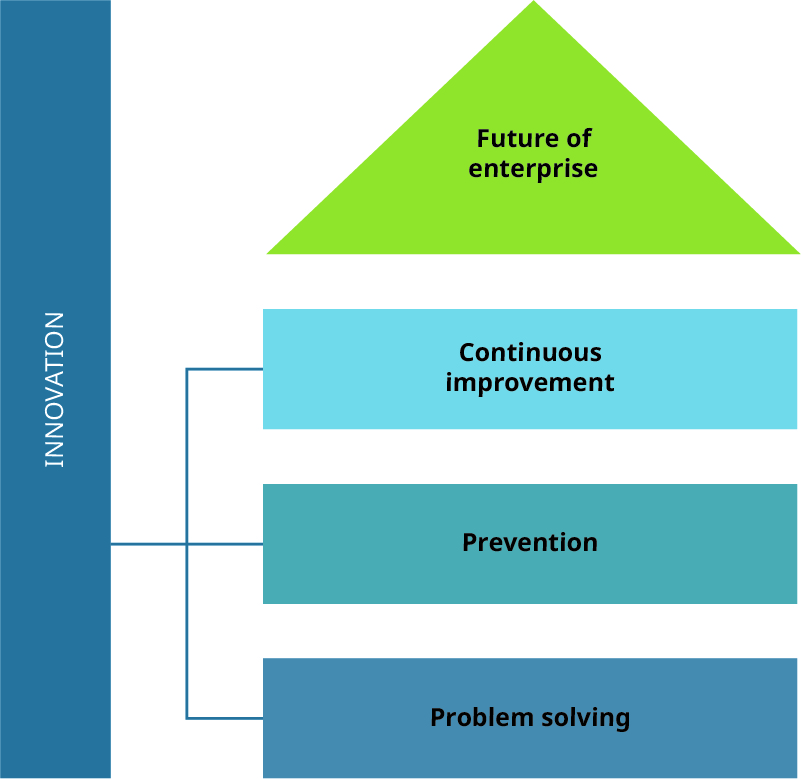
Even if you are not interested in shaping the future of whole industry sectors, developing future-focused innovation practices still is a good idea. It will help you prepare for disruption. The pace of technological change is such that workers at all levels need to be prepared to innovate. Innovation leaders, such as the marketing guru Guy Kawasaki, have built on psychological principles to suggest new ways to approach innovation. According to Kawasaki, innovative products include five key qualities: deep, indulgent, complete, elegant, and emotive—DICEE ().8 You can strive to infuse individual innovations with these qualities in practical ways.

Deep
Deep products are based on the logic of innovation that we’ve just established and anticipate users’ needs before they have them. These types of innovations often have masterful designs that are intuitive for new users while still being capable of completing complex tasks. Adobe is an innovative corporation working in several fields, such as software, marketing, and artificial intelligence. Adobe often creates software applications with basic functions that are easily accessible to new users but that also enable experienced users to innovate on their own.9 Creating a platform for innovation is a hallmark of deep, forward-thinking innovation.
Indulgent
Innovations with lasting power engage users in ways that make them feel special for having purchased the product or for having found the service. Indulgence refers to a depth of quality that does not come from being the fastest solution to a problem. Indulgence may even sound like a negative trait. In humans, it certainly can be, but for someone using an innovative product, feeling indulgent can relate to a richness of experience with the user interface (UI). The UI of a product, particularly a software product, is what the user sees and interacts with. A feeling of indulgence imbues your product with a sense of value and durability that reassures users and encourages them to use your product confidently.
Complete
Kawasaki’s vision of a complete product includes the services wrapped around it and underlying it such that users understand the product well enough to be comfortable using it. Information about how it works and how it is meant to work is readily available. Thus, product innovation must include marketing and other communication efforts. For Kawasaki, this builds the “total user experience.”10 If you truly have solved a problem in the marketplace, users will understand what that problem is and how your product and related services deliver.
Elegant
Elegance also is part of a product’s UI. It refers to intuitive design that immediately makes sense to consumers. Elegance conveys more information with fewer words. Elegant design is not afraid of negative space or of the occasional pause. Elegant innovations solve problems without creating new ones. For Kawasaki, elegance is the difference between a pragmatic, good innovation and something great.
Emotive
Emotive innovations evoke the intended emotion and demand to be admired and shared. In other words, truly great innovations create fandoms, not just consumer bases. You can’t force people to love your product, but you can give them experiences that create a sense of excitement and anticipation of what you might come up with next.
Developing an Invention
The general process of inventing involves systematic and practical steps that might include linear and nonlinear thinking. You might think that only people with innate artistic skills are creative and that only geniuses become innovators and inventors, but much of creativity is driven by being immersed in a practice. You can build and foster your own creativity. Your idea of an inventor might be someone like Johannes Gutenberg, who developed the printing press. The spread of printing ultimately redrew the map of Europe and resulted in the foundation of new centers of learning. Gutenberg’s supposed spark actually was more of a slow burn. He was creative and innovative—one of history’s most famous inventors—but his printing press, like all other inventions, was a synthesis of existing technologies. Gutenberg’s most important innovation was his use of moveable, interchangeable metal type instead of entire hand-carved wooden blocks of text (). Perfecting his printing process took decades and left him all but broke.11 The notion of the inventor’s single stroke of genius is mostly myth. The people that history remembers usually worked very hard to develop their creativity, to become familiar with the processes and tools that were ripe for innovation in their time, and ultimately to make something so unique that society recognizes it as an invention.
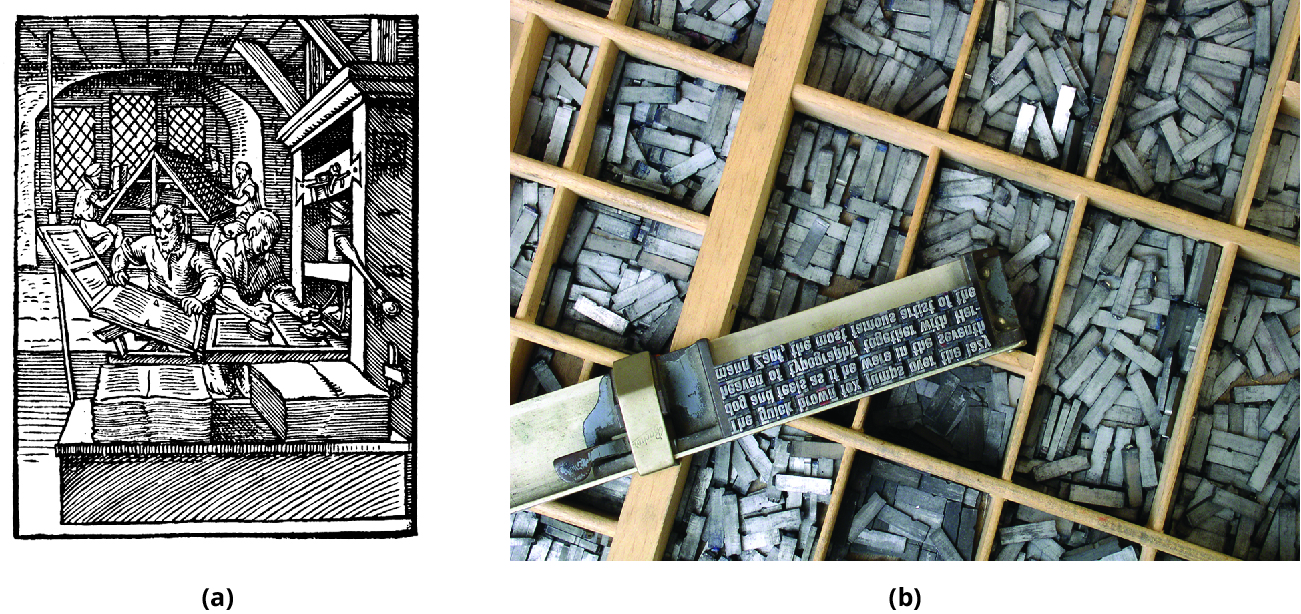
The old adage claims that “necessity is the mother of invention,” but an innovator needs experience in a field, creative effort, and knowledge to be a successful inventor. Entrepreneurship means taking your efforts and knowledge, and finding a market where your invention can first survive, then thrive.
One model for developing an invention is the first five steps of a plan adapted from Sourcify.com, which specializes in connecting product developers with manufacturers.12 This process is succinct and includes suggestions for building a team along the way ().

Step 1: Educate Yourself
Before your inventive product can do battle with other inventions, you will need to educate yourself. To prepare yourself to weather the competition, you need to learn as much as you can about the current investing climate, current product development opportunities, and current leadership approaches. Even if you are not deeply interested in leadership dogma, it helps to know what the current trends are in leadership and product development. To succeed as an inventor in a vast marketplace, you need to understand the rules, written and unwritten, of the industry and competitive landscape. The product development process can be quite involved. The process can vary by industry and by availability of resources.
Part of educating yourself is also gaining an understanding of your own strengths and weaknesses, and how those relate to your leadership style. A leadership style inventory can help you better understand your approach to leading others. This is just one example of many that exist to give you a starting point. As the inventor of your product or service, you will manage/lead others as you attempt to make your idea a reality. Also, the environment can constantly change. For this reason, it is important to understand the basic tenets of leadership and management in a dynamic work atmosphere. Many sources will give you insights into the challenges of management.
Another key step in educating yourself is to find out which kinds of contributors you are going to need to build a successful entrepreneurial team. Building a team is essential to making your invention a reality. Even those who invent alone—and they are quite rare—must have a development team, a manufacturing and/or service team, a marketing team, and other members with specific skill sets such as coders, graphic designers, test marketers, and more.
Step 2: Stay Organized
Most tip sheets for inventors suggest that you find a method for organizing your creativity so that you don’t spend time trying to remember previous ideas, plans, and decisions. You must organize information related to your business idea, your business plan, and your potential teammates in the process.
Contact management software has been popular for decades. Nowadays, you can investigate many other productivity and team-chat tools. Research ways to organize information about the people you plan to work with and hope to work for. The team-chat program Slack (www.slack.com) enables you to create specific topics for team members to discuss and collaborate on. Slack offers several features to help keep employees connected. Insightly (www.insightly.com) is a customer relationship management tool to stay better connected to your customers. Ryver and Glip incorporate task management. Flock and Microsoft Teams offer a host of features, with Microsoft leveraging its corporate position to bring about deployment in more than 200,000 organizations. Select the tool set that works best for you and consider paying for the software that offers the precise team communication functionality and utility you need.13
Step 3: Conduct Market Research
Market research is an obvious must, but many entrepreneurs fail to go as deeply as they should in researching their competition. You must be aware of current and future competitors so that you are prepared to compete in the marketplace when you are actually ready. Being the best on paper now won’t be much use when you enter the marketplace with an MVP in six to eight months in competition with competitors’ new products and updates.
What should you consider with regard to team development when you’re looking at the competition? Within the legal limits of any noncompete clauses, you should be shopping the competition for potential team members. The best leaders are always seeking talented people. If you sense that someone would be a good fit for your team, that they have not only the skill set but also the temperament that would help put your invention in the market, do not be afraid to reach out to them. How you reach out is something you must research for each industry. In some industries, you will have to be highly secretive. Part of market research is understanding the market well enough to understand the soft skills you need to find contributors who are already working in the industry or in an adjacent one
Step 4: Conduct Patent Research
If you expect to apply for a patent, take the time to read up on policies and procedures. Officials in the US Patent Office, or in similar bureaus in other countries, decide whether an invention is worthy of receiving a patent. A patentable invention must meet the criteria of being novel, useful, and nonobvious; it must be proven to be workable.14 Those three standards—novel, useful, and nonobvious—are subjective. So is the concept of invention, but conceptualizing invention this way sets a high bar for entrepreneurs who truly wish to make a social impact. Developing an invention that is patentable also creates a barrier against competition, which can make the difference between business success and failure. There are two types of patents. Utility patents last twenty years, and design patents usually last fourteen years. If a patent is granted, the inventor has a window of time in which to secure further funding, work to produce the product, and try to gain mass-market adoption.15 After all is said and done, you can apply your creativity to social innovations, product innovations, or service innovations. If you can combine enough innovations, add your unique creativity, and create something that survives the diffusion chasm, you can truly invent something new.
The patent basics page of the US Patent and Trademark Office’s website is roughly forty pages long.16 The utility patent process includes a thirteen-step flow chart17 that outlines the process. The patent office encourages you to use a registered patent attorney or agent. If you are skilled and diligent enough to secure a patent, you should expect to pay fees and file paperwork to maintain it for years after it is granted. We’ve already discussed the keys to securing a patent, but to reiterate, here is how an invention is defined in US patent law: “In the language of the statute, any person who ‘invents or discovers any new and useful process, machine, manufacture, or composition of matter, or any new and useful improvement thereof, may obtain a patent,’ subject to the conditions and requirements of the law.”18
When building a team to make your invention a reality, finding a patent lawyer or agent is key. Even those who have advocated for hiring patent attorneys in the past now suggest that hiring a patent agent might work. What’s the difference? Patent attorneys often bill by the hour, but they offer a full suite of legal advice. As the author Stephen Key indicates, patent agents are narrowly focused on helping you get and defend your patent.19 The other limitation that Key mentions is that patent agents may write a patent application in such a way that you are less prepared to protect your invention against future legal challenges. Key quotes Gene Quinn, a leading attorney on intellectual property and patent law: “By the time you realize that you are sitting on a million-dollar invention it will be too late to do anything about it.…Patent agents as a general rule tend to be very good at describing what it is that you as an inventor show up with.” What they tend to be much less good at is describing what your invention could be. They also frequently will use terms that are more concrete and limiting than would a patent attorney. Attorneys are taught the art of being hyper-specific, which is necessary at times, but also the art of being anything but specific.”20 Patents cannot be vague, but they can be written with just the right amount of specificity to protect against similar products that may arise and threaten your market share.
Step 5: Develop a Prototype
Developing a prototype can be the most fun or the most tedious part of inventing. Much of your attitude toward developing a prototype depends on available resources, technology, and expertise. In this text, we reference the concept of the lean startup from time to time. In the lean startup model, the prototype is most often an MVP. As we saw earlier, an MVP is a version of your invention that may not be polished or complete in terms of how you envisioned it, but it functions well enough and looks good enough that you can begin to market it with reasonable hopes that it will be adopted. For other inventions, you may need to build a more advanced prototype. This requires serious investment capital, but the payoff is that users will interact with a version of the product that looks and functions more like what you had in mind during your ideation phase. As an inventor, you are responsible for establishing quality control minimums for your product. You may have to compromise on your vision, but you should not compromise on basic functionality or basic levels of quality in materials.
You have many options at the prototype development stage. You can build the prototype yourself or with a small team. You can partner with design/invention firms that specialize in helping inventors create, but you must be very careful and involve your legal representation when working with such firms to be sure that you maintain the patents and other rights to your invention. Many inventors have partnered with such firms only to see their intellectual property stolen. Another option is to get funding for your invention on Kickstarter or some other crowdfunding site, but again you must beware that establishing such a campaign puts your idea in the public sphere. “Copycatters are monitoring crowdfunding platforms like Kickstarter and watching for trendy products to go viral,” according to Amedeo Ferraro, an intellectual property attorney.21 Competing companies, particularly in foreign markets, actively scout Kickstarter and similar platforms for new ideas that they can manufacture and bring to market before your crowdfunding project has run its course. Perhaps most chilling is this comment regarding legal protections that do not function, even when inventors take precautions to protect their intellectual property when working with some Chinese firms: “But even with these protections, there’s no guarantee that you can stop someone from copycatting your product. [One U.S. intellectual property lawyer] said that the problem lies not in China’s courts but enforcing rulings. Winning a case against one factory is relatively easy. But suing every factory and winning is expensive and time consuming.”22 For this reason, some inventors prefer to start small and local, if possible. It can be better for them to start with a trusted team striving for a small profit and a good market position than to see the market flooded with copycat products.
Summary
Whether an entrepreneur has innate creativity or not, practice can help improve creative efforts. One practice model includes preparation, incubation, insight, evaluation, and elaboration. Entrepreneurs can use their creativity to solve problems and innovate. However, innovators strive to anticipate and prevent problems, rather than react to them. The innovation pyramid begins with problem solving at the base, moving up to prevention, then continuous improvement, and finally directing the future of an industry. Innovative products are DICEE: They are deep, indulgent, complete, elegant, and emotive.
Building and fostering your own creativity often involves linear and nonlinear thinking. Models are available that help develop inventions, such as Sourcify.com’s five steps: Educate yourself, stay organized, conduct market research, conduct patent research, and develop a prototype. This model has guidelines for working with teams as well. These models allow you to apply your knowledge of creativity, innovation, and invention in an entrepreneurial context. Seek inspiration from inventors who have come before and learn from the modes of thought and models of practice that guide inventors today.
Review Questions
The model for building ________ also includes steps for team building, suggesting that the most complex developments require more than the lone mad scientist in a lab, despite what is often depicted in popular culture.
- creativity in an individual
- innovations
- inventions
Problem solving is part of but not the entire model for building innovations. True or False?
- true
- false
DICEE is a model for ________ that focuses on going beyond problem solving to get at the underlying qualities of what makes certain new products “sticky” in ways that make people true fans.
- creativity in practice
- innovative products
- inventions
- building creative teams
Discussion Questions
What makes a model for creativity necessary? Isn’t creativity the opposite or the absence of structure?
Why does the model for innovation stress that it does not end with problem solving?
Why does the section on invention focus so much on building a team? Aren’t most inventors and truly creative people famous for working solo?
Case Questions
Read this article to prepare for answering this question: https://www.brookings.edu/blog/brookings-now/2018/05/23/artificial-intelligence-will-disrupt-the-future-of-work-are-we-ready/. (Brennan Hoban. “Artificial Intelligence Will Disrupt the Future of Work. Are We Ready?” Brookings. May 23, 2018.)
Many signs point to growing automation across a variety of industries in the coming decades. In many cases, disruptive technologies will force people to innovate. Based on the DICEE innovation model, explain how humans will be needed on the design side of innovation to create human-centric products. In what ways can you create a career that is “disruption-proof”?
Suggested Resources
Additional information about product development: https://www.smartsheet.com/all-about-new-product-development-process
A summary of various leadership styles and traits that are essential for a changing business environment: https://www.christinespeaks.com/management/demonstrate-dynamic-leadership
Footnotes
- Aleza D’Agostino. “5 Stages of the Creative Process with James Taylor.” CreativeLive. December 28, 2015. https://www.creativelive.com/blog/5-stages-of-the-creative-process-with-james-taylor/ ↩
- Eugene Sadler-Smith. “Wallas’ Four-Stage Model of the Creative Process: More Than Meets the Eye?” Creativity Research Journal 27, no. 4 (2015): 342–352. ↩
- Eugene Sadler-Smith. “Wallas’ Four-Stage Model of the Creative Process: More Than Meets the Eye?” Creativity Research Journal 27, no. 4 (2015): 342–352. ↩
- Neal Zaslaw, “Mozart As a Working Stiff,” in James M. Morris, ed., On Mozart (Cambridge: Cambridge University Press, 1994), 109. ↩
- Steven M. Smith, Thomas B. Ward, and Ronald A. Finke, eds., The Creative Cognition Approach. Cambridge, MA: MIT Press, 1995. ↩
- Eugene Sadler-Smith. “Wallas’ Four-Stage Model of the Creative Process: More Than Meets the Eye?” Creativity Research Journal 27, no. 4 (2015): 342–352. ↩
- Larry Myler. “Innovation Is Problem Solving . . . And a Whole Lot More.” Forbes. June 13, 2014. https://www.forbes.com/sites/larrymyler/2014/06/13/innovation-is-problem-solving-and-a-whole-lot-more/#3f11abe533b9 ↩
- Guy Kawasaki. “Guy’s Golden Touch.” Guy Kawasaki. January 3, 2006. https://guykawasaki.com/guys_golden_tou/ ↩
- Adobe Communications Team. “Adobe Named One of Fast Company’s ‘Most Innovative Companies’ for AI.” Adobe Blog. February 20, 2018. https://theblog.adobe.com/adobe-named-one-fast-companys-innovative-companies-ai/ ↩
- Guy Kawasaki. “Guy’s Golden Touch.” Guy Kawasaki. January 3, 2006. https://guykawasaki.com/guys_golden_tou/ ↩
- John Man. The Gutenberg Revolution. New York: Random House, 2010. ↩
- Natalie Peters. “9 Key Steps to Bring Your Invention to Life.” Sourcify. December 11, 2017. https://www.sourcify.com/bring-your-invention-to-life/ ↩
- Aleksey Chepalov. “9 Slack Competitors in 2019: What Team Chat Tools Are Leading the Way?” Chanty. March 18, 2019. https://www.chanty.com/blog/slack-competitors/ ↩
- “Patent Subject Matter Eligibility.” United States Patent and Trademark Office (USPTO). n.d. https://www.uspto.gov/web/offices/pac/mpep/s2106.html ↩
- “How Long Does Patent, Trademark, or Copyright Protection Last?” Intellectual Property Rights Information and Assistance. July 7, 2016. https://www.stopfakes.gov/article?id=How-Long-Does-Patent-Trademark-or-Copyright-Protection-Last ↩
- “General Information Concerning Patents.” United States Patent and Trademark Office. October 2015. https://www.uspto.gov/patents-getting-started/general-information-concerning-patents ↩
- “Process for Obtaining a Utility Patent.” United States Patent and Trademark Office. n.d. https://www.uspto.gov/patents-getting-started/patent-basics/types-patent-applications/utility-patent/process-obtaining ↩
- “What Can Be Patented” in “General Information Concerning Patents.” United States Patent and Trademark Office. October 2015. https://www.uspto.gov/patents-getting-started/general-information-concerning-patents#heading-4 ↩
- Stephen Key. “Should You Hire a Patent Agent Instead of a Patent Attorney?” Inc. October 26, 2016. https://www.inc.com/stephen-key/should-you-hire-a-patent-agent-instead-of-a-patent-attorney.html ↩
- “Gene Quinn.” IP Watchdog. n.d. https://www.ipwatchdog.com/people/gene-quinn-3/ ↩
- Jennifer Schlesinger, Andrea Day, Bianca Fortis, Eunice Yoon, and Lilian Wu. “How One Entrepreneur’s American Dream Turned into a Copycat Nightmare.” CNBC. April 30, 2019. https://www.cnbc.com/2019/04/30/how-one-entrepreneurs-american-dream-turned-into-a-copycat-nightmare.html ↩
- Josh Horwitz. “Your Brilliant Kickstarter Idea Could Be on Sale in China before You’ve Even Finished Funding It.” Quartz. October 17, 2016. https://qz.com/771727/chinas-factories-in-shenzhen-can-copy-products-at-breakneck-speed-and-its-time-for-the-rest-of-the-world-to-get-over-it/ ↩