Sales and Customer Service
Learning Objectives
By the end of this section, you will be able to:
- Explain the importance of sales strategy and provide an example
- Explain the importance of customer service
View this section's JSON
{
"id": "m71153",
"doc_class": "",
"title": "Sales and Customer Service",
"objectives": [
"Explain the importance of sales strategy and provide an example",
"Explain the importance of customer service"
],
"figures": [
{
"src": "OSX_Eship_08_05_Sales.jpg",
"alt": "The six-step sales process includes Prospecting (identifying prospects and determining which prospects are qualified and which are unlikely consumers), Making the Sales Call (learning prospect demographics and setting objectives for the call), Presenting the Proposal (preparing talking points, visuals, and testimonials, and describing the product/service, costs, and benefits), Handling Objections (gaining feedback and responding to concerns and objections by offering information and solutions), Closing the Sale (asking trial close questions to test readiness and specific closing questions to move to the next step), and Fulfilling Orders, Fostering Relationships, and Asking for Referrals (fulfilling orders or commitments, communicating regularly about satisfaction and needs, and asking for referrals).",
"caption": "The <dfn>six-step sales process</dfn> does not end with the sale but with a positive customer relationship. (attribution: Copyright Rice University, OpenStax, under CC BY NC-SA 4.0 license)"
},
{
"src": "OSX_Eship_08_06_CustServ.jpg",
"alt": "Basic steps of customer service include developing guidelines or an operation manual for how to handle customer service, training employees before and during their employment, hiring employees with great customer service experience or those with the potential to learn, providing incentives such as awards and prizes, and walking the talk to provide great customer service to your employees because the attitude and disposition of the company’s leadership matter and employees will follow suit if they feel appreciated.",
"caption": "The quality of customer service can make or break a company. Following a few basic steps can ensure great customer service. (attribution: Copyright Rice University, OpenStax, under CC BY NC-SA 4.0 license)"
}
],
"tokens": 4530,
"blocks": [
{
"anchor": "m71153-b1",
"trail": [
"Learning Objectives"
],
"heading": "Learning Objectives",
"html": "<section class=\"learning-objectives\"><h2>Learning Objectives</h2><p>By the end of this section, you will be able to:</p><ul><li>Explain the importance of sales strategy and provide an example</li><li>Explain the importance of customer service</li></ul></section>",
"text": "Learning Objectives\nBy the end of this section, you will be able to:\nExplain the importance of sales strategy and provide an example\nExplain the importance of customer service",
"tokens": 43
},
{
"anchor": "m71153-b2",
"trail": [],
"heading": null,
"html": "<p>A <dfn>sales strategy</dfn> is a plan that the entrepreneur uses to identify and engage a consumer, from prospecting to securing the sale. This strategy should keep in mind the core benefit or <dfn>competitive advantage</dfn> that the product or service has and make sure this information filters through the entire sales execution process. The strategy should include a six-step process that is an integrated sales system for how to prospect, pitch, handle rejections, and the like.</p><p>Setting objectives is important before reaching out to prospects and current customers because they allow the salesperson to detail the strategy, have an end goal, and measure the results. For example, a salesperson may have a goal of closing one client out of ten prospects he or she sees per week (or through a sales cycle). So the detailed strategy would be:</p><ol><li>doing research about prospective clients and creating a list,</li><li>calling them to set up an appointment to talk about your product or service,</li><li>meeting with them to present a proposal,</li><li>handling objections,</li><li>closing the deal, and</li><li>nurturing the relationship after close.</li></ol><p>The end goal would be to gain a prospect as a client and develop a good relationship for future business. And the salesperson would measure the results by looking back at goals and outcomes.</p><p>There are many methods, tools, and techniques to sell, and there is no perfect set of strategies for a business. It depends on the goals and resources of the entrepreneur, as well as on the type of product they are launching. When selling to customers who are going to be spending a substantial amount on a product or service, like a piece of equipment, a luxury yacht, or an expensive software program, there must be a sales system in place to take consumers from prospects to customers. The preceding six steps are general stages in this system. Let’s take a look at each step.</p>",
"text": "A sales strategy is a plan that the entrepreneur uses to identify and engage a consumer, from prospecting to securing the sale. This strategy should keep in mind the core benefit or competitive advantage that the product or service has and make sure this information filters through the entire sales execution process. The strategy should include a six-step process that is an integrated sales system for how to prospect, pitch, handle rejections, and the like.\nSetting objectives is important before reaching out to prospects and current customers because they allow the salesperson to detail the strategy, have an end goal, and measure the results. For example, a salesperson may have a goal of closing one client out of ten prospects he or she sees per week (or through a sales cycle). So the detailed strategy would be:\ndoing research about prospective clients and creating a list,\ncalling them to set up an appointment to talk about your product or service,\nmeeting with them to present a proposal,\nhandling objections,\nclosing the deal, and\nnurturing the relationship after close.\nThe end goal would be to gain a prospect as a client and develop a good relationship for future business. And the salesperson would measure the results by looking back at goals and outcomes.\nThere are many methods, tools, and techniques to sell, and there is no perfect set of strategies for a business. It depends on the goals and resources of the entrepreneur, as well as on the type of product they are launching. When selling to customers who are going to be spending a substantial amount on a product or service, like a piece of equipment, a luxury yacht, or an expensive software program, there must be a sales system in place to take consumers from prospects to customers. The preceding six steps are general stages in this system. Let’s take a look at each step.",
"tokens": 464
},
{
"anchor": "m71153-b3",
"trail": [
"Sample Six-Step Sales Strategy"
],
"heading": "Sample Six-Step Sales Strategy",
"html": "<section class=\"\"><h2>Sample Six-Step Sales Strategy</h2><p> outlines an example of an effective sales system or strategy using a six-step approach.<sup class=\"footnote-ref\"><a id=\"fnref1\" href=\"#fn1\" aria-label=\"Footnote 1\">1</a></sup></p><figure><img src=\"media/OSX_Eship_08_05_Sales.jpg\" alt=\"The six-step sales process includes Prospecting (identifying prospects and determining which prospects are qualified and which are unlikely consumers), Making the Sales Call (learning prospect demographics and setting objectives for the call), Presenting the Proposal (preparing talking points, visuals, and testimonials, and describing the product/service, costs, and benefits), Handling Objections (gaining feedback and responding to concerns and objections by offering information and solutions), Closing the Sale (asking trial close questions to test readiness and specific closing questions to move to the next step), and Fulfilling Orders, Fostering Relationships, and Asking for Referrals (fulfilling orders or commitments, communicating regularly about satisfaction and needs, and asking for referrals).\"><figcaption>The <dfn>six-step sales process</dfn> does not end with the sale but with a positive customer relationship. (attribution: Copyright Rice University, OpenStax, under CC BY NC-SA 4.0 license)</figcaption><span class=\"figure-alt\">The six-step sales process includes Prospecting (identifying prospects and determining which prospects are qualified and which are unlikely consumers), Making the Sales Call (learning prospect demographics and setting objectives for the call), Presenting the Proposal (preparing talking points, visuals, and testimonials, and describing the product/service, costs, and benefits), Handling Objections (gaining feedback and responding to concerns and objections by offering information and solutions), Closing the Sale (asking trial close questions to test readiness and specific closing questions to move to the next step), and Fulfilling Orders, Fostering Relationships, and Asking for Referrals (fulfilling orders or commitments, communicating regularly about satisfaction and needs, and asking for referrals).</span></figure><section class=\"\"><h3>Prospecting and Preparing</h3><p><dfn>Prospecting</dfn> focuses on finding potential new customers for the product or service. This helps acquire new customers, replace customers lost to attrition, and expand sales from current customers. In essence, prospecting allows salespeople to collect information about potential customers and identify any who are not a good fit for the company. It is important to get as many prospects as possible to secure a few customers, as the pool of prospects diminishes through successive steps of the sales process.</p><p>You may need to have a list of twenty prospects to secure one or two customers. Prospecting also tends to be more important in certain industries such as financial advising or business-to-business industries. To determine whether a person or organization is a qualified prospect, the salesperson must consider several issues, such as whether this person/business needs my product or service, and if they can afford it.</p></section><section class=\"\"><h3>Making the Sales Call</h3><p>The next step of the sales system is to prepare for a sales call, contact, or meeting with a prospect. Effective sales people usually prepare well in advance of contacting a prospect. A salesperson can look for information regarding the company’s demographics, its competition, clients, and other companies they purchase from. Information can be gathered from online sources or referrals. It is also helpful to set objectives before contacting the prospect. Some of those objectives can include securing an appointment for a presentation, understanding the prospect better, scheduling a second call/contact, or perhaps starting a sale.</p><aside class=\"note note-link-to-learning\"><p class=\"note-label\">Link to learning</p><p>Neil <dfn>Rackham</dfn> wrote a book in 1998 called <em>Spin Selling</em>. It’s a classic in the sales world. In it, he outlined a new way to approach winning big sales deals. <dfn>SPIN</dfn> stands for situation, problem, implication, and need payoff. Visit the <a href=\"https://openstax.org/l/52SPIN\" rel=\"noopener\" target=\"_blank\">SPIN site</a> to learn about Rackham’s nontraditional approach to sales and the main principles he advocated.</p></aside></section><section class=\"\"><h3>Presenting the Proposal</h3><p>Once the salesperson has made a connection with a prospect and understands the prospect’s needs, the next step is to meet with the prospect for a sales presentation. A presentation is a great way to expand the prospect’s understanding about the offering. Strong presentations include good communication skills with strong visuals and testimonials. In this step, the salesperson can make a better case for the value proposition, citing the strengths of the product and how those strengths would help the prospect in their life or how it would help a company’s objectives. The presentation can also include the cost of the investment and a projection of the return on investment. In the case of a financial advisor, a presentation at a prospect’s home would show the potential products that the prospect might invest in, such as a variety of retirement accounts, life insurance, a college savings plan, or long-term care insurance, along with the costs and benefits of each. In the case of a business, the presentation could take place at the prospect’s office, and the meeting could include a slide presentation about a piece of equipment, with video showing how it is used and how it can benefit the company, including cost savings.</p></section><section class=\"\"><h3>Handling Objections</h3><p>During or after the presentation, a salesperson will likely encounter objections or questions from the prospect. This is a good way for the salesperson to gain feedback and respond to concerns from the prospect. Objections can arise during the appointment setting, during the presentation, or while trying to close the sale. The salesperson must be proficient at dealing with these in a truthful manner so the relationship that is established is based on trust. Some of those objections can include cost concerns, credit capabilities, product benefits, or plain rejection of the product. In this case, the financial advisor could answer questions about the potential benefits of one type of insurance over another, or handle objections on the monthly payment plan. If dealing with a company, these questions can take the form of credit opportunities and amount of cost savings in comparison to a competitor.</p></section><section class=\"\"><h3>Closing the Sale</h3><p>Once the presentation and objections are handled, the next step is to <dfn>close</dfn>, or ask for the sale. This is as important as being prepared to present and handle objections because it signals to the prospect that the product is a good fit and the relationship can be created. A good closing includes a trustworthy and logical process. Doing a trial close by asking “How is this so far?” or “Can I answer anything else?” can help the customer feel more at ease with making a decision. The customer will help set the pace for a final closing. Then, the salesperson can set up the next steps or ask the following questions: “Can I place the order for you?” “Can we open the life insurance account for you?” “Can you come see the demonstration at our office?” “Can we meet next week for the financial terms?”</p></section><section class=\"\"><h3>Fulfilling Orders, Fostering Relationships, and Asking for Referrals</h3><p>Finally, the salesperson must fulfill the order and make sure that the customer is satisfied with the product or service. The salesperson, in the end, is the one who is the main contact for the customer and therefore is responsible for the fulfillment of a correct order. The order needs to be closely monitored in case there are any delays or issues with it, so the customer can be immediately notified. The process of the order fulfillment has to be monitored until it is fulfilled. Software has now made it easier to keep track of these orders, so the salesperson can spend more time selling and less time on the order process. Customer relationship management tools such as <dfn>Salesforce</dfn> (https://www.salesforce.com/crm/) can help a small entrepreneur or a larger business keep track of its customers, their orders, troubleshooting, and strategies for cost effectiveness.</p><p>Building a direct relationship with the customer is also important; therefore, calls or emails to check in consistently is important to assess customer satisfaction and t build the relationship bridge to ask for referrals. Customer retention is more important than ever, as even a small percentage of customers can make up the majority of your sales. Wooing new customers is 5 percent more expensive than keeping your current ones, and in the long run, those who are your VIPs will generate most of your sales.<sup class=\"footnote-ref\"><a id=\"fnref2\" href=\"#fn2\" aria-label=\"Footnote 2\">2</a></sup> Research shows that retaining even 5 percent of your current customers can generate anywhere from 25 percent to 95 percent of your sales.<sup class=\"footnote-ref\"><a id=\"fnref3\" href=\"#fn3\" aria-label=\"Footnote 3\">3</a></sup></p></section></section>",
"text": "Sample Six-Step Sales Strategy\n outlines an example of an effective sales system or strategy using a six-step approach.1\n [figure: The six-step sales process includes Prospecting (identifying prospects and determining which prospects are qualified and which are unlikely consumers), Making the Sales Call (learning prospect demographics and setting objectives for the call), Presenting the Proposal (preparing talking points, visuals, and testimonials, and describing the product/service, costs, and benefits), Handling Objections (gaining feedback and responding to concerns and objections by offering information and solutions), Closing the Sale (asking trial close questions to test readiness and specific closing questions to move to the next step), and Fulfilling Orders, Fostering Relationships, and Asking for Referrals (fulfilling orders or commitments, communicating regularly about satisfaction and needs, and asking for referrals).] The six-step sales process does not end with the sale but with a positive customer relationship. (attribution: Copyright Rice University, OpenStax, under CC BY NC-SA 4.0 license)\nThe six-step sales process includes Prospecting (identifying prospects and determining which prospects are qualified and which are unlikely consumers), Making the Sales Call (learning prospect demographics and setting objectives for the call), Presenting the Proposal (preparing talking points, visuals, and testimonials, and describing the product/service, costs, and benefits), Handling Objections (gaining feedback and responding to concerns and objections by offering information and solutions), Closing the Sale (asking trial close questions to test readiness and specific closing questions to move to the next step), and Fulfilling Orders, Fostering Relationships, and Asking for Referrals (fulfilling orders or commitments, communicating regularly about satisfaction and needs, and asking for referrals).Prospecting and Preparing\nProspecting focuses on finding potential new customers for the product or service. This helps acquire new customers, replace customers lost to attrition, and expand sales from current customers. In essence, prospecting allows salespeople to collect information about potential customers and identify any who are not a good fit for the company. It is important to get as many prospects as possible to secure a few customers, as the pool of prospects diminishes through successive steps of the sales process.\nYou may need to have a list of twenty prospects to secure one or two customers. Prospecting also tends to be more important in certain industries such as financial advising or business-to-business industries. To determine whether a person or organization is a qualified prospect, the salesperson must consider several issues, such as whether this person/business needs my product or service, and if they can afford it.\nMaking the Sales Call\nThe next step of the sales system is to prepare for a sales call, contact, or meeting with a prospect. Effective sales people usually prepare well in advance of contacting a prospect. A salesperson can look for information regarding the company’s demographics, its competition, clients, and other companies they purchase from. Information can be gathered from online sources or referrals. It is also helpful to set objectives before contacting the prospect. Some of those objectives can include securing an appointment for a presentation, understanding the prospect better, scheduling a second call/contact, or perhaps starting a sale.\nLink to learning\nNeil Rackham wrote a book in 1998 called Spin Selling. It’s a classic in the sales world. In it, he outlined a new way to approach winning big sales deals. SPIN stands for situation, problem, implication, and need payoff. Visit the SPIN site to learn about Rackham’s nontraditional approach to sales and the main principles he advocated.\n\nPresenting the Proposal\nOnce the salesperson has made a connection with a prospect and understands the prospect’s needs, the next step is to meet with the prospect for a sales presentation. A presentation is a great way to expand the prospect’s understanding about the offering. Strong presentations include good communication skills with strong visuals and testimonials. In this step, the salesperson can make a better case for the value proposition, citing the strengths of the product and how those strengths would help the prospect in their life or how it would help a company’s objectives. The presentation can also include the cost of the investment and a projection of the return on investment. In the case of a financial advisor, a presentation at a prospect’s home would show the potential products that the prospect might invest in, such as a variety of retirement accounts, life insurance, a college savings plan, or long-term care insurance, along with the costs and benefits of each. In the case of a business, the presentation could take place at the prospect’s office, and the meeting could include a slide presentation about a piece of equipment, with video showing how it is used and how it can benefit the company, including cost savings.\nHandling Objections\nDuring or after the presentation, a salesperson will likely encounter objections or questions from the prospect. This is a good way for the salesperson to gain feedback and respond to concerns from the prospect. Objections can arise during the appointment setting, during the presentation, or while trying to close the sale. The salesperson must be proficient at dealing with these in a truthful manner so the relationship that is established is based on trust. Some of those objections can include cost concerns, credit capabilities, product benefits, or plain rejection of the product. In this case, the financial advisor could answer questions about the potential benefits of one type of insurance over another, or handle objections on the monthly payment plan. If dealing with a company, these questions can take the form of credit opportunities and amount of cost savings in comparison to a competitor.\nClosing the Sale\nOnce the presentation and objections are handled, the next step is to close, or ask for the sale. This is as important as being prepared to present and handle objections because it signals to the prospect that the product is a good fit and the relationship can be created. A good closing includes a trustworthy and logical process. Doing a trial close by asking “How is this so far?” or “Can I answer anything else?” can help the customer feel more at ease with making a decision. The customer will help set the pace for a final closing. Then, the salesperson can set up the next steps or ask the following questions: “Can I place the order for you?” “Can we open the life insurance account for you?” “Can you come see the demonstration at our office?” “Can we meet next week for the financial terms?”\nFulfilling Orders, Fostering Relationships, and Asking for Referrals\nFinally, the salesperson must fulfill the order and make sure that the customer is satisfied with the product or service. The salesperson, in the end, is the one who is the main contact for the customer and therefore is responsible for the fulfillment of a correct order. The order needs to be closely monitored in case there are any delays or issues with it, so the customer can be immediately notified. The process of the order fulfillment has to be monitored until it is fulfilled. Software has now made it easier to keep track of these orders, so the salesperson can spend more time selling and less time on the order process. Customer relationship management tools such as Salesforce (https://www.salesforce.com/crm/) can help a small entrepreneur or a larger business keep track of its customers, their orders, troubleshooting, and strategies for cost effectiveness.\nBuilding a direct relationship with the customer is also important; therefore, calls or emails to check in consistently is important to assess customer satisfaction and t build the relationship bridge to ask for referrals. Customer retention is more important than ever, as even a small percentage of customers can make up the majority of your sales. Wooing new customers is 5 percent more expensive than keeping your current ones, and in the long run, those who are your VIPs will generate most of your sales.2 Research shows that retaining even 5 percent of your current customers can generate anywhere from 25 percent to 95 percent of your sales.3",
"tokens": 2124
},
{
"anchor": "m71153-b4",
"trail": [
"Customer Service"
],
"heading": "Customer Service",
"html": "<section class=\"\"><h2>Customer Service</h2><p>One of the most important aspects of making the sale, and one that often wins or loses customers, is <dfn>customer service</dfn>. If you have ever stepped into a business where you have been greeted with a smile and treated kindly throughout the purchase process, you will probably want to come back and purchase from that store or salesperson again. However, if the sales associate is rude and doesn’t help you find what you need, chances are you will not return to the store a second time. For start-ups, customer service can be an advantage, as the business can focus on a few customers at a time in a more personal manner. The bigger a company is, the harder it is to manage many customers and sales associates on a personal level.</p><p>According to <dfn>Hubspot</dfn>’s top statistics on customer service, 70 percent of the customer experience or journey depends on how they are being treated. The majority of customers fall in love with a brand and are willing to pay a premium for amazing customer service, and they feel that great customer service is more important than price. They will also share positive experiences with other people—an average of eleven, according to Hubspot.<sup class=\"footnote-ref\"><a id=\"fnref4\" href=\"#fn4\" aria-label=\"Footnote 4\">4</a></sup> When a customer has a negative experience, or feels unappreciated, they are more likely to switch brands, and a company has to work harder to counteract a negative experience. It takes twelve positive reviews to counteract just one negative, unresolved customer issue.<sup class=\"footnote-ref\"><a id=\"fnref5\" href=\"#fn5\" aria-label=\"Footnote 5\">5</a></sup></p><p>As an entrepreneur, focusing on customer service before and after the purchase is an effective reminder that the company is trying to build trust and have a relationship with its customers. This also helps with the process of branding, as you’ve learned. Even in business-to-business sales transactions, the most important aspect of the sales process is building that trust relationship so the customer purchases from a “friend” again. Often when companies lose accounts, it is due to a change in sales personnel and the loss of the associated relationship.</p><p>One effective way to ensure great customer service is to create an operating manual for your employees that includes proper techniques for customer service. These techniques can include how to greet a customer, how to listen and help them get what they need, the philosophy of your company, how far to go when insuring great service, and how to be creative with customer service. Employees can review the manual when they are hired, and every year after that to ensure they continue to follow the procedures. Training programs before starting work and during the year can be facilitated by the entrepreneur or a consultant to sharpen the skills of the employees. These programs are a great way to energize salespeople to be more people oriented and to develop the proper attitude and positive thinking that is required when helping customers. Sales training programs are a great way to learn more about customer service. Zig <dfn>Ziglar</dfn> and Dr. <dfn>Cialdini</dfn> programs are designed with the salesperson in mind.</p><p>Also, when hiring, focus on candidates who already have customer service experience and those who come with good referrals. Incentives for great customer service such as an employee of the month/year award or financial incentives can also encourage employees to provide great service. Finally, the entrepreneur and any administrators are the leaders of a company who must show the same customer service to their employees. Walk the talk! If they realize that they are there to serve their employees and enable them to create a great customer service atmosphere, then the employees will share the same enthusiasm and energy toward their customers. Happy employees turn into profitable customers. shows a quick checklist for beginning entrepreneurs.</p><figure><img src=\"media/OSX_Eship_08_06_CustServ.jpg\" alt=\"Basic steps of customer service include developing guidelines or an operation manual for how to handle customer service, training employees before and during their employment, hiring employees with great customer service experience or those with the potential to learn, providing incentives such as awards and prizes, and walking the talk to provide great customer service to your employees because the attitude and disposition of the company’s leadership matter and employees will follow suit if they feel appreciated.\"><figcaption>The quality of customer service can make or break a company. Following a few basic steps can ensure great customer service. (attribution: Copyright Rice University, OpenStax, under CC BY NC-SA 4.0 license)</figcaption><span class=\"figure-alt\">Basic steps of customer service include developing guidelines or an operation manual for how to handle customer service, training employees before and during their employment, hiring employees with great customer service experience or those with the potential to learn, providing incentives such as awards and prizes, and walking the talk to provide great customer service to your employees because the attitude and disposition of the company’s leadership matter and employees will follow suit if they feel appreciated.</span></figure><p>Customer service doesn’t happen just in person or on the phone. Technology has enabled people and companies to connect through email and social media, taking the conversation and interaction online. Customers can now talk to the company employees, voice their concerns, and get issues resolve through these avenues. These technological advances have provided a bigger platform for customers to rave about companies or complain about them.<sup class=\"footnote-ref\"><a id=\"fnref6\" href=\"#fn6\" aria-label=\"Footnote 6\">6</a></sup> This love or dislike can translate into social media posts, tweets, pictures, videos, and reviews for thousands or millions of people to see and can help or tarnish a company.</p></section>",
"text": "Customer Service\nOne of the most important aspects of making the sale, and one that often wins or loses customers, is customer service. If you have ever stepped into a business where you have been greeted with a smile and treated kindly throughout the purchase process, you will probably want to come back and purchase from that store or salesperson again. However, if the sales associate is rude and doesn’t help you find what you need, chances are you will not return to the store a second time. For start-ups, customer service can be an advantage, as the business can focus on a few customers at a time in a more personal manner. The bigger a company is, the harder it is to manage many customers and sales associates on a personal level.\nAccording to Hubspot’s top statistics on customer service, 70 percent of the customer experience or journey depends on how they are being treated. The majority of customers fall in love with a brand and are willing to pay a premium for amazing customer service, and they feel that great customer service is more important than price. They will also share positive experiences with other people—an average of eleven, according to Hubspot.4 When a customer has a negative experience, or feels unappreciated, they are more likely to switch brands, and a company has to work harder to counteract a negative experience. It takes twelve positive reviews to counteract just one negative, unresolved customer issue.5\nAs an entrepreneur, focusing on customer service before and after the purchase is an effective reminder that the company is trying to build trust and have a relationship with its customers. This also helps with the process of branding, as you’ve learned. Even in business-to-business sales transactions, the most important aspect of the sales process is building that trust relationship so the customer purchases from a “friend” again. Often when companies lose accounts, it is due to a change in sales personnel and the loss of the associated relationship.\nOne effective way to ensure great customer service is to create an operating manual for your employees that includes proper techniques for customer service. These techniques can include how to greet a customer, how to listen and help them get what they need, the philosophy of your company, how far to go when insuring great service, and how to be creative with customer service. Employees can review the manual when they are hired, and every year after that to ensure they continue to follow the procedures. Training programs before starting work and during the year can be facilitated by the entrepreneur or a consultant to sharpen the skills of the employees. These programs are a great way to energize salespeople to be more people oriented and to develop the proper attitude and positive thinking that is required when helping customers. Sales training programs are a great way to learn more about customer service. Zig Ziglar and Dr. Cialdini programs are designed with the salesperson in mind.\nAlso, when hiring, focus on candidates who already have customer service experience and those who come with good referrals. Incentives for great customer service such as an employee of the month/year award or financial incentives can also encourage employees to provide great service. Finally, the entrepreneur and any administrators are the leaders of a company who must show the same customer service to their employees. Walk the talk! If they realize that they are there to serve their employees and enable them to create a great customer service atmosphere, then the employees will share the same enthusiasm and energy toward their customers. Happy employees turn into profitable customers. shows a quick checklist for beginning entrepreneurs.\n [figure: Basic steps of customer service include developing guidelines or an operation manual for how to handle customer service, training employees before and during their employment, hiring employees with great customer service experience or those with the potential to learn, providing incentives such as awards and prizes, and walking the talk to provide great customer service to your employees because the attitude and disposition of the company’s leadership matter and employees will follow suit if they feel appreciated.] The quality of customer service can make or break a company. Following a few basic steps can ensure great customer service. (attribution: Copyright Rice University, OpenStax, under CC BY NC-SA 4.0 license)\nBasic steps of customer service include developing guidelines or an operation manual for how to handle customer service, training employees before and during their employment, hiring employees with great customer service experience or those with the potential to learn, providing incentives such as awards and prizes, and walking the talk to provide great customer service to your employees because the attitude and disposition of the company’s leadership matter and employees will follow suit if they feel appreciated.Customer service doesn’t happen just in person or on the phone. Technology has enabled people and companies to connect through email and social media, taking the conversation and interaction online. Customers can now talk to the company employees, voice their concerns, and get issues resolve through these avenues. These technological advances have provided a bigger platform for customers to rave about companies or complain about them.6 This love or dislike can translate into social media posts, tweets, pictures, videos, and reviews for thousands or millions of people to see and can help or tarnish a company.",
"tokens": 1407
},
{
"anchor": "m71153-b5",
"trail": [
"Summary"
],
"heading": "Summary",
"html": "<section class=\"section-summary\"><h2>Summary</h2><p>Sales drives profit. They may require a simple sales approach or a complicated sales system. An example of a sales system is a six-step sales strategy: doing research about prospective clients and creating a list; making an appointment to talk about your good or service; meeting with them to present a proposal; handling objections; closing the deal; and nurturing the relationship after close. When selling luxury and expensive items, the sales approach is usually more thorough and requires more sales training and finesse. Customer service is a component that is linked to this process and with proper training can really differentiate a company from the competition.</p></section>",
"text": "Summary\nSales drives profit. They may require a simple sales approach or a complicated sales system. An example of a sales system is a six-step sales strategy: doing research about prospective clients and creating a list; making an appointment to talk about your good or service; meeting with them to present a proposal; handling objections; closing the deal; and nurturing the relationship after close. When selling luxury and expensive items, the sales approach is usually more thorough and requires more sales training and finesse. Customer service is a component that is linked to this process and with proper training can really differentiate a company from the competition.",
"tokens": 169
},
{
"anchor": "m71153-b6",
"trail": [
"Review Questions"
],
"heading": "Review Questions",
"html": "<section class=\"review-questions\"><h2>Review Questions</h2><div class=\"exercise\"><div class=\"problem\"><p>What are the steps in the sales process?</p></div></div><div class=\"exercise\"><div class=\"problem\"><p>How does customer service impact sales of a new business?</p></div></div></section>",
"text": "Review Questions\nWhat are the steps in the sales process?\nHow does customer service impact sales of a new business?",
"tokens": 28
},
{
"anchor": "m71153-b7",
"trail": [
"Discussion Questions"
],
"heading": "Discussion Questions",
"html": "<section class=\"discussion-questions\"><h2>Discussion Questions</h2><div class=\"exercise\"><div class=\"problem\"><p>Negative referrals can have a great impact on a company’s sales. Remember an instance where you were the source of a bad referral for a product or service, and determine what made the experience so negative. What would you have done differently as the sales person to prevent that?</p></div></div></section>",
"text": "Discussion Questions\nNegative referrals can have a great impact on a company’s sales. Remember an instance where you were the source of a bad referral for a product or service, and determine what made the experience so negative. What would you have done differently as the sales person to prevent that?",
"tokens": 75
},
{
"anchor": "m71153-b8",
"trail": [
"Case Questions"
],
"heading": "Case Questions",
"html": "<section class=\"case-questions\"><h2>Case Questions</h2><div class=\"exercise\"><div class=\"problem\"><p>You have recently become a supplier of heavy equipment to manufacturing plants that build automotive components. You have acquired one customer and would like to add more within the next three months. How would you go about prospecting?</p></div></div></section>",
"text": "Case Questions\nYou have recently become a supplier of heavy equipment to manufacturing plants that build automotive components. You have acquired one customer and would like to add more within the next three months. How would you go about prospecting?",
"tokens": 62
},
{
"anchor": "m71153-b9",
"trail": [
"Suggested Resources"
],
"heading": "Suggested Resources",
"html": "<section class=\"suggested-resources\"><h2>Suggested Resources</h2><p>Cialdini online tools: https://www.influenceatwork.com/</p><p>Hoffman Sales Training: https://sellhoffman.com/</p><p>Neil Rackman: http://neilrackham.com/</p><p>Spin Selling: https://blog.hubspot.com/sales/spin-selling-the-ultimate-guide</p><p>Zig Ziglar: https://www.ziglar.com/</p><p>The State of Customer Service: https://offers.hubspot.com/state-of-customer-service?hubs_post-cta=anchor&hsCtaTracking=9c545446-aacf-47a3-bfb3-1998f78b79c8%7C4f98051f-03f6-4061-9a68-5de8fcbb40c1</p><p>Cialdini, R. B. (2001). <em>Influence: Science and Practice</em> (4th ed.). Boston: Allyn & Bacon: Explains some aspects of the sales process in a fun and fact-based manner.</p></section>",
"text": "Suggested Resources\nCialdini online tools: https://www.influenceatwork.com/\nHoffman Sales Training: https://sellhoffman.com/\nNeil Rackman: http://neilrackham.com/\nSpin Selling: https://blog.hubspot.com/sales/spin-selling-the-ultimate-guide\nZig Ziglar: https://www.ziglar.com/\nThe State of Customer Service: https://offers.hubspot.com/state-of-customer-service?hubs_post-cta=anchor&hsCtaTracking=9c545446-aacf-47a3-bfb3-1998f78b79c8%7C4f98051f-03f6-4061-9a68-5de8fcbb40c1\nCialdini, R. B. (2001). Influence: Science and Practice (4th ed.). Boston: Allyn & Bacon: Explains some aspects of the sales process in a fun and fact-based manner.",
"tokens": 158
}
],
"footnotes": [
{
"id": "fn1",
"html": "Stephen Castleberry and John Tanner. <em>Selling: Building Partnerships</em>. New York: McGraw-Hill, 2019."
},
{
"id": "fn2",
"html": " Matt Mansfield. “Customer Retention Statistics: The Ultimate Collection for Small Business.” <em>Small Business Trends</em>. August 22, 2019. https://smallbiztrends.com/2016/10/customer-retention-statistics.html"
},
{
"id": "fn3",
"html": "Jia Wertz. “Don’t Spend 5 Times More Attracting New Customers, Nurture the Existing Ones.” <em>Forbes</em>. September 12, 2018. https://www.forbes.com/sites/jiawertz/2018/09/12/dont-spend-5-times-more-attracting-new-customers-nurture-the-existing-ones/#723fd9e15a8e"
},
{
"id": "fn4",
"html": "Swetha Amaresan. “31 Customer Service Stats to Know in 2019.” <em>HubSpot</em>. March 19, 2019. https://blog.hubspot.com/service/customer-service-stats"
},
{
"id": "fn5",
"html": "Swetha Amaresan. “31 Customer Service Stats to Know in 2019.” <em>HubSpot</em>. March 19, 2019. https://blog.hubspot.com/service/customer-service-stats"
},
{
"id": "fn6",
"html": "Liz Greene. “Social Media Is a Customer Service Channel Whether You Like It or Not.” <em>Digital Marketing Institute</em>. n.d. https://digitalmarketinginstitute.com/en-us/blog/social-media-is-a-customer-service-channel-whether-you-like-it-or-not"
}
],
"kind": "section",
"chapter": 8,
"number": "8.6"
}A sales strategy is a plan that the entrepreneur uses to identify and engage a consumer, from prospecting to securing the sale. This strategy should keep in mind the core benefit or competitive advantage that the product or service has and make sure this information filters through the entire sales execution process. The strategy should include a six-step process that is an integrated sales system for how to prospect, pitch, handle rejections, and the like.
Setting objectives is important before reaching out to prospects and current customers because they allow the salesperson to detail the strategy, have an end goal, and measure the results. For example, a salesperson may have a goal of closing one client out of ten prospects he or she sees per week (or through a sales cycle). So the detailed strategy would be:
- doing research about prospective clients and creating a list,
- calling them to set up an appointment to talk about your product or service,
- meeting with them to present a proposal,
- handling objections,
- closing the deal, and
- nurturing the relationship after close.
The end goal would be to gain a prospect as a client and develop a good relationship for future business. And the salesperson would measure the results by looking back at goals and outcomes.
There are many methods, tools, and techniques to sell, and there is no perfect set of strategies for a business. It depends on the goals and resources of the entrepreneur, as well as on the type of product they are launching. When selling to customers who are going to be spending a substantial amount on a product or service, like a piece of equipment, a luxury yacht, or an expensive software program, there must be a sales system in place to take consumers from prospects to customers. The preceding six steps are general stages in this system. Let’s take a look at each step.
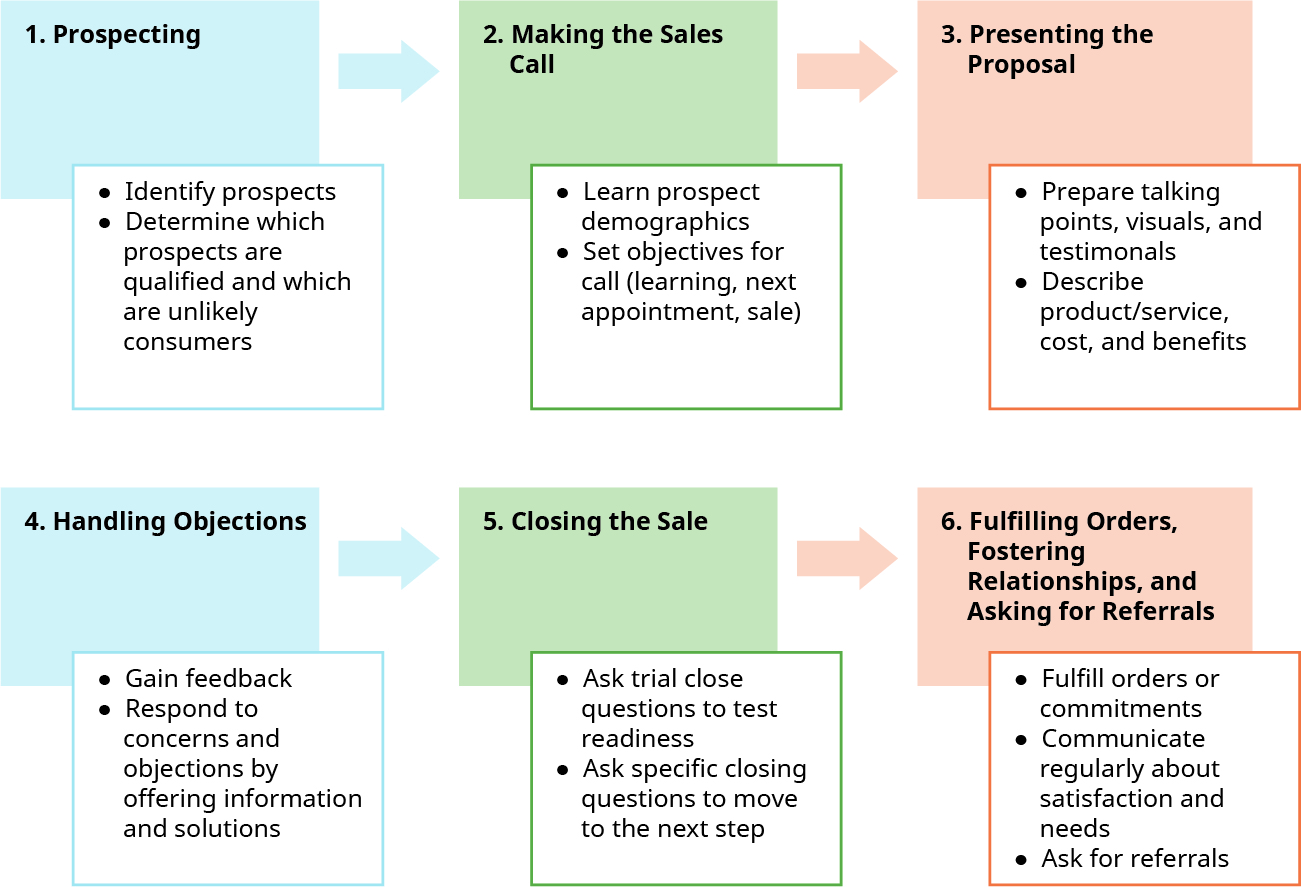
Sample Six-Step Sales Strategy
outlines an example of an effective sales system or strategy using a six-step approach.1
Prospecting and Preparing
Prospecting focuses on finding potential new customers for the product or service. This helps acquire new customers, replace customers lost to attrition, and expand sales from current customers. In essence, prospecting allows salespeople to collect information about potential customers and identify any who are not a good fit for the company. It is important to get as many prospects as possible to secure a few customers, as the pool of prospects diminishes through successive steps of the sales process.
You may need to have a list of twenty prospects to secure one or two customers. Prospecting also tends to be more important in certain industries such as financial advising or business-to-business industries. To determine whether a person or organization is a qualified prospect, the salesperson must consider several issues, such as whether this person/business needs my product or service, and if they can afford it.
Making the Sales Call
The next step of the sales system is to prepare for a sales call, contact, or meeting with a prospect. Effective sales people usually prepare well in advance of contacting a prospect. A salesperson can look for information regarding the company’s demographics, its competition, clients, and other companies they purchase from. Information can be gathered from online sources or referrals. It is also helpful to set objectives before contacting the prospect. Some of those objectives can include securing an appointment for a presentation, understanding the prospect better, scheduling a second call/contact, or perhaps starting a sale.
Presenting the Proposal
Once the salesperson has made a connection with a prospect and understands the prospect’s needs, the next step is to meet with the prospect for a sales presentation. A presentation is a great way to expand the prospect’s understanding about the offering. Strong presentations include good communication skills with strong visuals and testimonials. In this step, the salesperson can make a better case for the value proposition, citing the strengths of the product and how those strengths would help the prospect in their life or how it would help a company’s objectives. The presentation can also include the cost of the investment and a projection of the return on investment. In the case of a financial advisor, a presentation at a prospect’s home would show the potential products that the prospect might invest in, such as a variety of retirement accounts, life insurance, a college savings plan, or long-term care insurance, along with the costs and benefits of each. In the case of a business, the presentation could take place at the prospect’s office, and the meeting could include a slide presentation about a piece of equipment, with video showing how it is used and how it can benefit the company, including cost savings.
Handling Objections
During or after the presentation, a salesperson will likely encounter objections or questions from the prospect. This is a good way for the salesperson to gain feedback and respond to concerns from the prospect. Objections can arise during the appointment setting, during the presentation, or while trying to close the sale. The salesperson must be proficient at dealing with these in a truthful manner so the relationship that is established is based on trust. Some of those objections can include cost concerns, credit capabilities, product benefits, or plain rejection of the product. In this case, the financial advisor could answer questions about the potential benefits of one type of insurance over another, or handle objections on the monthly payment plan. If dealing with a company, these questions can take the form of credit opportunities and amount of cost savings in comparison to a competitor.
Closing the Sale
Once the presentation and objections are handled, the next step is to close, or ask for the sale. This is as important as being prepared to present and handle objections because it signals to the prospect that the product is a good fit and the relationship can be created. A good closing includes a trustworthy and logical process. Doing a trial close by asking “How is this so far?” or “Can I answer anything else?” can help the customer feel more at ease with making a decision. The customer will help set the pace for a final closing. Then, the salesperson can set up the next steps or ask the following questions: “Can I place the order for you?” “Can we open the life insurance account for you?” “Can you come see the demonstration at our office?” “Can we meet next week for the financial terms?”
Fulfilling Orders, Fostering Relationships, and Asking for Referrals
Finally, the salesperson must fulfill the order and make sure that the customer is satisfied with the product or service. The salesperson, in the end, is the one who is the main contact for the customer and therefore is responsible for the fulfillment of a correct order. The order needs to be closely monitored in case there are any delays or issues with it, so the customer can be immediately notified. The process of the order fulfillment has to be monitored until it is fulfilled. Software has now made it easier to keep track of these orders, so the salesperson can spend more time selling and less time on the order process. Customer relationship management tools such as Salesforce (https://www.salesforce.com/crm/) can help a small entrepreneur or a larger business keep track of its customers, their orders, troubleshooting, and strategies for cost effectiveness.
Building a direct relationship with the customer is also important; therefore, calls or emails to check in consistently is important to assess customer satisfaction and t build the relationship bridge to ask for referrals. Customer retention is more important than ever, as even a small percentage of customers can make up the majority of your sales. Wooing new customers is 5 percent more expensive than keeping your current ones, and in the long run, those who are your VIPs will generate most of your sales.2 Research shows that retaining even 5 percent of your current customers can generate anywhere from 25 percent to 95 percent of your sales.3
Customer Service
One of the most important aspects of making the sale, and one that often wins or loses customers, is customer service. If you have ever stepped into a business where you have been greeted with a smile and treated kindly throughout the purchase process, you will probably want to come back and purchase from that store or salesperson again. However, if the sales associate is rude and doesn’t help you find what you need, chances are you will not return to the store a second time. For start-ups, customer service can be an advantage, as the business can focus on a few customers at a time in a more personal manner. The bigger a company is, the harder it is to manage many customers and sales associates on a personal level.
According to Hubspot’s top statistics on customer service, 70 percent of the customer experience or journey depends on how they are being treated. The majority of customers fall in love with a brand and are willing to pay a premium for amazing customer service, and they feel that great customer service is more important than price. They will also share positive experiences with other people—an average of eleven, according to Hubspot.4 When a customer has a negative experience, or feels unappreciated, they are more likely to switch brands, and a company has to work harder to counteract a negative experience. It takes twelve positive reviews to counteract just one negative, unresolved customer issue.5
As an entrepreneur, focusing on customer service before and after the purchase is an effective reminder that the company is trying to build trust and have a relationship with its customers. This also helps with the process of branding, as you’ve learned. Even in business-to-business sales transactions, the most important aspect of the sales process is building that trust relationship so the customer purchases from a “friend” again. Often when companies lose accounts, it is due to a change in sales personnel and the loss of the associated relationship.
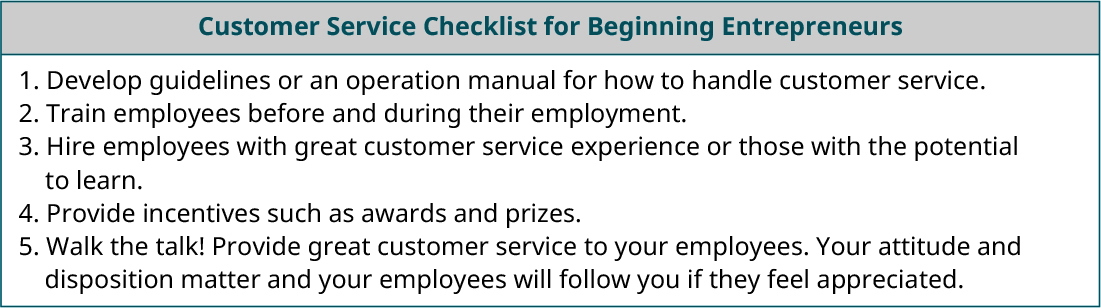
One effective way to ensure great customer service is to create an operating manual for your employees that includes proper techniques for customer service. These techniques can include how to greet a customer, how to listen and help them get what they need, the philosophy of your company, how far to go when insuring great service, and how to be creative with customer service. Employees can review the manual when they are hired, and every year after that to ensure they continue to follow the procedures. Training programs before starting work and during the year can be facilitated by the entrepreneur or a consultant to sharpen the skills of the employees. These programs are a great way to energize salespeople to be more people oriented and to develop the proper attitude and positive thinking that is required when helping customers. Sales training programs are a great way to learn more about customer service. Zig Ziglar and Dr. Cialdini programs are designed with the salesperson in mind.
Also, when hiring, focus on candidates who already have customer service experience and those who come with good referrals. Incentives for great customer service such as an employee of the month/year award or financial incentives can also encourage employees to provide great service. Finally, the entrepreneur and any administrators are the leaders of a company who must show the same customer service to their employees. Walk the talk! If they realize that they are there to serve their employees and enable them to create a great customer service atmosphere, then the employees will share the same enthusiasm and energy toward their customers. Happy employees turn into profitable customers. shows a quick checklist for beginning entrepreneurs.
Customer service doesn’t happen just in person or on the phone. Technology has enabled people and companies to connect through email and social media, taking the conversation and interaction online. Customers can now talk to the company employees, voice their concerns, and get issues resolve through these avenues. These technological advances have provided a bigger platform for customers to rave about companies or complain about them.6 This love or dislike can translate into social media posts, tweets, pictures, videos, and reviews for thousands or millions of people to see and can help or tarnish a company.
Summary
Sales drives profit. They may require a simple sales approach or a complicated sales system. An example of a sales system is a six-step sales strategy: doing research about prospective clients and creating a list; making an appointment to talk about your good or service; meeting with them to present a proposal; handling objections; closing the deal; and nurturing the relationship after close. When selling luxury and expensive items, the sales approach is usually more thorough and requires more sales training and finesse. Customer service is a component that is linked to this process and with proper training can really differentiate a company from the competition.
Review Questions
What are the steps in the sales process?
How does customer service impact sales of a new business?
Discussion Questions
Negative referrals can have a great impact on a company’s sales. Remember an instance where you were the source of a bad referral for a product or service, and determine what made the experience so negative. What would you have done differently as the sales person to prevent that?
Case Questions
You have recently become a supplier of heavy equipment to manufacturing plants that build automotive components. You have acquired one customer and would like to add more within the next three months. How would you go about prospecting?
Suggested Resources
Cialdini online tools: https://www.influenceatwork.com/
Hoffman Sales Training: https://sellhoffman.com/
Neil Rackman: http://neilrackham.com/
Spin Selling: https://blog.hubspot.com/sales/spin-selling-the-ultimate-guide
Zig Ziglar: https://www.ziglar.com/
The State of Customer Service: https://offers.hubspot.com/state-of-customer-service?hubs_post-cta=anchor&hsCtaTracking=9c545446-aacf-47a3-bfb3-1998f78b79c8%7C4f98051f-03f6-4061-9a68-5de8fcbb40c1
Cialdini, R. B. (2001). Influence: Science and Practice (4th ed.). Boston: Allyn & Bacon: Explains some aspects of the sales process in a fun and fact-based manner.
Footnotes
- Stephen Castleberry and John Tanner. Selling: Building Partnerships. New York: McGraw-Hill, 2019. ↩
- Matt Mansfield. “Customer Retention Statistics: The Ultimate Collection for Small Business.” Small Business Trends. August 22, 2019. https://smallbiztrends.com/2016/10/customer-retention-statistics.html ↩
- Jia Wertz. “Don’t Spend 5 Times More Attracting New Customers, Nurture the Existing Ones.” Forbes. September 12, 2018. https://www.forbes.com/sites/jiawertz/2018/09/12/dont-spend-5-times-more-attracting-new-customers-nurture-the-existing-ones/#723fd9e15a8e ↩
- Swetha Amaresan. “31 Customer Service Stats to Know in 2019.” HubSpot. March 19, 2019. https://blog.hubspot.com/service/customer-service-stats ↩
- Swetha Amaresan. “31 Customer Service Stats to Know in 2019.” HubSpot. March 19, 2019. https://blog.hubspot.com/service/customer-service-stats ↩
- Liz Greene. “Social Media Is a Customer Service Channel Whether You Like It or Not.” Digital Marketing Institute. n.d. https://digitalmarketinginstitute.com/en-us/blog/social-media-is-a-customer-service-channel-whether-you-like-it-or-not ↩