The Challenging Truth about Business Ownership
Learning Objectives
By the end of this section, you will be able to:
- Explain the pros and cons of business ownership before you launch
- Understand current trends in entrepreneurship in the US
- Determine the challenges women face in entrepreneurship and what resources they can use to overcome them
- Determine the challenges minority entrepreneurs face and resources available for them
View this section's JSON
{
"id": "m71166",
"doc_class": "",
"title": "The Challenging Truth about Business Ownership",
"objectives": [
"Explain the pros and cons of business ownership before you launch",
"Understand current trends in entrepreneurship in the US",
"Determine the challenges women face in entrepreneurship and what resources they can use to overcome them",
"Determine the challenges minority entrepreneurs face and resources available for them"
],
"figures": [
{
"src": "OSX_Eship_10_03_Estab.jpg",
"alt": "A graph of the number of business establishments less than one year old from 1994 to 2015. There were approximately 575,000 such businesses in 1994, which increased gradually until peaking in 2006 at around 720,000, then abruptly falling to a low in 2010 to approximately 560,000 before climbing again to around 675,000 in 2015.",
"caption": "The number of new businesses usually rises and falls with the economy. This graph shows that the number of new establishments has risen in recent years.<span class=\"footnote\">Bureau of Labor Statistics. “Entrepreneurship and the US Economy.” <em>United States Department of Labor</em>. April 28, 2016. https://www.bls.gov/bdm/entrepreneurship/entrepreneurship.htm</span> (attribution: Copyright Rice University, OpenStax, under CC BY NC-SA 4.0 license)"
},
{
"src": "OSX_Eship_10_03_Jobs.jpg",
"alt": "A graph of the jobs created by establishments less than one year old from 1994 to 2015. There were approximately 4,200,000 such jobs in 1994, which increased gradually until 1999 at around 4,750,000, then gradually falling to a low in 2010 to approximately 2,500,000 before gradually climbing again to around 3,000,000 in 2015. Source: U.S. Bureau of Labor Statistics.",
"caption": "While the number of new business establishments has risen, the number of jobs and the survival of businesses (following) have decreased during the same period.<span class=\"footnote\">Bureau of Labor Statistics. “Entrepreneurship and the US Economy.” <em>United States Department of Labor</em>. April 28, 2016. https://www.bls.gov/bdm/entrepreneurship/entrepreneurship.htm</span> (attribution: Copyright Rice University, OpenStax, under CC BY NC-SA 4.0 license)"
},
{
"src": "OSX_Eship_10_03_SurvRate.jpg",
"alt": "Graph of the survival rates of establishments, by year started and number of years since starting, from 1994 to 2015. There is a sharp decrease within the first 5 years, followed by a slower drop. Even at 22 years, survival is still dropping. Source: U.S. Bureau of Labor Statistics.",
"caption": "Survival rates of businesses from 1994–2015. This graph shows that as years go by, fewer businesses stay open.<span class=\"footnote\">Bureau of Labor Statistics. “Entrepreneurship and the US Economy.” <em>United States Department of Labor</em>. April 28, 2016. https://www.bls.gov/bdm/entrepreneurship/entrepreneurship.htm</span> (attribution: Copyright Rice University, OpenStax, under CC BY NC-SA 4.0 license)"
}
],
"tokens": 5177,
"blocks": [
{
"anchor": "m71166-b1",
"trail": [
"Learning Objectives"
],
"heading": "Learning Objectives",
"html": "<section class=\"learning-objectives\"><h2>Learning Objectives</h2><p>By the end of this section, you will be able to:</p><ul><li>Explain the pros and cons of business ownership before you launch</li><li>Understand current trends in entrepreneurship in the US</li><li>Determine the challenges women face in entrepreneurship and what resources they can use to overcome them</li><li>Determine the challenges minority entrepreneurs face and resources available for them</li></ul></section>",
"text": "Learning Objectives\nBy the end of this section, you will be able to:\nExplain the pros and cons of business ownership before you launch\nUnderstand current trends in entrepreneurship in the US\nDetermine the challenges women face in entrepreneurship and what resources they can use to overcome them\nDetermine the challenges minority entrepreneurs face and resources available for them",
"tokens": 95
},
{
"anchor": "m71166-b2",
"trail": [],
"heading": null,
"html": "<p>People usually have different reasons for starting a business. Some of the reasons—other than the idea they’ve hit upon—include the freedom to set their own hours, spend more time with family, be their own boss, and make money. However, in many cases, they will probably work more than planned, be challenged to find the work-life balance, face fears and doubts, and perhaps struggle to make ends meet for the first few months or years. Prior to launch, they will need the support of family, friends, and mentors to understand the limitations of time and the pressures they face.</p>",
"text": "People usually have different reasons for starting a business. Some of the reasons—other than the idea they’ve hit upon—include the freedom to set their own hours, spend more time with family, be their own boss, and make money. However, in many cases, they will probably work more than planned, be challenged to find the work-life balance, face fears and doubts, and perhaps struggle to make ends meet for the first few months or years. Prior to launch, they will need the support of family, friends, and mentors to understand the limitations of time and the pressures they face.",
"tokens": 144
},
{
"anchor": "m71166-b3",
"trail": [
"Pros and Cons of Business Ownership"
],
"heading": "Pros and Cons of Business Ownership",
"html": "<section class=\"\"><h2>Pros and Cons of Business Ownership</h2><p> lists the positives and negatives that should be considered prior to opening a business and throughout its operation. Positives of entrepreneurship include having the freedom and independence to expand your skills and develop your own ideas. Instead of working for another organization on projects and ideas that are not your own, you get to serve people in a way that feels right for you. You also have the opportunity to make a profit and have a better lifestyle. Having the freedom to set your own schedule and work at your own pace can be very satisfying as well.</p><p>On the opposite side, those “freedoms” translate into being in charge of the business and the significant responsibility that entails. You must resolve issues that arise every day, such as dealing with employees, customers, production, marketing, and financing, among others. Most of the time, you wear many hats, especially during the venture’s early lifecycle stages, and most entrepreneurs usually work more hours than anticipated. In addition, you must deal with losses and risk if things don’t go well. The important thing to keep in mind is that all of the negative aspects have solutions and can even be prevented if planning, mentorship, and a good support system are in place, which can alleviate many of the stresses that entrepreneurs experience. Also, having attainable goals in creating awareness of the business, number of clients, and sales or profit can be beneficial in alleviating some of that pressure.</p><table><thead><tr><th>Pros and Cons of Business Ownership</th></tr><tr><th>Pros</th><th>Cons</th></tr></thead><tbody><tr><td><ul><li>Being autonomous, being your own boss, expanding ideas, enjoying creative freedom</li><li>Lifestyle, making your own schedule, flexibility</li><li>Satisfied with career</li><li>Serving customers and employees</li><li>Profit</li><li>Being known in the community</li></ul></td><td><ul><li>Being in charge, resolving issues, hiring/firing employees, and wearing many hats</li><li>Dealing with stress, time constraints, and management</li><li>Lack of focus, loss of passion</li><li>Customer and employee complaints</li><li>Money/cash flow problems</li><li>Must deal with losses and financial risk</li></ul></td></tr></tbody></table></section>",
"text": "Pros and Cons of Business Ownership\n lists the positives and negatives that should be considered prior to opening a business and throughout its operation. Positives of entrepreneurship include having the freedom and independence to expand your skills and develop your own ideas. Instead of working for another organization on projects and ideas that are not your own, you get to serve people in a way that feels right for you. You also have the opportunity to make a profit and have a better lifestyle. Having the freedom to set your own schedule and work at your own pace can be very satisfying as well.\nOn the opposite side, those “freedoms” translate into being in charge of the business and the significant responsibility that entails. You must resolve issues that arise every day, such as dealing with employees, customers, production, marketing, and financing, among others. Most of the time, you wear many hats, especially during the venture’s early lifecycle stages, and most entrepreneurs usually work more hours than anticipated. In addition, you must deal with losses and risk if things don’t go well. The important thing to keep in mind is that all of the negative aspects have solutions and can even be prevented if planning, mentorship, and a good support system are in place, which can alleviate many of the stresses that entrepreneurs experience. Also, having attainable goals in creating awareness of the business, number of clients, and sales or profit can be beneficial in alleviating some of that pressure.\nPros and Cons of Business Ownership\nProsCons\nBeing autonomous, being your own boss, expanding ideas, enjoying creative freedom\nLifestyle, making your own schedule, flexibility\nSatisfied with career\nServing customers and employees\nProfit\nBeing known in the community\nBeing in charge, resolving issues, hiring/firing employees, and wearing many hats\nDealing with stress, time constraints, and management\nLack of focus, loss of passion\nCustomer and employee complaints\nMoney/cash flow problems\nMust deal with losses and financial risk",
"tokens": 514
},
{
"anchor": "m71166-b4",
"trail": [
"Entrepreneurship and Competition in the US"
],
"heading": "Entrepreneurship and Competition in the US",
"html": "<section class=\"\"><h2>Entrepreneurship and Competition in the US</h2><p>Entrepreneurs operate in an unbelievably competitive landscape. Although <dfn>competition</dfn> helps create better products and services, it also places many stresses on a business owner who must compete with new, more flexible businesses that may have lower prices and better products. As shown in , the number of new establishments that are less than one year old has increased over the past two decades from 1994 to 2015. There was a dip during the 2009 recession, but the trend continued after 2011, and the number of businesses increased again. This means more competition for businesses that are already established.</p><figure><img src=\"media/OSX_Eship_10_03_Estab.jpg\" alt=\"A graph of the number of business establishments less than one year old from 1994 to 2015. There were approximately 575,000 such businesses in 1994, which increased gradually until peaking in 2006 at around 720,000, then abruptly falling to a low in 2010 to approximately 560,000 before climbing again to around 675,000 in 2015.\"><figcaption>The number of new businesses usually rises and falls with the economy. This graph shows that the number of new establishments has risen in recent years.<sup class=\"footnote-ref\"><a id=\"fnref1\" href=\"#fn1\" aria-label=\"Footnote 1\">1</a></sup> (attribution: Copyright Rice University, OpenStax, under CC BY NC-SA 4.0 license)</figcaption><span class=\"figure-alt\">A graph of the number of business establishments less than one year old from 1994 to 2015. There were approximately 575,000 such businesses in 1994, which increased gradually until peaking in 2006 at around 720,000, then abruptly falling to a low in 2010 to approximately 560,000 before climbing again to around 675,000 in 2015.</span></figure><p>The number of jobs created by these young establishments has also decreased in this period, which affirms the likelihood that entrepreneurs are wearing many hats in their own businesses. charts this trend.</p><figure><img src=\"media/OSX_Eship_10_03_Jobs.jpg\" alt=\"A graph of the jobs created by establishments less than one year old from 1994 to 2015. There were approximately 4,200,000 such jobs in 1994, which increased gradually until 1999 at around 4,750,000, then gradually falling to a low in 2010 to approximately 2,500,000 before gradually climbing again to around 3,000,000 in 2015. Source: U.S. Bureau of Labor Statistics.\"><figcaption>While the number of new business establishments has risen, the number of jobs and the survival of businesses (following) have decreased during the same period.<sup class=\"footnote-ref\"><a id=\"fnref2\" href=\"#fn2\" aria-label=\"Footnote 2\">2</a></sup> (attribution: Copyright Rice University, OpenStax, under CC BY NC-SA 4.0 license)</figcaption><span class=\"figure-alt\">A graph of the jobs created by establishments less than one year old from 1994 to 2015. There were approximately 4,200,000 such jobs in 1994, which increased gradually until 1999 at around 4,750,000, then gradually falling to a low in 2010 to approximately 2,500,000 before gradually climbing again to around 3,000,000 in 2015. Source: U.S. Bureau of Labor Statistics.</span></figure><p>As you’ve learned, only about 20–30 percent of businesses succeed to the five- or ten-year mark. shows that only half of businesses survive to the five-year mark, and only 20 percent are sustained for two decades. Their failures may be due to a number of factors such as cash flow problems, lack of passion, lack of support, lack of innovation, difficulty adapting to new technologies or customer demand, and environmental factors that can influence a business as well, such as the economy, trends, regulations, or sociocultural changes. Therefore, it’s important for entrepreneurs to research their internal as well as their external environments before launching. The chapters on Identifying Entrepreneurial Opportunity and Entrepreneurial Marketing and Sales take a look at such research, as it pertains to both the entrepreneur and the marketing environment respectively.</p><figure><img src=\"media/OSX_Eship_10_03_SurvRate.jpg\" alt=\"Graph of the survival rates of establishments, by year started and number of years since starting, from 1994 to 2015. There is a sharp decrease within the first 5 years, followed by a slower drop. Even at 22 years, survival is still dropping. Source: U.S. Bureau of Labor Statistics.\"><figcaption>Survival rates of businesses from 1994–2015. This graph shows that as years go by, fewer businesses stay open.<sup class=\"footnote-ref\"><a id=\"fnref3\" href=\"#fn3\" aria-label=\"Footnote 3\">3</a></sup> (attribution: Copyright Rice University, OpenStax, under CC BY NC-SA 4.0 license)</figcaption><span class=\"figure-alt\">Graph of the survival rates of establishments, by year started and number of years since starting, from 1994 to 2015. There is a sharp decrease within the first 5 years, followed by a slower drop. Even at 22 years, survival is still dropping. Source: U.S. Bureau of Labor Statistics.</span></figure></section>",
"text": "Entrepreneurship and Competition in the US\nEntrepreneurs operate in an unbelievably competitive landscape. Although competition helps create better products and services, it also places many stresses on a business owner who must compete with new, more flexible businesses that may have lower prices and better products. As shown in , the number of new establishments that are less than one year old has increased over the past two decades from 1994 to 2015. There was a dip during the 2009 recession, but the trend continued after 2011, and the number of businesses increased again. This means more competition for businesses that are already established.\n [figure: A graph of the number of business establishments less than one year old from 1994 to 2015. There were approximately 575,000 such businesses in 1994, which increased gradually until peaking in 2006 at around 720,000, then abruptly falling to a low in 2010 to approximately 560,000 before climbing again to around 675,000 in 2015.] The number of new businesses usually rises and falls with the economy. This graph shows that the number of new establishments has risen in recent years.1 (attribution: Copyright Rice University, OpenStax, under CC BY NC-SA 4.0 license)\nA graph of the number of business establishments less than one year old from 1994 to 2015. There were approximately 575,000 such businesses in 1994, which increased gradually until peaking in 2006 at around 720,000, then abruptly falling to a low in 2010 to approximately 560,000 before climbing again to around 675,000 in 2015.The number of jobs created by these young establishments has also decreased in this period, which affirms the likelihood that entrepreneurs are wearing many hats in their own businesses. charts this trend.\n [figure: A graph of the jobs created by establishments less than one year old from 1994 to 2015. There were approximately 4,200,000 such jobs in 1994, which increased gradually until 1999 at around 4,750,000, then gradually falling to a low in 2010 to approximately 2,500,000 before gradually climbing again to around 3,000,000 in 2015. Source: U.S. Bureau of Labor Statistics.] While the number of new business establishments has risen, the number of jobs and the survival of businesses (following) have decreased during the same period.2 (attribution: Copyright Rice University, OpenStax, under CC BY NC-SA 4.0 license)\nA graph of the jobs created by establishments less than one year old from 1994 to 2015. There were approximately 4,200,000 such jobs in 1994, which increased gradually until 1999 at around 4,750,000, then gradually falling to a low in 2010 to approximately 2,500,000 before gradually climbing again to around 3,000,000 in 2015. Source: U.S. Bureau of Labor Statistics.As you’ve learned, only about 20–30 percent of businesses succeed to the five- or ten-year mark. shows that only half of businesses survive to the five-year mark, and only 20 percent are sustained for two decades. Their failures may be due to a number of factors such as cash flow problems, lack of passion, lack of support, lack of innovation, difficulty adapting to new technologies or customer demand, and environmental factors that can influence a business as well, such as the economy, trends, regulations, or sociocultural changes. Therefore, it’s important for entrepreneurs to research their internal as well as their external environments before launching. The chapters on Identifying Entrepreneurial Opportunity and Entrepreneurial Marketing and Sales take a look at such research, as it pertains to both the entrepreneur and the marketing environment respectively.\n [figure: Graph of the survival rates of establishments, by year started and number of years since starting, from 1994 to 2015. There is a sharp decrease within the first 5 years, followed by a slower drop. Even at 22 years, survival is still dropping. Source: U.S. Bureau of Labor Statistics.] Survival rates of businesses from 1994–2015. This graph shows that as years go by, fewer businesses stay open.3 (attribution: Copyright Rice University, OpenStax, under CC BY NC-SA 4.0 license)\nGraph of the survival rates of establishments, by year started and number of years since starting, from 1994 to 2015. There is a sharp decrease within the first 5 years, followed by a slower drop. Even at 22 years, survival is still dropping. Source: U.S. Bureau of Labor Statistics.",
"tokens": 1101
},
{
"anchor": "m71166-b5",
"trail": [
"Challenges of Business Ownership for Women"
],
"heading": "Challenges of Business Ownership for Women",
"html": "<section class=\"\"><h2>Challenges of Business Ownership for Women</h2><p>Challenges for business owners can be many. Female entrepreneurs, however, can face additional hardships. These can range from not being able to secure financing for their businesses, having a hard time breaking into an industry, and dealing with fears of starting and growing a business, and not being taken seriously.</p><p>Current research shows that the importance of female entrepreneurship is key to economic success. Women own 40 percent of the country’s businesses,<sup class=\"footnote-ref\"><a id=\"fnref4\" href=\"#fn4\" aria-label=\"Footnote 4\">4</a></sup> generating over $1.4 trillion in sales.<sup class=\"footnote-ref\"><a id=\"fnref5\" href=\"#fn5\" aria-label=\"Footnote 5\">5</a></sup> Women entrepreneurs are closing the gender gap, as their ventures have grown substantially in the past few years. In the past two years, women entrepreneurship rates have gone up by 10 percent each year, compared to men’s 5 percent growth. This surge has been spurred by increased available resources, including mentorship, funding, and programs to help women succeed.<sup class=\"footnote-ref\"><a id=\"fnref6\" href=\"#fn6\" aria-label=\"Footnote 6\">6</a></sup> Nonetheless, there are still great challenges to overcome, as women move into the next generation of business ownership. Some of the main challenges are:</p><ul><li><em>Difficulty gaining entry in certain industries</em>. Women have made great strides in business, but they still face many obstacles, especially in certain industries. Women tend to be underrepresented in specific areas, notably in the tech industry, where they run only 9 percent of businesses.<sup class=\"footnote-ref\"><a id=\"fnref7\" href=\"#fn7\" aria-label=\"Footnote 7\">7</a></sup> Women tend to be underpaid in tech positions, they experience <dfn>sexism</dfn>, and they are often passed over for promotions, especially if they have families with young children. So, if there are no female role models, it is difficult for women to follow an entrepreneurial path that is already full of obstacles. Although young girls and women desire to study and expand their careers, historically, they have not been presented with the opportunities and encouragement to do so, especially in STEM. By the time they get into college, the number of women in these careers—which can be rich in entrepreneurial opportunities—is very small. However, more efforts are being made today to support young girls interested in scientific, technological, and mathematical careers.</li><li><em>Lower sales and fewer employees</em>. Women overall tend to struggle more to keep their businesses afloat, as they have fewer employees,<sup class=\"footnote-ref\"><a id=\"fnref8\" href=\"#fn8\" aria-label=\"Footnote 8\">8</a></sup> less revenue, and less profit than male-owned businesses. Only 2 percent of female-owned businesses make over $1 million in sales. Male-owned businesses, on the other hand, are 3.5 times more likely to hit that revenue target.<sup class=\"footnote-ref\"><a id=\"fnref9\" href=\"#fn9\" aria-label=\"Footnote 9\">9</a></sup> Some of the reasons why women experience this is because women may enter entrepreneurship part time, often striving to sustain a decent family work balance, which is difficult when children, especially young children, are part of the equation. This set-up usually includes one employee, who is the entrepreneur herself, and she may have attained her goals without wanting to make millions. Time, flexibility, and work-life balance can be reasons women become entrepreneurs, and they are happy with their goals of making some money while taking care of their family and household. Lack of experience in business or managing a family business, and lack of access to capital are also reasons for the lower metrics.<sup class=\"footnote-ref\"><a id=\"fnref10\" href=\"#fn10\" aria-label=\"Footnote 10\">10</a></sup></li><li><em>Less access to capital</em>. Regardless of their success and prowess, women still have a harder time securing funding for their businesses. A recent Kauffman Foundation survey determined that more than 72 percent of women don’t have the access to capital they need.<sup class=\"footnote-ref\"><a id=\"fnref11\" href=\"#fn11\" aria-label=\"Footnote 11\">11</a></sup> Nirupama <dfn>Mallavarupu</dfn>, founder of <dfn>MobileArq</dfn> says, “As a woman entrepreneur with a focus on helping non-profits and schools, it has been difficult to get investors. We have turned this around by pursuing customer acquisition organically and relying on direct revenues instead of investment growth.”<sup class=\"footnote-ref\"><a id=\"fnref12\" href=\"#fn12\" aria-label=\"Footnote 12\">12</a></sup> Women usually don’t ask for funding, or if they do but are turned down, they turn to funding from family and friends. They are more likely to finance their ventures this way than men.<sup class=\"footnote-ref\"><a id=\"fnref13\" href=\"#fn13\" aria-label=\"Footnote 13\">13</a></sup></li><li><em>Not taken seriously</em>. Sometimes it’s not that women don’t have the opportunities, money, or mentorships to start a business: Sometimes, women are just not taken seriously. Research by Freshbooks Accounting and Software firm and Research Now asked 2,700 entrepreneurs about gender discrimination and the wage gap that exist today. Thirty percent of women pointed out that they are not taken seriously as business owners, as they must work harder than their male counterparts and have to charge less to get a client.<sup class=\"footnote-ref\"><a id=\"fnref14\" href=\"#fn14\" aria-label=\"Footnote 14\">14</a></sup> Emily <dfn>Harsh</dfn>, owner of <dfn>Heart Move Collective</dfn>, comments in her blog, “Because I am in the fitness industry and female, I am often not taken seriously as a professional. I think the number one most important thing you can do as a woman fighting to pave your own path is to continually stay authentic.”<sup class=\"footnote-ref\"><a id=\"fnref15\" href=\"#fn15\" aria-label=\"Footnote 15\">15</a></sup></li><li><em>Resources</em>. Fortunately, there are many resources that women can take advantage of. Organizations such as the <dfn>Women’s Business Center of the Small Business Administration</dfn>, the <dfn>National Association for Women Owners</dfn>, the <dfn>Female Entrepreneur Association</dfn>, <dfn>Ladies Who Launch</dfn>, <dfn>Minority Business Development Agency</dfn>, the <dfn>National Association of Professional Women</dfn>, and the <dfn>Women’s Business Enterprise National Council</dfn> strive to help women succeed in all industries by providing loans and programs that prepare them for a competitive landscape. Mentoring by other women has also proven to be effective in women’s success in entrepreneurship.<sup class=\"footnote-ref\"><a id=\"fnref16\" href=\"#fn16\" aria-label=\"Footnote 16\">16</a></sup> Having peers that can help and strong mentors can make a difference in the outcome of a business.</li></ul><p>Other helpful tips to counteract the challenges facing women entrepreneurs include being assertive, being authentic, networking, and developing a thick skin for rejections and other challenges. <dfn>Facebook</dfn> COO Sheryl <dfn>Sandberg</dfn>, in her book <em>Lean In</em>, states that “being confident and believing in your own self-worth is necessary to achieving your potential” and she encourages women entrepreneurs to ask themselves: “What would you do if you weren't afraid?”<sup class=\"footnote-ref\"><a id=\"fnref17\" href=\"#fn17\" aria-label=\"Footnote 17\">17</a></sup></p><p>Women bring great qualities to entrepreneurship such as strong leadership, as well as management, time, multitasking, and listening skills. Women also have a collaborative approach to relationships that works well in many industries.<sup class=\"footnote-ref\"><a id=\"fnref18\" href=\"#fn18\" aria-label=\"Footnote 18\">18</a></sup></p></section>",
"text": "Challenges of Business Ownership for Women\nChallenges for business owners can be many. Female entrepreneurs, however, can face additional hardships. These can range from not being able to secure financing for their businesses, having a hard time breaking into an industry, and dealing with fears of starting and growing a business, and not being taken seriously.\nCurrent research shows that the importance of female entrepreneurship is key to economic success. Women own 40 percent of the country’s businesses,4 generating over $1.4 trillion in sales.5 Women entrepreneurs are closing the gender gap, as their ventures have grown substantially in the past few years. In the past two years, women entrepreneurship rates have gone up by 10 percent each year, compared to men’s 5 percent growth. This surge has been spurred by increased available resources, including mentorship, funding, and programs to help women succeed.6 Nonetheless, there are still great challenges to overcome, as women move into the next generation of business ownership. Some of the main challenges are:\nDifficulty gaining entry in certain industries. Women have made great strides in business, but they still face many obstacles, especially in certain industries. Women tend to be underrepresented in specific areas, notably in the tech industry, where they run only 9 percent of businesses.7 Women tend to be underpaid in tech positions, they experience sexism, and they are often passed over for promotions, especially if they have families with young children. So, if there are no female role models, it is difficult for women to follow an entrepreneurial path that is already full of obstacles. Although young girls and women desire to study and expand their careers, historically, they have not been presented with the opportunities and encouragement to do so, especially in STEM. By the time they get into college, the number of women in these careers—which can be rich in entrepreneurial opportunities—is very small. However, more efforts are being made today to support young girls interested in scientific, technological, and mathematical careers.\nLower sales and fewer employees. Women overall tend to struggle more to keep their businesses afloat, as they have fewer employees,8 less revenue, and less profit than male-owned businesses. Only 2 percent of female-owned businesses make over $1 million in sales. Male-owned businesses, on the other hand, are 3.5 times more likely to hit that revenue target.9 Some of the reasons why women experience this is because women may enter entrepreneurship part time, often striving to sustain a decent family work balance, which is difficult when children, especially young children, are part of the equation. This set-up usually includes one employee, who is the entrepreneur herself, and she may have attained her goals without wanting to make millions. Time, flexibility, and work-life balance can be reasons women become entrepreneurs, and they are happy with their goals of making some money while taking care of their family and household. Lack of experience in business or managing a family business, and lack of access to capital are also reasons for the lower metrics.10\nLess access to capital. Regardless of their success and prowess, women still have a harder time securing funding for their businesses. A recent Kauffman Foundation survey determined that more than 72 percent of women don’t have the access to capital they need.11 Nirupama Mallavarupu, founder of MobileArq says, “As a woman entrepreneur with a focus on helping non-profits and schools, it has been difficult to get investors. We have turned this around by pursuing customer acquisition organically and relying on direct revenues instead of investment growth.”12 Women usually don’t ask for funding, or if they do but are turned down, they turn to funding from family and friends. They are more likely to finance their ventures this way than men.13\nNot taken seriously. Sometimes it’s not that women don’t have the opportunities, money, or mentorships to start a business: Sometimes, women are just not taken seriously. Research by Freshbooks Accounting and Software firm and Research Now asked 2,700 entrepreneurs about gender discrimination and the wage gap that exist today. Thirty percent of women pointed out that they are not taken seriously as business owners, as they must work harder than their male counterparts and have to charge less to get a client.14 Emily Harsh, owner of Heart Move Collective, comments in her blog, “Because I am in the fitness industry and female, I am often not taken seriously as a professional. I think the number one most important thing you can do as a woman fighting to pave your own path is to continually stay authentic.”15\nResources. Fortunately, there are many resources that women can take advantage of. Organizations such as the Women’s Business Center of the Small Business Administration, the National Association for Women Owners, the Female Entrepreneur Association, Ladies Who Launch, Minority Business Development Agency, the National Association of Professional Women, and the Women’s Business Enterprise National Council strive to help women succeed in all industries by providing loans and programs that prepare them for a competitive landscape. Mentoring by other women has also proven to be effective in women’s success in entrepreneurship.16 Having peers that can help and strong mentors can make a difference in the outcome of a business.\nOther helpful tips to counteract the challenges facing women entrepreneurs include being assertive, being authentic, networking, and developing a thick skin for rejections and other challenges. Facebook COO Sheryl Sandberg, in her book Lean In, states that “being confident and believing in your own self-worth is necessary to achieving your potential” and she encourages women entrepreneurs to ask themselves: “What would you do if you weren't afraid?”17\nWomen bring great qualities to entrepreneurship such as strong leadership, as well as management, time, multitasking, and listening skills. Women also have a collaborative approach to relationships that works well in many industries.18",
"tokens": 1548
},
{
"anchor": "m71166-b6",
"trail": [
"Challenges of Business Ownership for Minorities"
],
"heading": "Challenges of Business Ownership for Minorities",
"html": "<section class=\"\"><h2>Challenges of Business Ownership for Minorities</h2><p>Entrepreneurs from minority groups encounter additional challenges. Minority groups are a strong force in the economy of the country, yet they still experience additional challenges that sometimes prevent them from succeeding in their businesses. These can range from having lower capital access<sup class=\"footnote-ref\"><a id=\"fnref19\" href=\"#fn19\" aria-label=\"Footnote 19\">19</a></sup> due to little credit history, small or nonexistent business networks, and lower business knowledge.<sup class=\"footnote-ref\"><a id=\"fnref20\" href=\"#fn20\" aria-label=\"Footnote 20\">20</a></sup> According to the Census Bureau, minorities own about 29 percent of US businesses.<sup class=\"footnote-ref\"><a id=\"fnref21\" href=\"#fn21\" aria-label=\"Footnote 21\">21</a></sup></p><p>Hispanic people<sup class=\"footnote-ref\"><a id=\"fnref22\" href=\"#fn22\" aria-label=\"Footnote 22\">22</a></sup> comprise 17 percent of the population and own approximately four million (13%) companies in the US with $661 billion in revenue. From 2007 to 2015, business revenue grew 88 percent for Hispanic people, which means that they have more power to employ more people to provide goods and services to a wider audience, and to purchase from other vendors. Given its growth and current size, this group is vital to the health of the economy.<sup class=\"footnote-ref\"><a id=\"fnref23\" href=\"#fn23\" aria-label=\"Footnote 23\">23</a></sup> Unfortunately, research shows that if measured by financial outcomes, Hispanic people still struggle to succeed in business ventures due to a lack of funding, less managerial/business education, and lack of mentorship.<sup class=\"footnote-ref\"><a id=\"fnref24\" href=\"#fn24\" aria-label=\"Footnote 24\">24</a></sup> A higher rate of foreign-born entrepreneurs can experience these challenges due to the lack of networks and financial history in the country.<sup class=\"footnote-ref\"><a id=\"fnref25\" href=\"#fn25\" aria-label=\"Footnote 25\">25</a></sup></p><p>Black people make up 14 percent of the total US population, and their businesses represent about 7 percent of total businesses. Although they are opening businesses faster than their White counterparts, their businesses, as well as Hispanic businesses, tend to have higher failure rates than White- and Asian-owned businesses.<sup class=\"footnote-ref\"><a id=\"fnref26\" href=\"#fn26\" aria-label=\"Footnote 26\">26</a></sup> Similar to Hispanic people, Black people tend to lack funding, managerial/business education, and mentorship.</p><p>Asian Americans make up 5 percent of the population and own just over 4 percent of the businesses in the country. Although they are considered minorities, Asian Americans tend to be better educated and have more access to capital than Hispanic Americans and African Americans.<sup class=\"footnote-ref\"><a id=\"fnref27\" href=\"#fn27\" aria-label=\"Footnote 27\">27</a></sup></p><p>Organizations such as the <dfn>Hispanic, Black, and Asian American Chambers</dfn>, the <dfn>Minority Business and Development Agency (MBDA)</dfn>, and the <dfn>Small Business Administration (SBA)</dfn> have developed programs to help minority entrepreneurs succeed in various ways. These organizations hold workshops once or twice a month to provide helpful information and business plan templates so owners work through their preparation to launch a venture. Chambers are also helpful in matching companies with banks for loans based on their needs and industries. The <dfn>8a certification</dfn> is also facilitated by the Chambers and the MBDA, and provides disadvantaged businesses with an assistance program.</p><aside class=\"note note-link-to-learning\"><p class=\"note-label\">Link to learning</p><p>Go to the <a href=\"https://openstax.org/l/52MBDA\" rel=\"noopener\" target=\"_blank\">MBDA’s page on the 8(a) Business Development Program</a> and read about the requirements and benefits of 8a certification. You can also see that the MBDA offers access to grant and loan programs, and many other helpful resources.</p></aside><p>Disadvantaged businesses are those that are small, owned by someone economically disadvantaged (a person who has less than $250,000 in personal net worth, which includes assets such as cash, home, car, and real estate minus liabilities such as mortgages, credit card debt, and car and bank loans), with an owner demonstrating that the business can be successful. This program helps minority business owners access finances, mentors, counselors, and management assistance, among other resources.<sup class=\"footnote-ref\"><a id=\"fnref28\" href=\"#fn28\" aria-label=\"Footnote 28\">28</a></sup> In addition to this support, some organizations, such as the SBA, provide certifications on various business topics on marketing, finance, accounting, management, and production that usually take the form of short classes for business owners to acquire business acumen. These programs help entrepreneurs gain needed knowledge, grow professionally, and connect with people as they go through their entrepreneurial journeys.</p><aside class=\"note note-link-to-learning\"><p class=\"note-label\">Link to learning</p><p>Read this <a href=\"https://openstax.org/l/52SmallBusChal\" rel=\"noopener\" target=\"_blank\">article from Investopedia on challenges facing small businesses</a> to learn more.</p></aside></section>",
"text": "Challenges of Business Ownership for Minorities\nEntrepreneurs from minority groups encounter additional challenges. Minority groups are a strong force in the economy of the country, yet they still experience additional challenges that sometimes prevent them from succeeding in their businesses. These can range from having lower capital access19 due to little credit history, small or nonexistent business networks, and lower business knowledge.20 According to the Census Bureau, minorities own about 29 percent of US businesses.21\nHispanic people22 comprise 17 percent of the population and own approximately four million (13%) companies in the US with $661 billion in revenue. From 2007 to 2015, business revenue grew 88 percent for Hispanic people, which means that they have more power to employ more people to provide goods and services to a wider audience, and to purchase from other vendors. Given its growth and current size, this group is vital to the health of the economy.23 Unfortunately, research shows that if measured by financial outcomes, Hispanic people still struggle to succeed in business ventures due to a lack of funding, less managerial/business education, and lack of mentorship.24 A higher rate of foreign-born entrepreneurs can experience these challenges due to the lack of networks and financial history in the country.25\nBlack people make up 14 percent of the total US population, and their businesses represent about 7 percent of total businesses. Although they are opening businesses faster than their White counterparts, their businesses, as well as Hispanic businesses, tend to have higher failure rates than White- and Asian-owned businesses.26 Similar to Hispanic people, Black people tend to lack funding, managerial/business education, and mentorship.\nAsian Americans make up 5 percent of the population and own just over 4 percent of the businesses in the country. Although they are considered minorities, Asian Americans tend to be better educated and have more access to capital than Hispanic Americans and African Americans.27\nOrganizations such as the Hispanic, Black, and Asian American Chambers, the Minority Business and Development Agency (MBDA), and the Small Business Administration (SBA) have developed programs to help minority entrepreneurs succeed in various ways. These organizations hold workshops once or twice a month to provide helpful information and business plan templates so owners work through their preparation to launch a venture. Chambers are also helpful in matching companies with banks for loans based on their needs and industries. The 8a certification is also facilitated by the Chambers and the MBDA, and provides disadvantaged businesses with an assistance program.\nLink to learning\nGo to the MBDA’s page on the 8(a) Business Development Program and read about the requirements and benefits of 8a certification. You can also see that the MBDA offers access to grant and loan programs, and many other helpful resources.\n\nDisadvantaged businesses are those that are small, owned by someone economically disadvantaged (a person who has less than $250,000 in personal net worth, which includes assets such as cash, home, car, and real estate minus liabilities such as mortgages, credit card debt, and car and bank loans), with an owner demonstrating that the business can be successful. This program helps minority business owners access finances, mentors, counselors, and management assistance, among other resources.28 In addition to this support, some organizations, such as the SBA, provide certifications on various business topics on marketing, finance, accounting, management, and production that usually take the form of short classes for business owners to acquire business acumen. These programs help entrepreneurs gain needed knowledge, grow professionally, and connect with people as they go through their entrepreneurial journeys.\nLink to learning\nRead this article from Investopedia on challenges facing small businesses to learn more.",
"tokens": 1004
},
{
"anchor": "m71166-b7",
"trail": [
"Summary"
],
"heading": "Summary",
"html": "<section class=\"section-summary\"><h2>Summary</h2><p>Entrepreneurs operate in an extremely competitive landscape. This space has positives and negatives, including being autonomous, being able to expand one’s own ideas, and schedule flexibility. Serving people and employees well can be very satisfying as can the financial success of a strong profit. On the negative side, resolving constantly arising challenges, wearing many hats, dealing with challenges and issues, and having adequate time and cash flow can make entrepreneurship difficult. Women and minority entrepreneurs face additional challenges that can make the experience of being an entrepreneur much more difficult. These include lack of funding opportunities, lack of business education, not being taken seriously, lack of mentorship, and lack of resources. However, there are several organizations that provide the guidance and connections targeted to these groups.</p></section>",
"text": "Summary\nEntrepreneurs operate in an extremely competitive landscape. This space has positives and negatives, including being autonomous, being able to expand one’s own ideas, and schedule flexibility. Serving people and employees well can be very satisfying as can the financial success of a strong profit. On the negative side, resolving constantly arising challenges, wearing many hats, dealing with challenges and issues, and having adequate time and cash flow can make entrepreneurship difficult. Women and minority entrepreneurs face additional challenges that can make the experience of being an entrepreneur much more difficult. These include lack of funding opportunities, lack of business education, not being taken seriously, lack of mentorship, and lack of resources. However, there are several organizations that provide the guidance and connections targeted to these groups.",
"tokens": 221
},
{
"anchor": "m71166-b8",
"trail": [
"Review Questions"
],
"heading": "Review Questions",
"html": "<section class=\"review-questions\"><h2>Review Questions</h2><div class=\"exercise\"><div class=\"problem\"><p>What are some of the realities of business ownership?</p></div></div><div class=\"exercise\"><div class=\"problem\"><p>How can entrepreneurs deal with these negative realities?</p></div></div><div class=\"exercise\"><div class=\"problem\"><p>What percentage of businesses last five years or more?</p></div></div><div class=\"exercise\"><div class=\"problem\"><p>What percentage of US businesses are minority owned?</p></div></div></section>",
"text": "Review Questions\nWhat are some of the realities of business ownership?\nHow can entrepreneurs deal with these negative realities?\nWhat percentage of businesses last five years or more?\nWhat percentage of US businesses are minority owned?",
"tokens": 59
},
{
"anchor": "m71166-b9",
"trail": [
"Discussion Questions"
],
"heading": "Discussion Questions",
"html": "<section class=\"discussion-questions\"><h2>Discussion Questions</h2><div class=\"exercise\"><div class=\"problem\"><p>Discuss how minorities and women can use resources and strategies to deal with their additional challenges as entrepreneurs.</p></div></div><div class=\"exercise\"><div class=\"problem\"><p>Pick three cons of business ownership and strategize how to turn them into pros.</p></div></div><div class=\"exercise\"><div class=\"problem\"><p>Now choose three of the pros of business ownership and consider whether any of them could be cons in certain situations.</p></div></div></section>",
"text": "Discussion Questions\nDiscuss how minorities and women can use resources and strategies to deal with their additional challenges as entrepreneurs.\nPick three cons of business ownership and strategize how to turn them into pros.\nNow choose three of the pros of business ownership and consider whether any of them could be cons in certain situations.",
"tokens": 86
},
{
"anchor": "m71166-b10",
"trail": [
"Case Questions"
],
"heading": "Case Questions",
"html": "<section class=\"case-questions\"><h2>Case Questions</h2><div class=\"exercise\"><div class=\"problem\"><p>Your best friend is a kindergarten teacher who has decided to open a new learning center where toddlers and young children can play in an interactive environment to enhance their motor skills, cognitive development, and leadership skills. She is very excited about her new entrepreneurial experience, but has no idea about the challenges she may face as a young Hispanic woman in her 30s. She knows you have taken an entrepreneurship class before, so she asks for your help in figuring out where to find business resources and recommendations to overcome the challenges she may face. You are happy to help and you answer the following questions:</p><p>What kind of overall advice would you give her? What groups and resources do you think she can tap into? What are some of the challenges she may face as a minority? How can she overcome them?</p></div></div></section>",
"text": "Case Questions\nYour best friend is a kindergarten teacher who has decided to open a new learning center where toddlers and young children can play in an interactive environment to enhance their motor skills, cognitive development, and leadership skills. She is very excited about her new entrepreneurial experience, but has no idea about the challenges she may face as a young Hispanic woman in her 30s. She knows you have taken an entrepreneurship class before, so she asks for your help in figuring out where to find business resources and recommendations to overcome the challenges she may face. You are happy to help and you answer the following questions:\nWhat kind of overall advice would you give her? What groups and resources do you think she can tap into? What are some of the challenges she may face as a minority? How can she overcome them?",
"tokens": 213
},
{
"anchor": "m71166-b11",
"trail": [
"Suggested Resources"
],
"heading": "Suggested Resources",
"html": "<section class=\"suggested-resources\"><h2>Suggested Resources</h2><p>Asian American Chamber of Commerce: http://www.asian-americanchamber.org/</p><p>Black Chamber of Commerce: https://www.nationalbcc.org/</p><p>Hispanic Chamber of Commerce: https://ushcc.com/</p><p>Ladies Who Launch: https://www.ladieswholaunch.org/</p><p>Minority Business Development Agency: https://www.mbda.gov/</p><p>National Association of Professional Women: http://womenforhire.com/company/national-association-of-professional-women-napw/</p><p>National Association for Women Owners: https://www.nawbo.org/</p><p>Small Business Agency: https://www.sba.gov/</p><p>The Female Entrepreneur Association: https://femaleentrepreneurassociation.com/</p><p>Women’s Business Center at SBA: https://www.sba.gov/tools/local-assistance/wbc</p><p>Women’s Business Enterprise National Council: https://www.wbenc.org/</p></section>",
"text": "Suggested Resources\nAsian American Chamber of Commerce: http://www.asian-americanchamber.org/\nBlack Chamber of Commerce: https://www.nationalbcc.org/\nHispanic Chamber of Commerce: https://ushcc.com/\nLadies Who Launch: https://www.ladieswholaunch.org/\nMinority Business Development Agency: https://www.mbda.gov/\nNational Association of Professional Women: http://womenforhire.com/company/national-association-of-professional-women-napw/\nNational Association for Women Owners: https://www.nawbo.org/\nSmall Business Agency: https://www.sba.gov/\nThe Female Entrepreneur Association: https://femaleentrepreneurassociation.com/\nWomen’s Business Center at SBA: https://www.sba.gov/tools/local-assistance/wbc\nWomen’s Business Enterprise National Council: https://www.wbenc.org/",
"tokens": 192
}
],
"footnotes": [
{
"id": "fn1",
"html": "Bureau of Labor Statistics. “Entrepreneurship and the US Economy.” <em>United States Department of Labor</em>. April 28, 2016. https://www.bls.gov/bdm/entrepreneurship/entrepreneurship.htm"
},
{
"id": "fn2",
"html": "Bureau of Labor Statistics. “Entrepreneurship and the US Economy.” <em>United States Department of Labor</em>. April 28, 2016. https://www.bls.gov/bdm/entrepreneurship/entrepreneurship.htm"
},
{
"id": "fn3",
"html": "Bureau of Labor Statistics. “Entrepreneurship and the US Economy.” <em>United States Department of Labor</em>. April 28, 2016. https://www.bls.gov/bdm/entrepreneurship/entrepreneurship.htm"
},
{
"id": "fn4",
"html": "Bernard Meyer. “Business Woman Challenges, Examples and Opportunities in 2107 and Beyond.” <em>InvoiceBerry</em>. June 19, 2017. https://blog.invoiceberry.com/2017/06/business-woman-challenges-examples-opportunities/"
},
{
"id": "fn5",
"html": "National Association of Women Business Owners (NAWBO). “Women Business Owner Statistics.” <em>NAWBO</em>. 2017. https://www.nawbo.org/resources/women-business-owner-statistics"
},
{
"id": "fn6",
"html": "Elaine Pofeldt. “Why Women Entrepreneurs Will Be the Economic Force to Reckon with in 2017.” <em>CNBC</em>. February 28, 2017. https://www.cnbc.com/2017/02/28/why-women-entrepreneurs-will-be-economic-force-to-reckon-with-in-2017.html"
},
{
"id": "fn7",
"html": "Sahil Raina. “Research: The Gender Gap in Startup Success Disappears When Women Fund Women.” <em>Harvard Business Review</em>. July 19, 2016. https://hbr.org/2016/07/research-the-gender-gap-in-startup-success-disappears-when-women-fund-women"
},
{
"id": "fn8",
"html": "Michael J. McManus. “Women’s Business Ownership: Data from the 2012 Survey of Business Owners.” <em>US Small Business Administration Office of Advocacy</em>. May 31, 2017. https://www.sba.gov/sites/default/files/advocacy/Womens-Business-Ownership-in-the-US.pdf"
},
{
"id": "fn9",
"html": "Eilene Zimmerman. “Only 2% of Women-Owned Businesses Break the $1 Million Mark—Here’s How to Be One of Them.” <em>Forbes</em>. April 1, 2015. https://www.forbes.com/sites/eilenezimmerman/2015/04/01/only-2-of-women-owned-businesses-break-the-1-million-mark-heres-how-to-be-one-of-them/#2a53233727a6"
},
{
"id": "fn10",
"html": "Robert W. Fairlie and Alicia M. Robb. “Gender Differences in Business Performance: Evidence from the Characteristics of Business Owners Survey.” <em>SpringerLink</em>. May 5, 2009. https://link.springer.com/article/10.1007/s11187-009-9207-5"
},
{
"id": "fn11",
"html": "Elaine Pofeldt. “Why Women Entrepreneurs Will Be the Economic Force to Reckon with in 2017.” <em>CNBC</em>. February 28, 2017. https://www.cnbc.com/2017/02/28/why-women-entrepreneurs-will-be-economic-force-to-reckon-with-in-2017.html"
},
{
"id": "fn12",
"html": "Bernard Meyer. “Business Woman Challenges, Examples and Opportunities in 2107 and Beyond.” <em>InvoiceBerry</em>. June 19, 2017. https://blog.invoiceberry.com/2017/06/business-woman-challenges-examples-opportunities/"
},
{
"id": "fn13",
"html": "Elaine Pofeldt. “Why Women Entrepreneurs Will Be the Economic Force to Reckon with in 2017.” <em>CNBC</em>. February 28, 2017. https://www.cnbc.com/2017/02/28/why-women-entrepreneurs-will-be-economic-force-to-reckon-with-in-2017.html"
},
{
"id": "fn14",
"html": "“New Research from FreshBooks Discovers a 28% Wage Gap among Self-Employed Men and Women.” <em>FreshBooks</em>. n.d. https://www.freshbooks.com/press/data-research/women-in-the-workforce-2018?ref=10400&utm_source=sas&utm_medium=affiliate&utm_campaign=314743&sscid=31k3_f8pv3"
},
{
"id": "fn15",
"html": "Bernard Meyer. “Business Woman Challenges, Examples and Opportunities in 2107 and Beyond.” <em>InvoiceBerry</em>. June 19, 2017. https://blog.invoiceberry.com/2017/06/business-woman-challenges-examples-opportunities/"
},
{
"id": "fn16",
"html": "Robin L. Laukhuf and Timothy A. Malone. “Women Entrepreneurs Need Mentors.” <em>International Journal of Evidence Based Coaching and Mentoring</em> 13(1): 70–86. 2015. http://ijebcm.brookes.ac.uk/documents/vol13issue1-paper-05.pdf"
},
{
"id": "fn17",
"html": "Sheryl Sanders. <em>Lean In: Women, Work, and the Will to Lead</em>. (New York: Knopf. March 12, 2013)."
},
{
"id": "fn18",
"html": "S. Mohan Kumara, H.S. Chandrika Mohana, Vijaya C., and Lokeshwari N. <em>International Journal of Current Engineering and Technology</em> (Special Issue 1): 100–104. 2013. http://inpressco.com/wp-content/uploads/2013/09/Paper20100-104.pdf"
},
{
"id": "fn19",
"html": "Minority Business Development Agency. “Access to Capital Is Still a Challenge for Minority Business Entrepreneurs.” <em>US Department of Commerce: Minority Business Entrepreneur</em>. March/April 2010. https://www.mbda.gov/news/blog/2010/07/access-capital-still-challenge-minority-business-enterprises"
},
{
"id": "fn20",
"html": "David Kiger. “Minority Entrepreneurs Face Challenges in Business Development.” <em>Business 2 Community</em>. April 2, 2016. https://www.business2community.com/small-business/minority-entrepreneurs-face-challenges-business-development-01497508"
},
{
"id": "fn21",
"html": "Aleks Merkovich. “30 Insightful Small Business Statistics.” <em>FitSmallBusiness</em>. March 18, 2019. https://fitsmallbusiness.com/small-business-statistics/"
},
{
"id": "fn22",
"html": "“Of Hispanic or Latino Origin” as used in the 2010 Census refers to a person of Cuban, Mexican, Puerto Rican, South or Central American, or other Spanish culture or origin regardless of race. https://www.census.gov/prod/cen2010/briefs/c2010br-02.pdf"
},
{
"id": "fn23",
"html": "Geoscape. “Hispanic Businesses and Entrepreneurs Drive Growth in the New Economy: Third Annual Report.” <em>Geoscape</em>. 2015. https://ushcc.com/wp-content/uploads/2015/11/HispanicBusinessReport2015_Final_Sept19.pdf"
},
{
"id": "fn24",
"html": "Denisse Olivas. <em>Entrepreneurship Success: A Hispanic Point of View</em>. Center for Hispanic Entrepreneurship. University of Texas at El Paso. Proceedings from the International Conference of Facets Doing Business in Emerging Markets. July 2016. https://www.utep.edu/business/_Files/docs/cfhe/newentrepreneurship-success-presentation-cfhe.pdf"
},
{
"id": "fn25",
"html": "Geoscape. “Hispanic Businesses and Entrepreneurs Drive Growth in the New Economy: Third Annual Report.” <em>Geoscape</em>. 2015. https://ushcc.com/wp-content/uploads/2015/11/HispanicBusinessReport2015_Final_Sept19.pdf"
},
{
"id": "fn26",
"html": "“Race.” <em>Kaufmann Foundation</em>. n.d. https://www.kauffman.org/microsites/state-of-the-field/topics/background-of-entrepreneurs/demographics/race"
},
{
"id": "fn27",
"html": "“Race.” <em>Kaufmann Foundation</em>. n.d. https://www.kauffman.org/microsites/state-of-the-field/topics/background-of-entrepreneurs/demographics/race"
},
{
"id": "fn28",
"html": "Minority Business Development Agency. “What Is the 8(a) Business Development Program.” <em>US Department of Commerce</em>. n.d. https://www.mbda.gov/news/blog/2012/03/what-8a-business-development-program"
}
],
"kind": "section",
"chapter": 10,
"number": "10.3"
}People usually have different reasons for starting a business. Some of the reasons—other than the idea they’ve hit upon—include the freedom to set their own hours, spend more time with family, be their own boss, and make money. However, in many cases, they will probably work more than planned, be challenged to find the work-life balance, face fears and doubts, and perhaps struggle to make ends meet for the first few months or years. Prior to launch, they will need the support of family, friends, and mentors to understand the limitations of time and the pressures they face.
Pros and Cons of Business Ownership
lists the positives and negatives that should be considered prior to opening a business and throughout its operation. Positives of entrepreneurship include having the freedom and independence to expand your skills and develop your own ideas. Instead of working for another organization on projects and ideas that are not your own, you get to serve people in a way that feels right for you. You also have the opportunity to make a profit and have a better lifestyle. Having the freedom to set your own schedule and work at your own pace can be very satisfying as well.
On the opposite side, those “freedoms” translate into being in charge of the business and the significant responsibility that entails. You must resolve issues that arise every day, such as dealing with employees, customers, production, marketing, and financing, among others. Most of the time, you wear many hats, especially during the venture’s early lifecycle stages, and most entrepreneurs usually work more hours than anticipated. In addition, you must deal with losses and risk if things don’t go well. The important thing to keep in mind is that all of the negative aspects have solutions and can even be prevented if planning, mentorship, and a good support system are in place, which can alleviate many of the stresses that entrepreneurs experience. Also, having attainable goals in creating awareness of the business, number of clients, and sales or profit can be beneficial in alleviating some of that pressure.
| Pros and Cons of Business Ownership | |
|---|---|
| Pros | Cons |
|
|
Entrepreneurship and Competition in the US
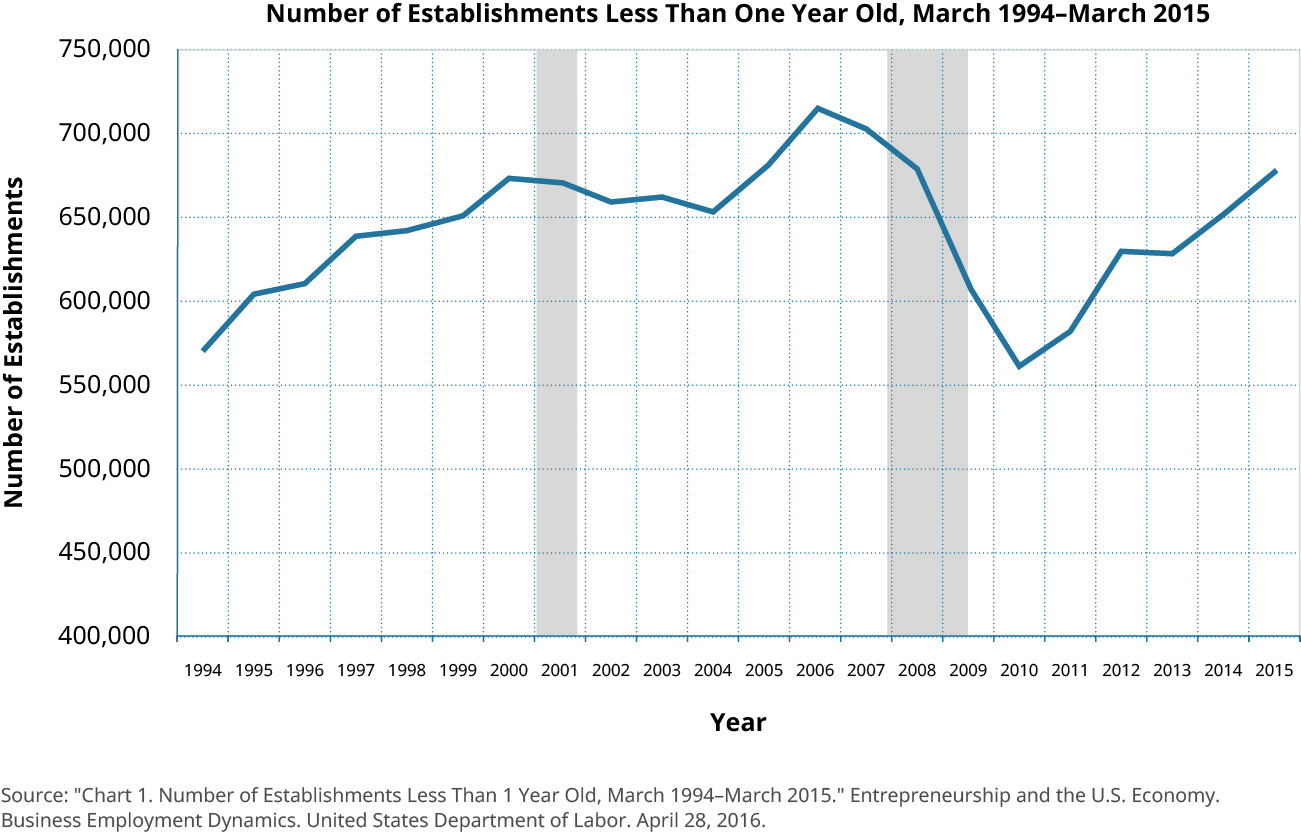
Entrepreneurs operate in an unbelievably competitive landscape. Although competition helps create better products and services, it also places many stresses on a business owner who must compete with new, more flexible businesses that may have lower prices and better products. As shown in , the number of new establishments that are less than one year old has increased over the past two decades from 1994 to 2015. There was a dip during the 2009 recession, but the trend continued after 2011, and the number of businesses increased again. This means more competition for businesses that are already established.
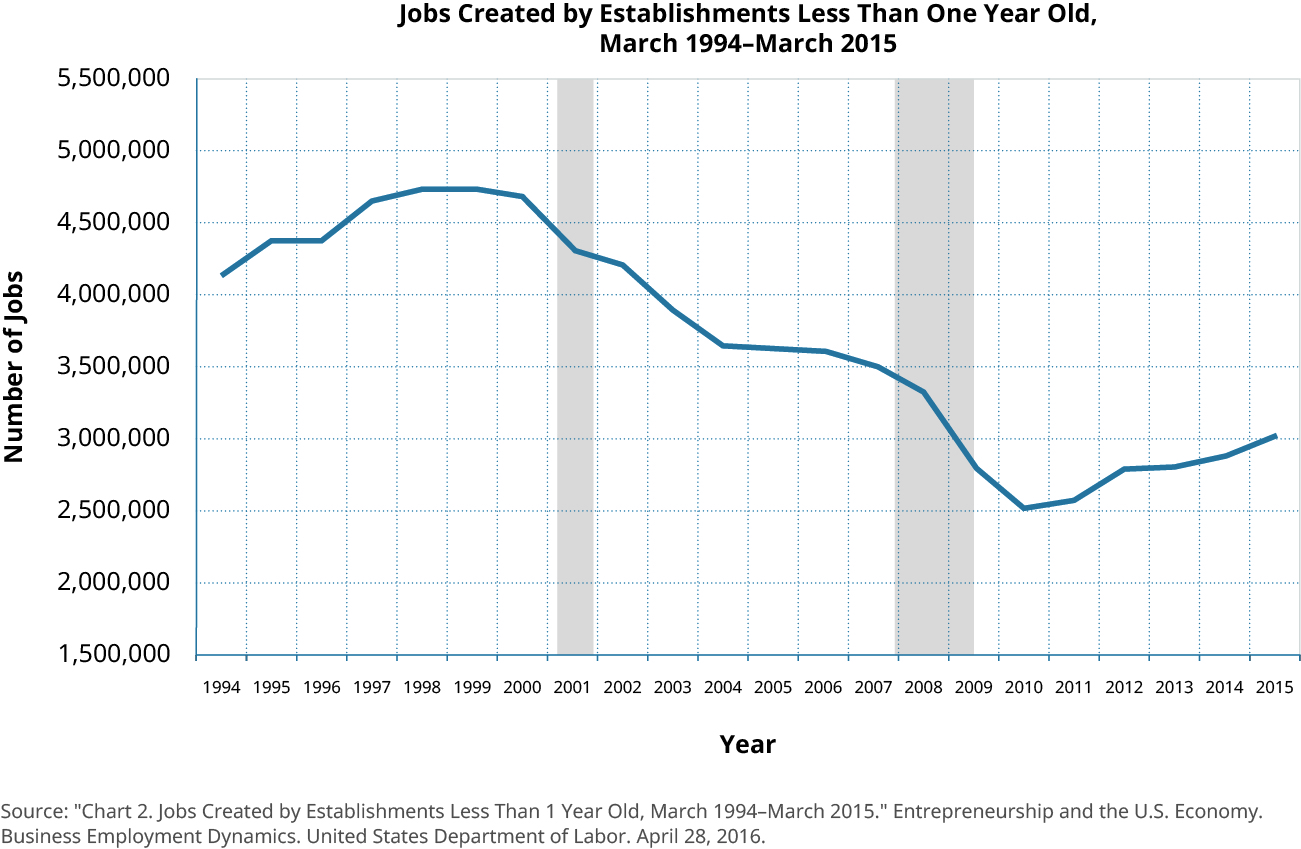
The number of jobs created by these young establishments has also decreased in this period, which affirms the likelihood that entrepreneurs are wearing many hats in their own businesses. charts this trend.
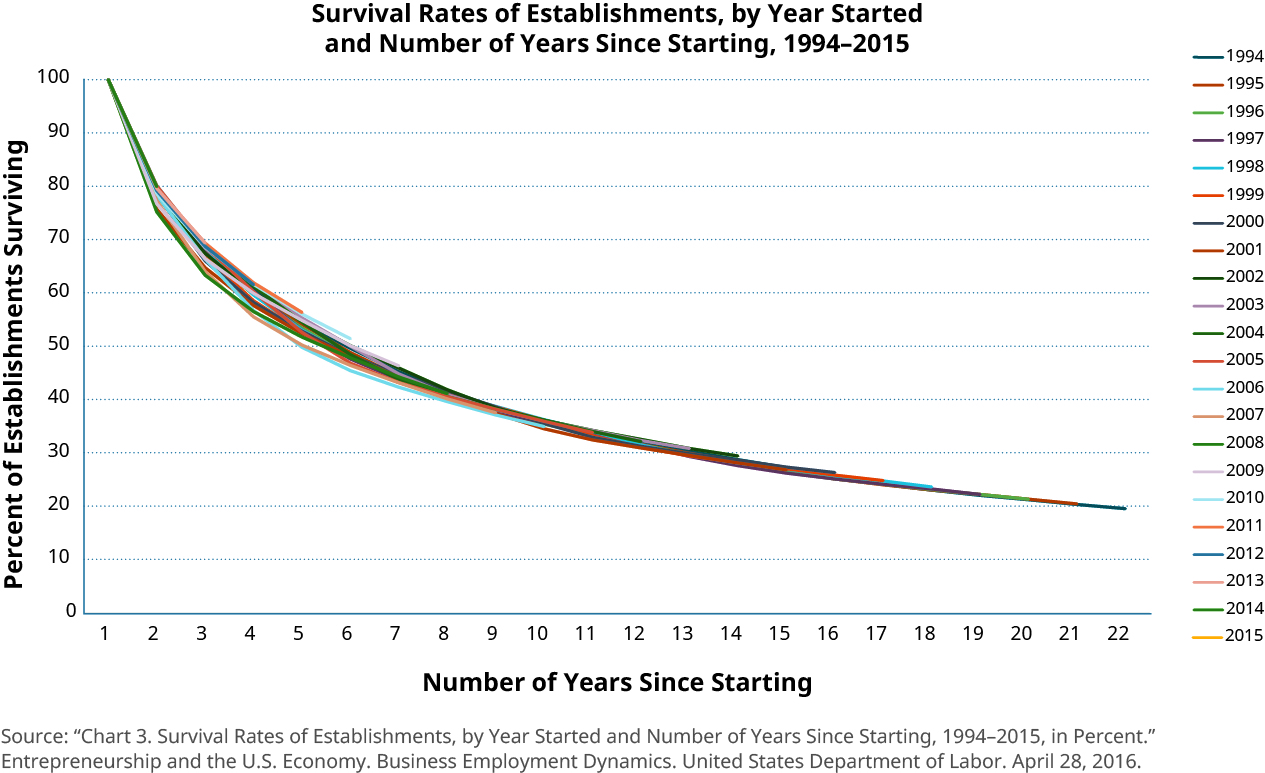
As you’ve learned, only about 20–30 percent of businesses succeed to the five- or ten-year mark. shows that only half of businesses survive to the five-year mark, and only 20 percent are sustained for two decades. Their failures may be due to a number of factors such as cash flow problems, lack of passion, lack of support, lack of innovation, difficulty adapting to new technologies or customer demand, and environmental factors that can influence a business as well, such as the economy, trends, regulations, or sociocultural changes. Therefore, it’s important for entrepreneurs to research their internal as well as their external environments before launching. The chapters on Identifying Entrepreneurial Opportunity and Entrepreneurial Marketing and Sales take a look at such research, as it pertains to both the entrepreneur and the marketing environment respectively.
Challenges of Business Ownership for Women
Challenges for business owners can be many. Female entrepreneurs, however, can face additional hardships. These can range from not being able to secure financing for their businesses, having a hard time breaking into an industry, and dealing with fears of starting and growing a business, and not being taken seriously.
Current research shows that the importance of female entrepreneurship is key to economic success. Women own 40 percent of the country’s businesses,4 generating over $1.4 trillion in sales.5 Women entrepreneurs are closing the gender gap, as their ventures have grown substantially in the past few years. In the past two years, women entrepreneurship rates have gone up by 10 percent each year, compared to men’s 5 percent growth. This surge has been spurred by increased available resources, including mentorship, funding, and programs to help women succeed.6 Nonetheless, there are still great challenges to overcome, as women move into the next generation of business ownership. Some of the main challenges are:
- Difficulty gaining entry in certain industries. Women have made great strides in business, but they still face many obstacles, especially in certain industries. Women tend to be underrepresented in specific areas, notably in the tech industry, where they run only 9 percent of businesses.7 Women tend to be underpaid in tech positions, they experience sexism, and they are often passed over for promotions, especially if they have families with young children. So, if there are no female role models, it is difficult for women to follow an entrepreneurial path that is already full of obstacles. Although young girls and women desire to study and expand their careers, historically, they have not been presented with the opportunities and encouragement to do so, especially in STEM. By the time they get into college, the number of women in these careers—which can be rich in entrepreneurial opportunities—is very small. However, more efforts are being made today to support young girls interested in scientific, technological, and mathematical careers.
- Lower sales and fewer employees. Women overall tend to struggle more to keep their businesses afloat, as they have fewer employees,8 less revenue, and less profit than male-owned businesses. Only 2 percent of female-owned businesses make over $1 million in sales. Male-owned businesses, on the other hand, are 3.5 times more likely to hit that revenue target.9 Some of the reasons why women experience this is because women may enter entrepreneurship part time, often striving to sustain a decent family work balance, which is difficult when children, especially young children, are part of the equation. This set-up usually includes one employee, who is the entrepreneur herself, and she may have attained her goals without wanting to make millions. Time, flexibility, and work-life balance can be reasons women become entrepreneurs, and they are happy with their goals of making some money while taking care of their family and household. Lack of experience in business or managing a family business, and lack of access to capital are also reasons for the lower metrics.10
- Less access to capital. Regardless of their success and prowess, women still have a harder time securing funding for their businesses. A recent Kauffman Foundation survey determined that more than 72 percent of women don’t have the access to capital they need.11 Nirupama Mallavarupu, founder of MobileArq says, “As a woman entrepreneur with a focus on helping non-profits and schools, it has been difficult to get investors. We have turned this around by pursuing customer acquisition organically and relying on direct revenues instead of investment growth.”12 Women usually don’t ask for funding, or if they do but are turned down, they turn to funding from family and friends. They are more likely to finance their ventures this way than men.13
- Not taken seriously. Sometimes it’s not that women don’t have the opportunities, money, or mentorships to start a business: Sometimes, women are just not taken seriously. Research by Freshbooks Accounting and Software firm and Research Now asked 2,700 entrepreneurs about gender discrimination and the wage gap that exist today. Thirty percent of women pointed out that they are not taken seriously as business owners, as they must work harder than their male counterparts and have to charge less to get a client.14 Emily Harsh, owner of Heart Move Collective, comments in her blog, “Because I am in the fitness industry and female, I am often not taken seriously as a professional. I think the number one most important thing you can do as a woman fighting to pave your own path is to continually stay authentic.”15
- Resources. Fortunately, there are many resources that women can take advantage of. Organizations such as the Women’s Business Center of the Small Business Administration, the National Association for Women Owners, the Female Entrepreneur Association, Ladies Who Launch, Minority Business Development Agency, the National Association of Professional Women, and the Women’s Business Enterprise National Council strive to help women succeed in all industries by providing loans and programs that prepare them for a competitive landscape. Mentoring by other women has also proven to be effective in women’s success in entrepreneurship.16 Having peers that can help and strong mentors can make a difference in the outcome of a business.
Other helpful tips to counteract the challenges facing women entrepreneurs include being assertive, being authentic, networking, and developing a thick skin for rejections and other challenges. Facebook COO Sheryl Sandberg, in her book Lean In, states that “being confident and believing in your own self-worth is necessary to achieving your potential” and she encourages women entrepreneurs to ask themselves: “What would you do if you weren't afraid?”17
Women bring great qualities to entrepreneurship such as strong leadership, as well as management, time, multitasking, and listening skills. Women also have a collaborative approach to relationships that works well in many industries.18
Challenges of Business Ownership for Minorities
Entrepreneurs from minority groups encounter additional challenges. Minority groups are a strong force in the economy of the country, yet they still experience additional challenges that sometimes prevent them from succeeding in their businesses. These can range from having lower capital access19 due to little credit history, small or nonexistent business networks, and lower business knowledge.20 According to the Census Bureau, minorities own about 29 percent of US businesses.21
Hispanic people22 comprise 17 percent of the population and own approximately four million (13%) companies in the US with $661 billion in revenue. From 2007 to 2015, business revenue grew 88 percent for Hispanic people, which means that they have more power to employ more people to provide goods and services to a wider audience, and to purchase from other vendors. Given its growth and current size, this group is vital to the health of the economy.23 Unfortunately, research shows that if measured by financial outcomes, Hispanic people still struggle to succeed in business ventures due to a lack of funding, less managerial/business education, and lack of mentorship.24 A higher rate of foreign-born entrepreneurs can experience these challenges due to the lack of networks and financial history in the country.25
Black people make up 14 percent of the total US population, and their businesses represent about 7 percent of total businesses. Although they are opening businesses faster than their White counterparts, their businesses, as well as Hispanic businesses, tend to have higher failure rates than White- and Asian-owned businesses.26 Similar to Hispanic people, Black people tend to lack funding, managerial/business education, and mentorship.
Asian Americans make up 5 percent of the population and own just over 4 percent of the businesses in the country. Although they are considered minorities, Asian Americans tend to be better educated and have more access to capital than Hispanic Americans and African Americans.27
Organizations such as the Hispanic, Black, and Asian American Chambers, the Minority Business and Development Agency (MBDA), and the Small Business Administration (SBA) have developed programs to help minority entrepreneurs succeed in various ways. These organizations hold workshops once or twice a month to provide helpful information and business plan templates so owners work through their preparation to launch a venture. Chambers are also helpful in matching companies with banks for loans based on their needs and industries. The 8a certification is also facilitated by the Chambers and the MBDA, and provides disadvantaged businesses with an assistance program.
Disadvantaged businesses are those that are small, owned by someone economically disadvantaged (a person who has less than $250,000 in personal net worth, which includes assets such as cash, home, car, and real estate minus liabilities such as mortgages, credit card debt, and car and bank loans), with an owner demonstrating that the business can be successful. This program helps minority business owners access finances, mentors, counselors, and management assistance, among other resources.28 In addition to this support, some organizations, such as the SBA, provide certifications on various business topics on marketing, finance, accounting, management, and production that usually take the form of short classes for business owners to acquire business acumen. These programs help entrepreneurs gain needed knowledge, grow professionally, and connect with people as they go through their entrepreneurial journeys.
Summary
Entrepreneurs operate in an extremely competitive landscape. This space has positives and negatives, including being autonomous, being able to expand one’s own ideas, and schedule flexibility. Serving people and employees well can be very satisfying as can the financial success of a strong profit. On the negative side, resolving constantly arising challenges, wearing many hats, dealing with challenges and issues, and having adequate time and cash flow can make entrepreneurship difficult. Women and minority entrepreneurs face additional challenges that can make the experience of being an entrepreneur much more difficult. These include lack of funding opportunities, lack of business education, not being taken seriously, lack of mentorship, and lack of resources. However, there are several organizations that provide the guidance and connections targeted to these groups.
Review Questions
What are some of the realities of business ownership?
How can entrepreneurs deal with these negative realities?
What percentage of businesses last five years or more?
What percentage of US businesses are minority owned?
Discussion Questions
Discuss how minorities and women can use resources and strategies to deal with their additional challenges as entrepreneurs.
Pick three cons of business ownership and strategize how to turn them into pros.
Now choose three of the pros of business ownership and consider whether any of them could be cons in certain situations.
Case Questions
Your best friend is a kindergarten teacher who has decided to open a new learning center where toddlers and young children can play in an interactive environment to enhance their motor skills, cognitive development, and leadership skills. She is very excited about her new entrepreneurial experience, but has no idea about the challenges she may face as a young Hispanic woman in her 30s. She knows you have taken an entrepreneurship class before, so she asks for your help in figuring out where to find business resources and recommendations to overcome the challenges she may face. You are happy to help and you answer the following questions:
What kind of overall advice would you give her? What groups and resources do you think she can tap into? What are some of the challenges she may face as a minority? How can she overcome them?
Suggested Resources
Asian American Chamber of Commerce: http://www.asian-americanchamber.org/
Black Chamber of Commerce: https://www.nationalbcc.org/
Hispanic Chamber of Commerce: https://ushcc.com/
Ladies Who Launch: https://www.ladieswholaunch.org/
Minority Business Development Agency: https://www.mbda.gov/
National Association of Professional Women: http://womenforhire.com/company/national-association-of-professional-women-napw/
National Association for Women Owners: https://www.nawbo.org/
Small Business Agency: https://www.sba.gov/
The Female Entrepreneur Association: https://femaleentrepreneurassociation.com/
Women’s Business Center at SBA: https://www.sba.gov/tools/local-assistance/wbc
Women’s Business Enterprise National Council: https://www.wbenc.org/
Footnotes
- Bureau of Labor Statistics. “Entrepreneurship and the US Economy.” United States Department of Labor. April 28, 2016. https://www.bls.gov/bdm/entrepreneurship/entrepreneurship.htm ↩
- Bureau of Labor Statistics. “Entrepreneurship and the US Economy.” United States Department of Labor. April 28, 2016. https://www.bls.gov/bdm/entrepreneurship/entrepreneurship.htm ↩
- Bureau of Labor Statistics. “Entrepreneurship and the US Economy.” United States Department of Labor. April 28, 2016. https://www.bls.gov/bdm/entrepreneurship/entrepreneurship.htm ↩
- Bernard Meyer. “Business Woman Challenges, Examples and Opportunities in 2107 and Beyond.” InvoiceBerry. June 19, 2017. https://blog.invoiceberry.com/2017/06/business-woman-challenges-examples-opportunities/ ↩
- National Association of Women Business Owners (NAWBO). “Women Business Owner Statistics.” NAWBO. 2017. https://www.nawbo.org/resources/women-business-owner-statistics ↩
- Elaine Pofeldt. “Why Women Entrepreneurs Will Be the Economic Force to Reckon with in 2017.” CNBC. February 28, 2017. https://www.cnbc.com/2017/02/28/why-women-entrepreneurs-will-be-economic-force-to-reckon-with-in-2017.html ↩
- Sahil Raina. “Research: The Gender Gap in Startup Success Disappears When Women Fund Women.” Harvard Business Review. July 19, 2016. https://hbr.org/2016/07/research-the-gender-gap-in-startup-success-disappears-when-women-fund-women ↩
- Michael J. McManus. “Women’s Business Ownership: Data from the 2012 Survey of Business Owners.” US Small Business Administration Office of Advocacy. May 31, 2017. https://www.sba.gov/sites/default/files/advocacy/Womens-Business-Ownership-in-the-US.pdf ↩
- Eilene Zimmerman. “Only 2% of Women-Owned Businesses Break the $1 Million Mark—Here’s How to Be One of Them.” Forbes. April 1, 2015. https://www.forbes.com/sites/eilenezimmerman/2015/04/01/only-2-of-women-owned-businesses-break-the-1-million-mark-heres-how-to-be-one-of-them/#2a53233727a6 ↩
- Robert W. Fairlie and Alicia M. Robb. “Gender Differences in Business Performance: Evidence from the Characteristics of Business Owners Survey.” SpringerLink. May 5, 2009. https://link.springer.com/article/10.1007/s11187-009-9207-5 ↩
- Elaine Pofeldt. “Why Women Entrepreneurs Will Be the Economic Force to Reckon with in 2017.” CNBC. February 28, 2017. https://www.cnbc.com/2017/02/28/why-women-entrepreneurs-will-be-economic-force-to-reckon-with-in-2017.html ↩
- Bernard Meyer. “Business Woman Challenges, Examples and Opportunities in 2107 and Beyond.” InvoiceBerry. June 19, 2017. https://blog.invoiceberry.com/2017/06/business-woman-challenges-examples-opportunities/ ↩
- Elaine Pofeldt. “Why Women Entrepreneurs Will Be the Economic Force to Reckon with in 2017.” CNBC. February 28, 2017. https://www.cnbc.com/2017/02/28/why-women-entrepreneurs-will-be-economic-force-to-reckon-with-in-2017.html ↩
- “New Research from FreshBooks Discovers a 28% Wage Gap among Self-Employed Men and Women.” FreshBooks. n.d. https://www.freshbooks.com/press/data-research/women-in-the-workforce-2018?ref=10400&utm_source=sas&utm_medium=affiliate&utm_campaign=314743&sscid=31k3_f8pv3 ↩
- Bernard Meyer. “Business Woman Challenges, Examples and Opportunities in 2107 and Beyond.” InvoiceBerry. June 19, 2017. https://blog.invoiceberry.com/2017/06/business-woman-challenges-examples-opportunities/ ↩
- Robin L. Laukhuf and Timothy A. Malone. “Women Entrepreneurs Need Mentors.” International Journal of Evidence Based Coaching and Mentoring 13(1): 70–86. 2015. http://ijebcm.brookes.ac.uk/documents/vol13issue1-paper-05.pdf ↩
- Sheryl Sanders. Lean In: Women, Work, and the Will to Lead. (New York: Knopf. March 12, 2013). ↩
- S. Mohan Kumara, H.S. Chandrika Mohana, Vijaya C., and Lokeshwari N. International Journal of Current Engineering and Technology (Special Issue 1): 100–104. 2013. http://inpressco.com/wp-content/uploads/2013/09/Paper20100-104.pdf ↩
- Minority Business Development Agency. “Access to Capital Is Still a Challenge for Minority Business Entrepreneurs.” US Department of Commerce: Minority Business Entrepreneur. March/April 2010. https://www.mbda.gov/news/blog/2010/07/access-capital-still-challenge-minority-business-enterprises ↩
- David Kiger. “Minority Entrepreneurs Face Challenges in Business Development.” Business 2 Community. April 2, 2016. https://www.business2community.com/small-business/minority-entrepreneurs-face-challenges-business-development-01497508 ↩
- Aleks Merkovich. “30 Insightful Small Business Statistics.” FitSmallBusiness. March 18, 2019. https://fitsmallbusiness.com/small-business-statistics/ ↩
- “Of Hispanic or Latino Origin” as used in the 2010 Census refers to a person of Cuban, Mexican, Puerto Rican, South or Central American, or other Spanish culture or origin regardless of race. https://www.census.gov/prod/cen2010/briefs/c2010br-02.pdf ↩
- Geoscape. “Hispanic Businesses and Entrepreneurs Drive Growth in the New Economy: Third Annual Report.” Geoscape. 2015. https://ushcc.com/wp-content/uploads/2015/11/HispanicBusinessReport2015_Final_Sept19.pdf ↩
- Denisse Olivas. Entrepreneurship Success: A Hispanic Point of View. Center for Hispanic Entrepreneurship. University of Texas at El Paso. Proceedings from the International Conference of Facets Doing Business in Emerging Markets. July 2016. https://www.utep.edu/business/_Files/docs/cfhe/newentrepreneurship-success-presentation-cfhe.pdf ↩
- Geoscape. “Hispanic Businesses and Entrepreneurs Drive Growth in the New Economy: Third Annual Report.” Geoscape. 2015. https://ushcc.com/wp-content/uploads/2015/11/HispanicBusinessReport2015_Final_Sept19.pdf ↩
- “Race.” Kaufmann Foundation. n.d. https://www.kauffman.org/microsites/state-of-the-field/topics/background-of-entrepreneurs/demographics/race ↩
- “Race.” Kaufmann Foundation. n.d. https://www.kauffman.org/microsites/state-of-the-field/topics/background-of-entrepreneurs/demographics/race ↩
- Minority Business Development Agency. “What Is the 8(a) Business Development Program.” US Department of Commerce. n.d. https://www.mbda.gov/news/blog/2012/03/what-8a-business-development-program ↩